COLLECTIVE MADNESS


“Soft despotism is a term coined by Alexis de Tocqueville describing the state into which a country overrun by "a network of small complicated rules" might degrade. Soft despotism is different from despotism (also called 'hard despotism') in the sense that it is not obvious to the people."

Wednesday, March 16, 2016

Political Corruption, Your Name is Clinton: A catastrophe for working families, African-Americans, and latinos.

The Clintons' $93 Million Romance With Wall Street


For 24 years Bill and Hillary Clinton have courted Wall Street money with notable success. During that time the New York banks contributed:
  • $11.17 million to Bill Clinton's presidential campaign in 1992.
  • $28.37 million for his re-election in 1996.
  • $2.13 million to Hillary Clinton's senatorial campaign in 2002.
  • $6.02 million for her re-election in 2006.
  • $14.61 million to Hillary Clinton's presidential campaign in 2008.
  • $21.42 million to her 2016 campaign. 
The total here is $83.72 million for the six campaigns,i ii disbursed from 11 banks: Goldman Sachs, Citigroup, UBS, Bank of America/Merrill Lynch, Wells Fargo, Barclay's, JP Morgan Chase, CIBC, Credit Suisse, Deutsche Bank, and Morgan Stanley.iii iv
Then there were the speeches. Sixteen days after leaving the White House in 2001, Mr. Clinton delivered a speech to Morgan Stanley, for which he was paid $125,000. That was the first of many speeches to the New York banks. Over the next 14 years, Mr. Clinton's Wall Street speaking engagements earned him a total of $5,910,000:v
  • $1,550,000 from Goldman Sachs.
  • $1,690,000 from UBS. 
  • $1,075,000 from Bank of America/Merrill Lynch.
  • $770,000 from Deutsche Bank.
  • $700,000 from Citigroup
After she resigned as Secretary of State in 2012, Hillary Clinton took to the lecture circuit as well. Some of her income has come to light during the current presidential campaign, like the $675,000 she was paid for three speeches to Goldman Sachs. That disclosure, however, belittles her financial achievement and the scope of her audiences. She also addressed the Bank of America/Merrill Lynch, Morgan Stanley, Deutsche Bank, UBS, Ameriprise, Apollo Management Holdings, CIBC, Fidelity Investments, and Golden Tree Asset Management, earning another $2,265,000.vi

No other political couple in modern history has enjoyed so much money flowing to them from Wall Street for such a long time—$92.57 million over a quarter century.

During a CNN forum on February 3, Anderson Cooper wondered if Goldman Sachs' $675,000 might impact her prospective presidential decisions. Defending her integrity with undisguised indignation, she described her independence from the banks:
Anybody who knows me, who thinks that they can influence me, name anything they've influenced me on. Just name one thing. I'm out here every day saying I'm going to shut them down, I'm going after them. I'm going to jail them if they should be jailed. I'm going to break them up.vii
Her campaign website confirms her fierce determination to oversee the banks and hold them strictly to account. “Wall Street must work for Main Street,” the website claims, outlining her program for “Wall Street Reform":
  • Veto Republican efforts to repeal or weaken Dodd-Frank
  • Tackle dangerous risks in the big banks and elsewhere in the financial system.
  • Hold both individuals and corporations accountable when they break the law.viii
$675,000 might be insufficient to elicit Ms. Clinton's sympathetic ear, but a quarter century of accepting tens of millions of dollars is not so easily dismissed. It might have some impact on the Clintons’ sense of gratitude and certainly on their social, cultural and political environments. 

Over that period of time, while one or the other held public office almost continuously, the couple accumulated a net worth of $125 million.ix x Measured by family wealth, this inserted the couple into the top 1% of American families by a factor of 16 ($7.88 million is the threshold). 

In New York, their home upon leaving the White House, the Clintons moved easily among other multimillionaires, the celebrated, wealthy, and accomplished people of the city, such as Lloyd Blankfein, Robert Rubin and Henry Paulson, CEOs of the benefactor Wall Street banks. The couple could scarcely avoid adopting the mindset and political perspectives of the people who now constituted their peer group.

Breaking up banks, jailing the lawless executives, forcing Wall Street to work for Main Street: Hillary Clinton's stern proclamations of impartial law enforcement and strict regulation are difficult to take seriously.
Wall Street doesn't. One bank executive assured his clients, “We continue to believe Clinton would be one of the better candidates for financial firms.” He was quoted in a CNN Money article, “Wall Street Isn't Worried about Hillary Clinton's Plan,” which stated, 
Hillary Clinton unveiled her big plan to curb the worst of Wall Street's excesses. The reaction from the banking community was a shrug.xi

There is good reason for the banks’ sanguine view. 

Over the 24 years of the romance, the Clintons first reoriented their political party, gave it a new name, the New Democratic Party, and put it at Wall Street's service. Then they engineered financial opportunities for the New York banks of immense value, running into the hundreds of billions. And through the years as president, senator and secretary of state, the Clintons supported Wall Street’s interests at every necessary turn. 

In the early 1990s, chairing the Democratic Leadership Council, Bill Clinton ushered in the centrist, triangulating New Democratic Party, explicitly to be more business-friendly and to attract the financial support of corporate America. Wall Street supported his 1992 campaign handsomely, and Bill Clinton became the first president under the new banner, with Hillary Clinton at his side.

When he appointed Robert Rubin of Goldman Sachs as Secretary of the Treasury Department, Clinton established a precedent. For the next 24 years, every administration would find Wall Street executives to serve in the position. 

But the working families of America and the African-American and Hispanic communities—the party's historic constituencies—were betrayed and abandoned, deprived of effective representation in Washington. The Clintons' political campaigns over the next decades became monumental hypocrisies, Bill donning sunglasses to play his saxophone for Arsenio Hall, Hillary visiting black churches to hug the parishioners. They speak warmly to the traditional constituencies with carefully scripted political rhetoric, currying their favor, depending on them for electoral victory, but effectively obscuring the truth of their betrayal.

The traditional constituencies were not only betrayed, but targeted. On taking office Mr. Clinton announced, “The era of big government is over.” On that cue he co-opted two issues long used by Republicans to mask their party's racism: “welfare” and “crime.” To address the issues, two laws were passed in Clinton’s first term that savaged the betrayed constituencies. 

The first was the Personal Responsibility and Work Opportunity Reconciliation Act, which fulfilled Clinton's promise to “end welfare as we know it.” Since the end of the Clinton administration, poverty in the U.S. has nearly doubled: “...the number of Americans living in high-poverty areas rose to 13.8 million in 2013 from 7.2 million in 2000, with African Americans and Latinos driving most of the gains.”xii
To show how tough on crime he could be, Clinton next guided The Violent Crime Control and Law Enforcement Act of 1994 through Congress. A flurry of prison construction quickly followed, an industry of private for-profit prisons took hold and flourished, and a skyrocketing population mostly of young black males soon filled them, most frequently charged with drug offenses, non-violent and victim-free.

Sixteen years later the effects of the law were described in a searing book: The New Jim Crow: Mass Incarceration in the Age of Colorblindness.
The author of the book is a distinguished legal scholar and human rights activist, Michelle Alexander.

Ms. Alexander well understands how the Clintons and their creation, the New Democratic Party, left working families and communities of color without a political voice. And no one addresses the tragedy more forcefully. Her latest work is an article, “Black Lives Shattered,” in the February 29, 2016 issue of The Nation. She details how the two Clinton laws have devastated African-American families and sent millions—particularly those young black males—to prison. In the article’s caption, she asks, The Clinton's legacy has been the impoverishment of black America—so why are we still voting for them?

The online version of her article carries a different title, Why Hillary Clinton Doesn't Deserve the Black Vote . Her compelling case is abbreviated in the subtitle:
From the crime bill to welfare reform, policies Bill Clinton enacted—and Hillary Clinton supported—decimated black America.

Hillary Clinton now apologizes for the laws, suggesting they are no longer quite so appropriate. But she has not, cannot and will not mention two other laws passed at the bidding of President Clinton's Treasury Secretary, Robert Rubin. These laws enriched the Wall Street banks by hundreds of billions of dollars, but they too devastated working families, African Americans and Latinos.

The first was the Financial Services Modernization Act of 1999, repealing the Glass-Steagall legislation of 1933. Now it was legal once more for financial institutions to mix commercial and investment banking. Goldman Sachs et al. could now use depositor’s funds, insured by the Federal Deposit Insurance Corporation, to buy up “subprime” mortgages, the high-interest debt obligations of typically low-income, black and Latino families.

The next law was the Commodity Futures Modernization Act. Now Goldman Sachs et al. could transform packages of those subprime mortgages into complicated derivatives called mortgage-backed-obligations, have them fraudulently rated as AAA investments, and sell them around the world, without limit, restriction or regulation, at immense profit.

For eight years the bubble inflated, and then it collapsed in the last year of George Bush's administration. Real estate values plummeted. The stock market was hammered. So was the U.S. economy. And so tragically were many low-income, African American and Latino families. $13 trillion in household wealth vaporized. Nine million workers lost their jobs. Five million families were evicted from their homes.xiii
This is what the Clinton administration, and the New Democratic Party, had wrought. The banks were caught with hundreds of billions in mortgage-backed derivatives still in the pipeline, the market values dropping like stones. Wall Street's prospective losses were horrific; bankruptcies loomed. But George Bush's Treasury Secretary was the obligatory Wall Streeter: Hank Paulson, recently CEO of Goldman Sachs. In a heartbeat, Paulson rammed through Congress the Emergency Economic Stabilization Act of 2008. It was known as the Troubled Asset Relief Program, and it handed Paulson $700 billion of taxpayers' money to buy the near-worthless securities from the banks.
Hillary Clinton, now the U.S. senator from New York, voted for the bill, telling a New York radio station the next day, “I think the banks of New York...are probably the biggest winners in this.”xiv

Paulson started buying, typically paying the banks half again the market value of the “troubled assets.”xv But a presidential campaign was underway, and soon he would have to stop.

Barack Obama, overcoming Hillary Clinton in the primaries, was elected as the second president from the New Democratic Party. Obama's campaign contributions from Wall Street:
  • Goldman Sachs: $1,034,615
  • JP Morgan Chase: $847,855
  • Citigroup: $755,057
  • Morgan Stanley: $528,182
The total is $3.7 million.xvi (Hillary Clinton’s campaign, apparently thought more likely to succeed, was supported with $14.6 million from the banks.xvii)

President Obama's choice of Wall Street bankers to head his Treasury Department was Timothy Geithner, lately the president of the Federal Reserve Bank of New York. Geithner wasted no time in resuming the troubled asset purchases, and his execution of the program was no less profitable for the banks than Paulson’s.xviii

Wall Street's grip on the New Democratic Party, however, and its influence in the Obama administration, appeared in the Department of Justice as well. Eric Holder joined the administration from the law firm of Covington Burling, which represents in Washington most of the Wall Street banks. Charged with prosecuting their criminal behavior, Holder found the banks “too big to fail.” Instead of criminal indictments and lawsuits, Holder negotiated with each of the banks a financial penalty to be paid from corporate funds. No corporate executives were jailed, no personal fines levied, no records of criminal conduct filed, no salaries reduced, no bonuses denied. 

Today the Wall Street banks are larger and more powerful than ever, and Holder has returned to Covington Burling. President Obama—of the New Democratic Party—has provided no similar relief to the working families and communities of color. Their struggles continue, the crime and welfare laws have not been repealed, and the title of a recent study tells the tragic truth: "During Obama's Presidency, Wealth Inequality has Increased and Poverty Levels are Higher."xix
Because of the Clintons' romance with Wall Street and their corrupt New Democratic Party, the New York bankers and the Clintons are richer today. Others—betrayed, abandoned, savaged—are not.

i“Two Clintons. 41 years. $3 Billion,” Washington Post, November 19, 2015
ii“Occupy Hillary Clinton's Wall Street Speeches,” Huffpost Politics, February 28, 2016
iii“Hillary Clinton. Top 20 Contributors, 1999-2002,” http://www.opensecrets.org/politicians/contrib.php/type==C&cid.
iv“Hillary Clinton, Jeb Bush Still Favorites of Wall Street Banks,” Huffpost Politics, October 22, 2015
v“$153 Million in Bill and Hillary Speaking Fees, Documented,” Robert Yoon, CNN, Updated February 6, 2016.
vi“Hillary Clinton Made More in 12 Speeches to Big Banks That Most of Us Earn in a Lifetime,” https://theintercept.com/2016/01/08/hillary-clinton-earned-more-from-12-speeches-to-big-banks-than-most-americans-earn-in-their-lifetime/
vii“Clinton Defends Wall Street Speeches at CNN Town Hall,”  Time, February 4, 2016
viiiFrom Hillary Clinton's campaign website, under “Wall Street Reform,” http://hillaryclinton.com/issues/wall-street
ix“Hillary Clinton net worth: $45 Million,” http://www.celebritynetworth.com/
x“Bill Clinton net worth: $80 Million,” http://www.celebritynetworth.com/
xi“Wall Street Isn't Worried about Hillary Clinton's Plan,”  CNN Money, October 8, 2015.
xii“Poverty Has Nearly Doubled Since 2000 in America,”  International Business Times, August 9, 2015
xiii“Wall Street Reform: Wall Street must work for Main Street,” http://hillaryclinton.com/issues/wall-street
xiv“Hillary Clinton's Tough Talk on Wall Street,” http://www.thedailybeast.com/articles/2015/11/13/hillary-clinton..
xv“Troubled Asset Relief Program,” Wikipedia
xvi“Barack Obama. Top Contributors, 2008 Cycle,” http;//www.opensecrets.org/pres08/contrib.php/cid=...
xviiWashington Post, “Two Clintons. 41 Years. $3 Billion”
xviiiSee Bailout: An Inside Account of How Washington Abandoned Main Street While Rescuing Wall Street, by Neil Barofsky, passim.
Richard Behan lives in Corvallis, Oregon. He can be reached at rwbehan(at)comcast.net. 

Tuesday, March 15, 2016

Can one imagine how the media would pile on Trump if working-class white males in Trump T-shirts invaded a Hillary Clinton rally and shut it down?

REPUBLICAN WIMPS ABSOLVE THE RIOTERS

Pat Buchanan decries Cruz-Rubio-Kasich 'equivocating' over anti-Trump disrupters


Friday evening’s Donald Trump rally in Chicago was broken up by a foul-mouthed mob that infiltrated the hall and forced the cancellation of the event to prevent violence and bloodshed.

Brownshirt tactics worked. The mob, triumphant, rejoiced. 
And the reaction of Marco Rubio, Ted Cruz and John Kasich?
All three Republican rivals blamed – Donald Trump.

With his “dangerous style of leadership,” Trump stokes this anger, mewed Rubio, “This is what happens when a leading presidential candidate goes around feeding into a narrative of bitterness and anger and frustration.”

Rubio implies that if Trump doesn’t tone down his remarks to pacify the rabble, he will be responsible for the violence visited upon him. 

Kasich echoed Rubio: “Donald Trump has created a toxic environment (that) has allowed his supporters and those who sometimes seek confrontation to come together in violence.”

But were the thousands of Trump supporters who came out to cheer him that night really looking for a fight? Or were they exercising their right of peaceful assembly?

Cruz charged Trump with “creating an environment that only encourages this sort of nasty discord,” thus offering absolution to the mob. 

Friday night cried out for moral clarity. What we got from Trump’s rivals was moral mush that called to mind JFK’s favorite quote from Dante: The hottest places in hell are reserved for those who in time of moral crisis maintain their neutrality. 

As news outlets have reported, Friday’s disruption at the University of Illinois-Chicago auditorium was a preplanned assault.

Behind it were the George Soros-funded MoveOn.org, Black Lives Matter, Occupy Wall Street, Hispanics hoisting Mexican flags and cop-haters carrying filthy signs to show their contempt for police.

People for Bernie, a pro-Sanders outfit, tweeted, “[This] wasn’t just luck. It took organizers from dozens of organizations and thousands of people to pull off. Great work.” 

Now, Sanders did not order this assault on the civil rights of Trump supporters. But MoveOn.org has endorsed him, and “Bernie” signs and T-shirts were everywhere among the disrupters. Hence, he has a duty to disavow this conduct and those who engaged in it. 


If Sanders refuses, he condones it, and is morally complicit.

Can one imagine how the media would pile on Trump if working-class white males in Trump T-shirts invaded a Hillary Clinton rally and shut it down?

Can one imagine how the networks and cable TV channels that host town halls with the candidates would react if hell-raisers sneaked into their audiences and shouted obscenities during discussions?

The keening over the First Amendment would not cease for weeks.
Some of us have been here before and know how this ends. 

When the urban riots broke out in the ’60s, Hubert Humphrey declared that, if he lived in a ghetto, “I could lead a pretty good riot myself.” 

At his 1968 convention in Chicago, radicals baited and provoked the cops in the front of the Conrad Hilton, and as this writer watched, their patience exhausted after days of abuse, Chicago’s finest tore into the mob and delivered some street justice.

“Richard Nixon,” wrote Hunter S. Thompson, “is living in the White House today because of what happened that night in Chicago.”

Hunter got that one right.

That fall, Humphrey was daily assailed by the kinds of haters now disrupting Trump rallies. Everywhere he went, they chanted, “Dump the Hump!” At times, Humphrey came close to tears.

That fall, Humphrey realized the monster he helped nurture.

My tormentors, he said, are “not just hecklers, but highly disciplined, well-organized agitators … some of them are anarchists, and some of these groups are destroying the Democratic Party and destroying this country.”

In 1970, when President Nixon sent U.S. troops into Cambodia to clean out Viet Cong sanctuaries, and students rioted, Ronald Reagan called them “cowardly fascists,” and declared, “If there’s going to be a bloodbath, let it begin here.”
Not much Cruz-Rubio-Kasich equivocating there. 

When radicals stomped down Wall Street desecrating Old Glory, construction workers came down from the building sites they were working and whaled on them.


Union president Peter J. Brennan was soon in the Oval Office – and in Nixon’s Cabinet. “Secretary Bunker,” we called him.

Prediction. Given their “victory” in Chicago, MoveOn.org and its allied nasties will try to replicate it, again and again. And as Americans came to despise the ’60s radicals, they will come to despise them.

And, as in the 1960s, the country will take a turn – to the right.

America has changed from the land we grew up in. But she is not yet ready to allow ugly mobs screaming obscenities at Trump and his folks inside and outside that hall in Chicago, or their paragons like socialist Bernie Sanders, to take over the country.

Those raising hell in the street in Chicago and that convention hall are unfit to be citizens of this democratic republic. 

For as Edmund Burke reminded us, “Men of intemperate minds can never be free. Their passions forge their fetters.”

Monday, March 14, 2016

Is this a “Mission Accomplished."

Putin withdrawing Russian forces from Syria: why now and why it matters


Updated by  on March 14, 2016, 5:00 p.m. ET  


On Monday, the same day Syria peace talks resumed in Geneva, Russian President Vladimir Putin made a surprising announcement: He would begin immediately withdrawing the “main" Russian forces from Syria, almost six months after he first intervened in the war.

To state the obvious, we should wait and see the degree to which Putin honors his word. Russia has sent large troop deployments into eastern Ukraine, which it denies, and its Syria intervention has heavily bombed non-ISIS rebels despite claims of targeting only extremists. So cautious skepticism is merited.

Still, there is real reason to suspect that Putin could be sincere — and that his withdrawal could be a positive step toward ending the Syrian conflict that has become the worst war of the 21st century.

To be clear, even if Putin does withdraw, I would still be surprised if Syria reached a peace deal even on paper this year, and I would be downright shocked if Syria's war actually ended before 2020. But if Putin does withdraw from Syria — which he says will begin on Tuesday — the world will be a little bit closer to that goal.

What Putin wanted in Syria and how he got it


Sasha Mordovets/Getty(Sasha Mordovets/Getty Images)
(Sasha Mordovets/Getty)

For all Putin's sweeping language about Syria as akin to the war against the Nazis, his aims always appeared quite narrow:
  1. To prevent Syrian leader Bashar al-Assad from collapsing 
  2. To win Russia some political leverage on peace talks
There is an odd tendency in Washington to treat Russia as a resurgent superpower on a terrifying march toward global domination, but in Moscow, Russian power is understood to be far more limited. It is often aimed at maintaining what little remains of Russia’s global influence, and that appeared to be the case in Syria.

Russia has military bases in only one country outside of the former Soviet Union, and that country is Syria. Military and politically, Syria is its toehold for influence in the Middle East and, to a lesser degree, in the Mediterranean. So when it looked like Syrian leader Bashar al-Assad was going to fall, Moscow was desperate to prop him up.

In that, Putin succeeded. The Russian intervention, along with an even heavier Iranian intervention, helped Assad take back just enough territory to remain viable — though not nearly enough territory that Assad has any hope of actually winning the war outright.

So Russia did help to turn the tide in the war, though it's worth noting that Syria's war has, from the beginning, oscillated between rebel advances and Assad advances. Syria is a stalemate, and one with heavy outside intervention, which means the two sides are constantly escalating against one another.

Russia's intervention looked like something dramatically different, because it's Russia. But other countries — including states like Saudi Arabia and Turkey that back the rebels — have been intervening in Syria for years, pushing the momentum of the war one way or another.

That’s all to say that no one intervention (including America's) was ever enough to fix the core problem with Syria's war: It is a stalemate, which means that fighting will continue for years and to the detriment of everyone, unless there is a negotiated peace deal.

That brings us to Putin’s second objective in Syria: playing just enough of a role in the war to win Russia a seat at the negotiating table and thus ensure Moscow will have a chance to press its interests in any final peace deal.

Just before Russia intervened, there was strong indication that Russia was losing influence in the Syrian government, which was increasingly dominated by Iran's growing presence in Damascus. Indeed, some reports suggest that Assad even invited Russia's intervention to counter Iranian influence. While Russia and Iran are nominally aligned, they are also competitors for regional influence.
But now no one, not in Damascus and not in Geneva, can deny that Russia is a significant player in the Syrian proxy war. It has to be included in peace talks. Russia has its seat at the table, which it can use to guarantee that it retains its military bases in Syria and its high-level contacts in the Syrian military.

Why Russia would withdraw now


 John Cantlie/Getty Images
Posters of Bashar al-Assad burn at a protest in Syria.

The timing speaks to this: Peace talks are just getting started again. And for the first time perhaps ever, Syria peace talks look — well, I wouldn’t call them hopeful or even particularly viable, but at least substantially less doomed.

This is because Syria has been experimenting with a recent ceasefire, and while there have certainly been violations, and the ceasefire is very fragile and could collapse at any moment, it has seen violence drop dramatically. This has saved many lives, allowed humanitarian access to areas otherwise off limits, and made peace negotiations look a little realer.

This is, for Moscow, a good time to step back. Russia has already achieved its immediate aims, so it wins little by fighting more. The status quo is okay for Putin to accept and to use as a basis of negotiations.

But much more important may be Russia’s signal here to Syria.

Russia has shown time and again that it has very limited influence over Bashar al-Assad's regime, which has proven itself to be reckless, often escalating the fighting even at moments when it was strategically unwise. If Moscow wants to freeze the status quo in Syria, it has to convince Assad to finally negotiate in good faith and not break the ceasefire outright.

Putin thus has to do more than just tell Assad to finally try for peace: He has to force him. Russia, by removing some significant chunk of its military force in Syria, makes Assad weaker, and thus makes negotiation more attractive. If you don’t believe Putin would coerce his own ally, consider that Assad was reportedly notified about Putin's decision just today.

Putin's wisest strategy, a few analysts have pointed out to me, would be to remove forces such that Assad feels pressured to negotiate for a peace deal, but to keep just enough of a Russian force in Syria so as to deter anti-Assad forces (Saudi Arabia, the US) from escalating, by implicitly threatening that Russia would just match them by re-intervening. And that indeed appears to be what Putin is doing.
If this analysis is correct, then this suggests that Russia is ready to negotiate in earnest, and also that Moscow believes it is at least possible that Bashar al-Assad is ready to do the same. That doesn't mean that peace is around the corner, that the parties can find mutually agreeable terms, or that either Putin or Assad is about to become our partners in peace. But even a possible willingness to accept a negotiated settlement is a good sign.

The costs of Russia's Syria adventure were exceeding the benefits


Putin
(Sasha Mordovets/Getty Images)

Vladimir Putin appears to be declaring mission accomplished in Syria, and it appears there's something to this: He has achieved his two immediate, if unstated, aims in Syria. But it’s a superficial victory, and underneath it were some real setbacks.

Putin has failed in his two stated goals in Syria: bringing Assad's military victory and leading a global coalition against Syria's extremists.

Such a global coalition, which Putin called for last year in his first United Nations General Assembly speech in a decade, would not just ensure Russia’s interests in Syria but would end Russia's isolation from the West — a problem that is far costlier to Russia, and far more important to Putin, than anything that could happen in Syria.

Assad still can't win in Syria and Russia is still isolated from the West, which never answered his implicit requests for a grand bargain, in which the West accepts his help in Syria and forgives his crimes in Ukraine. His withdrawal from Syria now (again, if it actually happens) is thus a declaration of defeat as much as a declaration of victory.

Syria was also not quite the domestic political victory that Putin may have hoped for. In 2014, he had intervened in Ukraine, which proved so popular with Russians that Putin’s approval ratings skyrocketed — something that wasn't just a feel-good moment for Putin but may have actually helped his regime survive a crippling economic downturn.

But Russian euphoria over Ukraine will inevitably fade, and the Russian economy is still a garbage fire, so if Putin wants to feel secure in his rule he needs to deliver another big political victory. Syria was never it. Public support for the war was initially low, and while it later improved, it was never as popular as Ukraine. Russian state media, often a good bellwether for Kremlin thinking, is portraying the war as a victory — but also as ending:
For all its trouble, Russia has, at best, returned to the status quo of 2014: when its ally Bashar al-Assad was neither winning nor losing the stalemate in Syria; when Russia, its economy sinking and influence declining, was isolated and sanctioned by the West; and when Putin had only one foreign war to worry about fighting. That's the baseline that Russia fought so hard to return to. But it seems to have gotten there.

Why is Trump Hated by the Neocons and Why Americans Love the Donald

The Donald Haters: What is Truly Behind Neocons’ Anti-Trump Hysteria?

Donald Trump’s triumphant march across the United States has prompted growing concerns among neocons and some GOP leaders.

"Some among the GOP elites, who have waited patiently through the Obama era to recapture control of US foreign policy, are now beside themselves with despair over Trump's success," US conservative commentator Patrick J. Buchanan notes.
"Fully 116 members of the GOP's national security community, many of them veterans of Bush administrations, have signed an open letter threatening that, if Trump is nominated, they will all desert, and some will defect — to Hillary Clinton!" he points out in his article for The American Conservative.

Republican Presidential candidate businessman Donald Trump (L) speaks next to Texas Senator Ted Cruz during the Republican Presidential debate sponsored by Fox Business and the Republican National Committee at the North Charleston Coliseum and Performing Arts Center in Charleston, South Carolina on January 14, 2016
© AFP 2016/ TIMOTHY A. CLARY
One of the signers, Robert Kagan — a neoconservative intellectual and vocal proponent of America’s overseas military campaigns — insisted in his op-ed for The Washington Post that "the only choice will be to vote for Hillary Clinton."


"Are they serious?" Buchanan asks.

What makes them so desperately unhappy about the prospect of Donald Trump’s potential victory?

The conservative commentator points out that Trump calls the Iraq War a “historic blunder" and promises to remain neutral while brokering peace between Israel and the Palestinians, as Jimmy Carter did.

And yes, he also says that he would “get along very well" with Russian President Vladimir Putin "as Richard Nixon got along with Leonid Brezhnev and Mao Zedong."

"Trump would launch no new crusades for democracy. He would not oppose Russia bombing ISIS [Daesh]. He would build that wall on the border. He would transfer from US taxpayers to rich allies more of the cost of defending themselves,” Buchanan continues.

Doesn’t it make sense?


However, the US political establishment fears that the presidential candidate will throw a monkey wrench in their global expansionist plans (which have nothing to do with America’s national interests).

"Now we all know that many of those who are hating on Donald Trump are doing so because he is threatening the cozy-crony-politico-predatory-capitalist system that has made so many of them fat and rich. He is intending to break their rice bowls as the Chinese would put it or, in a more American vernacular, the gravy train might be ending," CIA veteran Philip Giraldi wrote in his recent article for The Unz Review.
Trump supporters rally behind their candidate during the South Carolina primary process on Friday, February 19.
© AP Photo/ AP
Trump supporters rally behind their candidate during the South Carolina primary process on Friday, February 19.

On the other hand, Daniel McAdams of the Ron Paul Institute nailed it describingTrump haters as "soft skinned and well-perfumed keyboard warriors who eagerly send America's sons and daughters to be slaughtered in wars that achieve nothing but the ascendance of new 'bad guys' used to justify ever more wars. And all of it pays very nicely for them.”

It is hardly surprising that American oligarchs, including Nebraska’s billionaire Ricketts family and Hedge-fund billionaire Paul Singer, have thrown their weight behind the all-out anti-Trump media campaign.


Now he is “under a ceaseless barrage of attack ads on radio, TV, cable and social media."

The question then arises: can the American political and financial establishment stop Trump?

"Answer: It is possible, and we shall know by midnight, March 15. If Trump loses Florida and Ohio, winner-take-all primaries, he would likely fall short of the 1,237 delegates needed for nomination on the first ballot,” the conservative commentator stresses.

But it is not about Donald Trump, it’s the future of the United States and the world that is at stake.

"Can millionaires and billionaires who back open borders, mass immigration, globalization and the disappearance of nation states into transnational collectives overwhelm with their millions spent in ads the patriotic movements that arose this year to the wonderment of America and the world?" Buchanan asks.

Sunday, March 13, 2016

Today is Already Yesterday

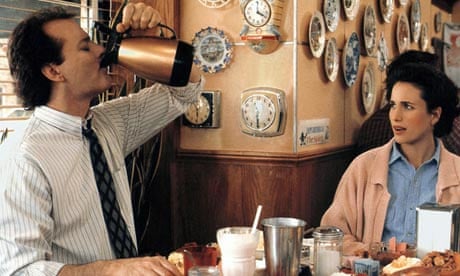
Groundhog Day: the perfect comedy, for ever

1993, GROUNDHOG DAY

I am holding for David O Russell, the Oscar-nominated director of Silver Linings Playbook and The Fighter, who has agreed to talk about one of his all-time favourite films: the comic masterpiece Groundhog Day, released in the US 20 years ago this month. (It reached the UK in May 1993.) But the person on the other end of the line doesn't sound like Russell: it's more of a shrill whine, the vocal equivalent of nails on a blackboard. Then the penny drops.

"Ryan? It's Ned! Ned Ryerson! Bing!" After a prolonged chuckle, Russell drops his impersonation of Groundhog Day's irksome insurance salesman, a minor but intensely memorable character, and explains excitedly that he recently met Andie MacDowell, one of the film's stars. "She came to a screening of Silver Linings Playbook and I was, like: 'Oh my God, you were in one of the greatest motion pictures of all time.' She goes: 'Four Weddings and a Funeral?' I said, 'No, Groundhog Day!' I would give my left arm to have written that fucking script. It's the only movie I think of from that period other than the ones by Quentin [Tarantino]. It makes me mad because I would so like to make a film like that. Oh man, I could go on for ever about that movie …”


Groundhog Day, Andie MacDowell
Andie MacDowell in Groundhog Day. Photograph: Allstar/Cinetext /Allstar Collection/COLUMBIA


We don't have for ever – isn't that one of the lessons of Groundhog Day? – but Russell happily slips in and out of voices and lines from the movie, his recollections punctuated by wistful sighs. This is what tends to happen when fans of Groundhog Day get together. On its release, the picture, directed by Harold Ramis, instantly took its place alongside long-cherished favourites such as It's a Wonderful Life and Some Like It Hot. It was a hit, if not a record-breaking one – Free Willy made more money that year. It wasn't even the biggest comedy of 1993: that honour went to the Robin Williams cross-dressing farce Mrs Doubtfire, which grossed more than three times as much in the US. But if one of the marks of a great film is that we can barely remember a time when it wasn't in our lives, then Groundhog Day passes that test with ease. It seems to have been with us for ever.

So, too, does its title, which has entered our language as shorthand for any period of intolerable monotony comparable to the one experienced by the misanthropic TV weatherman Phil Connors (Bill Murray). Phil is dispatched to the folksy town of Punxsutawney, Pennsylvania, to cover the annual 2 February celebrations, which revolve around a groundhog supposedly foreseeing the exact date of the arrival of spring. "This is one occasion where television really fails to capture the true excitement of a large squirrel predicting the weather," Phil sneers to camera. But when he wakes the following morning, it is 2 February again. And 2 February it will remain indefinitely, rebooted each day at 6am, until Phil can figure out how to arrest the cycle. The secret, it transpires, lies within him.


Groundhog Day.
Bill Murray interviews the groundhog. Photograph: Allstar/Cinetext /Allstar Collection/COLUMBIA


The film's timelessness can be attributed partly to its classical redemptive narrative, which has echoes of A Christmas Carol. "The redemption plot is one of the oldest story shapes," says Peter Baynham, the Day Today and Brass Eye writer whose script credits include Borat, Arthur Christmas and the forthcoming Alan Partridge: The Movie. "With so many movies, especially comedies, you can see the bones sticking out – you can see what they're trying to do. But Groundhog Day is such a clever, wonderful ride that you don't notice the joins. It's rare for a comedy to be funny and profound but also popular. Films such as Groundhog Day and Back to the Futuresold a lot of popcorn, but they were insanely smart too. That's very inspiring when you're sitting there trying to write a comedy screenplay. Groundhog Day is living proof that it’s possible to create intelligent comedy that still has a broad appeal."

Also remarkable is the film's refusal to reveal how Phil came to be stuck in his time-loop: there is no magical fairground machine (Big), no mantra (Shallow Hal), no curse (What Women Want). Nor does it specify the amount of times he repeats the same day. It could be 10 years or a thousand, however long it takes him to memorise the personal histories of Punxsutawney's townsfolk, and to become, among other things, a pianist, an ice-sculptor and a doctor ("It's kind of an honorary title," he shrugs). That radical withholding of information makes it something of an art film in mainstream clothing.

The artist and film-maker Gillian Wearing included Groundhog Day in her all-time top 10 when polled last year by Sight & Sound magazine. Her list included other enigmatic, if less multiplex-friendly, films – L'avventura, The Exterminating Angel, Last Year at Marienbad. "All those films reinvent structure and create a new conceptual framework that makes you understand them," says Wearing. "They share an almost surrealistic vision, and they pose philosophical questions. Groundhog Day is there primarily to entertain, but there are lots of really intelligent ideas in it. It makes me think of [the French philosopher Gilles] Deleuze and his thoughts on how change can arise from repetition. The film follows that to the letter.”

Not that the studio pushed the screenwriter Danny Rubin to go big on Deleuze or to make the third act more Marienbad-ish. On the contrary, Rubin was urged to write a Gypsy-curse scene explaining the loop, which Ramis wisely never shot. The mystery has only fortified the film's magic. Its chances of longevity were helped too by a purge on period references. Rubin urged Ramis, with whom he shares a writing credit, to expunge any nods to the 1990s: "You've gotta take all this out," he said, "because this movie is really going to go on for years and years." Compare this with Judd Apatow's films, which are peppered with gags about early-21st century celebrity culture. Parts of Funny People and This Is 40 will be incomprehensible in 50 years' time, whereas our descendants in 2063 will have no trouble understanding Groundhog Day when they download it on to their frontal lobes.

Groundhog Day, Stephen Tobolowsky
Stephen Tobolowsky (left) with Bill Murray in Groundhog Day. Photograph: Allstar/COLUMBIA/Sportsphoto Ltd./Allstar


Speak to any of the film's admirers and one word comes up repeatedly: perfect. "I thought straight away that it was a classic," says Wearing. "It's like a Billy Wilder film: other generations will understand immediately what's so good about it. To me, it’s a perfect film."

Russell agrees: "It's perfect in its structure, and its ideas are so profound. Very much like Silver Linings Playbook, it's about someone fighting their demons using all that humble, difficult, baby-steps hard work that it takes, but doing it in such a hilarious way. It shows that until you wake up and get things right, you're gonna live that stuff until you die: the same emotional prison every day. Phil has to go through every incarnation of what he thinks love is until he really gets it.”

Like Russell and Wearing, the former Monty Python member Terry Jones also included Groundhog Day in his top 10. "What's so remarkable about it," Jones observes over a pint in a north London pub, "is that normally when you're writing a screenplay you try to avoid repetition. And that's the whole thing here, it's built on repetition. That's so bold. The way they get through it is to short-circuit everything, so just when you think something is going to happen that you've seen before, the film gets to it before you and changes or abbreviates it in some way. I saw it when it came out and it just took my breath away."

GROUNDHOG DAY Bill Murray
Bill Murray in Groundhog Day. Photograph: Alamy


It still does. I watched the film again at a London cinema last weekend (on Groundhog Day itself, in fact), where it played to a rapturous sold-out crowd who hung on Murray's every poisonous putdown. ("Probably the best work that I've done," Murray once said of the movie.) His performances since then, from his collaborations with Wes Anderson (including last year's Moonrise Kingdom) to his Oscar-nominated turn in Sofia Coppola's Lost in Translation, each have as their springboard Groundhog Day. Before that, Murray was seen largely as a clown. After it, he was a complex actor with range. "It's the movie he was born to make," enthuses Russell. "It's his greatest role. His cynicism and eventually his sincerity feel so real because he comes by them so honestly. He proves that if you feel it from the feet up, there are no cliches.”

If the impact of Groundhog Day is still felt on Murray's career, its influence on cinema in general is ever more prevalent. It legitimised fantasy aspects in mainstream comedy so effectively that stars such as Jim Carrey (in The Truman Show, Liar Liar and Bruce Almighty) and Adam Sandler (in Click and 50 First Dates) spent years trying to replicate its formula. Its imprint can be detected on films as diverse as Sliding Doors, The Family Man, Run Lola Run and the recent Safety Not Guaranteed. In 2004, there was an Italian remake, though the best thing about that was the title: Ãˆ già ieri, or It's Already Yesterday. And Charlie Kaufman has also occupied the same philosophical terrain with films such as Being John Malkovich and Eternal Sunshine of the Spotless Mind (with Carrey again). "Look at everything Kaufman's done," says Russell, "and you'll see that Harold and Danny got there first." Later this year, Richard Curtis will try for the Groundhog Day effect with About Time, featuring a hero who can zip back and forth through episodes in his own life. In one sequence, he refines repeatedly his first night with a new girlfriend until he perfects his technique. Connors, never shy of using supernatural subterfuge for sex, would have approved.

"There have been a lot of messing-with-time movies where you can't help but see the influence of Groundhog Day," Rubin tells me. "There was Source Code, which was like Groundhog Day but with a bomb on a train. I quite liked that. Every time it happens, my friends say: 'You just got ripped off. I hope they paid you.' I'm, like: 'No, it's an homage.' It's not like I'm being erased. It's an honour. I always thought the premise could be explored a million different ways. I welcome all of these explorations; it's fun for me because I like to see how other people play with the idea. Basically it shows how ubiquitous it's become in the culture. It’s getting harder and harder now to find anyone who hasn't seen it."

• Groundhog Day by Ryan Gilbey is published by BFI Publishing, price £10.99. To order a copy for £8.79 with free UK p&p, go to guardian.co.uk/bookshop, or call 0330 333 6846.

Friday, March 11, 2016

Edged on by MSM, Protesters Threaten Violence and Trump Rally Postponed in Chicago

Trump rally in Chicago postponed amid growing security concerns

Chicago (CNN)Donald Trump’s campaign rally in Chicago on Friday was postponed amid growing security concerns.

"Mr. Trump just arrived in Chicago and after meeting with law enforcement has determined that for the safety of all of the tens of thousands of people that have gathered in and around the arena, tonight's rally will be postponed to another date," the Trump campaign said in a statement. “Thank you very much for your attendance and please go in peace."

Several fights between Trump supporters and protesters could be seen after the announcement, as a large contingent of Chicago police officers moved in to restore order.

Supporters of Trump still inside chanted “We want Trump" after the event was canceled.

A crowd of protesters outside the rally site had been steadily growing throughout the afternoon. Earlier Friday, 32 people were arrested in protests both inside and outside Trump's rally at the Peabody Opera House in St. Louis, police said. Thirty-one people were charged with disturbing the peace, and one was charged with third-degree assault. St. Louis police declined to provide further details.

CNN’s Mallory Thompson and Dylan Byers contributed to this report.

THE YOUNG TRUMP SUPPORTER IS RIGHT ABOUT LOUIS FARAKHAN ON TRUMP: