COLLECTIVE MADNESS


“Soft despotism is a term coined by Alexis de Tocqueville describing the state into which a country overrun by "a network of small complicated rules" might degrade. Soft despotism is different from despotism (also called 'hard despotism') in the sense that it is not obvious to the people."

Monday, November 06, 2017

Social Destruction: Only 4 percent of homes with a married mother and father are on food stamps at any given time. But 21 percent of cohabiting and 28 percent of single-mother homes require such public assistance.

The Research Proves The No. 1 Social Justice Imperative Is Marriage

For the last 20 years, marital status has increasingly become the central factor in whether our neighbors rise above, remain, or descend into poverty. The research is astounding.

A foundational value in our nation is the opportunity for all its citizens to be able to compete for a fair and meaningful shot at the American dream. This begins with access to citizenship, educational opportunity, and securing meaningful work that leads to greater life opportunities via commitment, diligence, and self-sacrifice. But an important contributor to putting and keeping men, women, and children on the escalator toward the American dream is little-known and widely ignored.

Just 70 years ago, social mobility and protection from poverty were largely a factor of employment. Those who had full-time work of any kind were seldom poor. Fifty years ago, education marked the gulf separating the haves from the have-nots. For the last 20 years or more, though, marital status has increasingly become the central factor in whether our neighbors and their children rise above, remain, or descend into poverty. The research is astounding.

Charles Murray of the American Enterprise Institute explains in his important book “Coming Apart: The State of White America” that in 1960, the poorly and moderately educated were only 10 percent less likely to be married than the college educated, with both numbers quite high: 84 and 94 respectively. That parity largely held until the late 1970s.

Today, these two groups are separated by a 35 percent margin and the gap continues to expand. All the movement is on one side. Marriage is sinking dramatically among lower- and middle-class Americans, down to a minority of 48 percent today. No indicators hint at any slowing. It’s remained generally constant among the well-to-do. This stark trend line led Murray to lament, “Marriage has become the fault line dividing America’s classes.” He has company in this conclusion.

Marriage Matters Lots More than Income and Race

Jonathan Rauch writing in the National Journal, certainly no conservative, notes that “marriage is displacing both income and race as the great class divide of the new century.” Isabel Sawhill, a senior scholar at the center-left Brookings Institute, boldly and correctly proclaimed some years ago that “the proliferation of single-parent households accounts for virtually all of the increase in child poverty since the early 1970s.” Virtually all of the increase!

Professor Bill Galston, President Clinton’s domestic policy advisor and now a senior fellow at Brookings, explained in the early 1990s that an American need only do three things to avoid living in poverty: graduate from high school, marry before having a child, and have that child after age twenty. Only 8 percent of people who do so, he reported, will be poor, while 79 percent who fail to do all three will.

Sociologists have referred to keeping these things in proper order as the “success sequence.” It remains true, according to a new research investigation from the Brookings and the American Enterprise institutes. It takes a deeper look at this “first comes love, then comes marriage” sequence by class and generation.

The increase of baby carriages coming before marriage is terribly alarming among the working poor. Working-class women are nearly three times more likely to have babies out of wedlock than upper-class women. Poor women are about five times more likely. These two groups are far less likely to be married overall and twice as likely to be cohabiting, suffering further from inherent instability of living together without marriage.
These troubling family-path trends leading to decreased life success are unfortunately true for millennials, as well.
A recent report on this topic focusing on millennials reports that 97 percent of those who follow the success sequence—earn at least a high-school diploma, work, and marry before having children—will not be poor as they enter their 30s. This is largely true for ethnic minorities and those who grew up in poor families. But sadly, fewer millennials are keeping these things in order, compared to their Boomer and Xer forbearers.
The success sequence of “first comes love” is so much more than moral choice or romantic idealism. These are deeply pragmatic, economic decisions powerfully affecting class mobility, where people live on the social scale, and the opportunities they will be able to provide for their children. This is because of the extraordinary economic power of marriage.

Marriage Boosts Every Measure Of Human Well-Being

A consistent and irrefutable mountain of research has shown, reaching back to the 1970s and beyond, that marriage strongly boosts every important measure of well-being for children, women, and men. Pick any measure you can imagine: overall physical and mental health, income, savings, employment, educational success, general life contentment and happiness, sexual satisfaction, even recovery from serious disease, healthy diet and exercise. Married people rate markedly and consistently better in each of these, and so many more, compared to their single, divorced, and cohabiting peers. Thus, marriage is an essential active ingredient in improving one’s overall life prospects, regardless of class, race, or educational status.

This is why it’s not merely one-parent versus two-parent families that makes the difference. The U.S. Census Bureau finds the poverty rate for children living with two unmarried cohabiting parents is similar to that of single-mother homes than to those living with their married mother and father. Married people, regardless of how much they have, tend to manage their money differently than divorced, single, and cohabiting people.

Only 4 percent of homes with a married mother and father are on food stamps at any given time. But 21 percent of cohabiting and 28 percent of single-mother homes require such public assistance. Likewise, 78 percent of married people own their own home—a central goal in achieving the American Dream—while only 41 percent of cohabiting adults and 44 percent of singles do. Data indicates that marital status boosts home ownership more than home ownership increases marital opportunities.

Shotgun Marriages Also Confer Big Benefits

Robert Lerman, an economist at the Urban Institute, reports the marriage benefit holds for even the most poor, and to a lesser degree but still consequentially for those who marry between conception and the birth of their first child. Despite “academic ability, school completion, family background, race, and age at pregnancy, women who are married between pregnancy and the birth of their first child averaged a 30 percent higher income-to-needs ratio and a 15 percent lower degree of [financial volatility].”

These numbers are not insignificant. Such marriages were associated with reducing the number of years the mother, father, and children spent in poverty by half, compared with those who did not marry before the birth of their first child. Remarkably, this difference was even greater—by substantial margins—for black mothers and those with low educational test scores. Lerman concludes, “Even among the mothers with the least qualifications and highest risk of poverty, marriage effects are consistently large and statistically significant.”

Even women entering marriage between the conception and birth of their first child, regardless of class, education, and race, benefit from a greater standard of living by the following percentages.
  • 65 percent over a single mother with no other live-in adult
  • 50 percent over a single mother living with a non-romantic adult
  • 20 percent over a single mother living with a man
Shotgun weddings are not just a moral action. Even among households with similar incomes, and comparable demographic and educational characteristics, the following statistics demonstrate that, over the past year, married households are at least half as likely to have difficulty meeting their basic monthly living expenses and bills. This was most pronounced for black families.
A major 2014 report from the American Enterprise Institute and the Institute for Family Studies at the University of Virginia reports that:
  • Adjusting for family size, family income is 73 percent higher for married women compared to that of their unmarried peers.
  • Married men benefit from an average annual economic “marriage premium” of at least $15,900 per year compared to their unmarried peers.
  • This investigation also finds that the marriage premium is even more substantial for the most disadvantaged.

Marriage Is Good for People of Every Race

The advantages of growing up in an intact family and being married extend across the population. They apply as much to blacks and Hispanics as they do to whites. For instance, black men enjoy a marriage premium of at least $12,500 in their individual income compared to their single peers. The advantages also apply, for the most part, to men and women who are less educated. For instance, men with a high-school degree or less enjoy a marriage premium of at least $17,000 compared to their single peers.
This is not simply because the well-to-do are more likely to marry, but that marriage itself is ‘a wealth-generating institution.’
So marriage is far more than just a personal, sentimental institution, giving folks something to feel-good about at each year’s anniversary. It produces profoundly practical and essential value. The scholars at the National Marriage Project working from the University of Virginia explain this is not simply because the well-to-do are more likely to marry, but that marriage itself is “a wealth-generating institution.” The sociological evidence on this fact is dramatic.

Marriage generates wealth largely because marriage molds men into producers, providers, and savers. Singleness and cohabiting don’t. Nobel-winning economist George Akerlof, in a prominent lecture more than a decade ago, explained the pro-social and market influence of marriage upon men and fathers: “Married men are more attached to the labor force, they have less substance abuse, they commit less crime, are less likely to become the victims of crime, have better health, and are less accident prone.”

Akerlof explains this is because “men settle down when they get married and if they fail to get married, they fail to settle down.” This is precisely why every insurance company offers lower premiums on health and auto insurance to married men. Settled-down men also work more, earn more, save more, and spend more money on their families than on themselves. They boost the well-being of women and children in every important way.

If You Really Care About Inequality, You Support Marriage

The evidence is impossible to ignore or explain away. Even The New York Timesnoted its importance in a major story some years ago entitled “Two Classes, Divided by ‘I Do.’” Marriage drives well-being and upward mobility. The absence of marriage diminishes it. Thus, the growing class divide. Any smart and compassionate effort to alleviate poverty and increase the well-being of our communities and its citizens cannot ignore this fact.

Today, many unfortunately believe that to be concerned about what kinds of families adults create and raise children in should be no one’s business. It’s a personal matter. Such people have no idea what a family is or does anthropologically. Each family is as much a public institution as it is private, if not more so. Its strength and weaknesses are felt throughout each community in countless ways. Government expands as marriage declines.

Working for healthy, well-formed, enduring marriages is one of the most effective ways we can do the work of social justice. That the effort is not hip and trendy has no bearing on its ability to change lives for the better. Decades of research and the lives of real people make the case over and again every day, for good or for bad. Let’s resolve as a nation to choose and work for the good and halt the ever widening chasm of class.

Glenn T. Stanton writes and speaks about family, gender, and art, is the director of family formation studies at Focus on the Family, and is the author of eight books including "The Ring Makes All the Difference" (Moody, 2011) and "Loving My LGBT Neighbor" (Moody, 2014). He blogs at glenntstanton.com.

Sunday, November 05, 2017

Bad Day at Tongo Tongo

US special forces 'fought Niger ambush alone after local troops fled'

Members of the 3rd Special Forces Group, 2nd battalion cry at the tomb of US Army Sgt La David Johnson at his burial service 21October 2017 in Hollywood, Florida. Johnson and three other US soldiers were killed in an ambush in Niger on 4 October.
Comrades of Sgt La David Johnson cry at his burial service on 21 October in Hollywood, Florida. Johnson and three other US soldiers were killed in Niger on 4 October. Photograph: Gaston de Cardenas/AFP/Getty Images
The US special forces detachment ambushed in the Niger last month fought alone for hours after the local Nigerien forces they were accompanying fled in the first minutes of the engagement, retired and serving special forces officers with knowledge of events have said.

The trapped soldiers also made repeated efforts to convince French warplanes sent from neighbouring Mali to engage the enemy, attempting to “talk in” the pilots who refused to attack due to poor weather, rough terrain and an inability to differentiate friend from foe, the officers said.

Four US Green Berets and five Nigerien troops died in the incident, which has been the focus of an intense debate in Washington over the executive branch’s extensive powers to use military force abroad without congressional approval and with little oversight. 

The Niger incident has been described as an “intelligence failure” by the Republican senator John McCain, who blamed it on budget cuts.
The US troops were part of a “train and equip” programme, but the incident has prompted questions in Congress on where such missions blur into counter-terrorist combat.

Controversy flared after Trump was accused of mishandling a phone call to the widow of La David Johnson, one of the dead soldiers. 
 Timeline

How the controversy over Trump's condolence call unfolded

The Pentagon has launched a special investigation to be carried out by officers from US Africa Command, which is due to report within two months. A defence department spokesman said that there would be no further comment on the incident until then. But defence department leaks have fuelled anger within the US special forces community at what one retired senior officer called “a massive blame game”.

“To them, it is obviously the [soldiers’ own] fault and error on a ‘routine’ training and advisory mission in Niger,” he wrote in an email to other members of the community, seen by the Guardian.

The email contains new details of the engagement, which took place on the immediate outskirts of the remote village of Tongo Tongo in south-western Niger, in the centre of the volatile Sahel region.

The Pentagon has said the unit that was attacked comprised 12 soldiers from the 3rd Special Forces Group which had recently arrived in Niger for a six-month tour, and about 30 Nigerien troops.

The ambush took place at 11:40pm on 4 October after the unit had spent two hours in Tongo Tongo, talking to local elders. The previous night, the Americans had destroyed a camp used by Djoundjoun Cheiffou, a lieutenant of Abu Waleed al-Sahraoui, an Islamic extremist based in neighbouring Mali who last year pledged allegiance to Islamic State.
Local media in Niger revealed this week that Cheffou was in detention there until 2016 when he was freed in return for the release of an Australian hostage, Jocelyn Elliott.

About 50 men attacked the US and Nigerien unit with small arms, rocket-propelled grenades and mortars.

The retired special forces officer said he had been told by servicemen with detailed knowledge of the incident that “approximately half of the US/Nigerien force was allowed to pass through the ambush killzone before the ambush was sprung, trapping the rear half.”

On hearing firing, the lead group of soldiers turned around to engage the militants.

“Except for those already dead or wounded, all of the Nigerien soldiers bugged out and left the Americans to fight … all by themselves. Two groups, roughly six Americans per group, fighting for their lives alone against a superior ALQ force,” the retired officer said.

A US drone was on the site of the engagement within minutes, but was unarmed. An hour passed before the trapped unit on the ground called for airstrikes against the militants who surrounded them. The delay has surprised and concerned experts and veterans.

“Airstrikes were requested as the Americans fought on. Several French Mirage fighters responded, but refused to engage citing poor weather, rough terrain and an inability to differentiate friend from foe. American SF [Special Forces] requested ‘danger close’ support and attempted to talk the CAS [close air support] in, but the French Mirages alleged continued to refuse to engage,” the officer wrote in the mail, based on his own discussions with serving and retired special forces soldiers with knowledge of the incident.

A spokesman for the French defence ministry did not respond to a request for comment on the allegations.

According to a CNN account of the incident, the attackers set fire to the dry bush around the encircled special forces soldiers to cover the battleground with smoke. The account quoted a Nigerien soldier as saying that the surviving troops from the patrol were fighting off their attackers, standing back to back in a last stand, when reinforcements finally arrived.

After two hours, French special forces flown by helicopter from their base in Mali reached the site of the ambush, prompting the attackers to withdraw. The French soldiers searched the immediate vicinity and evacuated survivors, including several who were wounded.

Four US special forces soldiers were left behind. Three are thought to have been dead at the site. It is unclear when Johnson was killed, but the 25-year-old mechanic had become separated from the rest of the unit almost immediately after the ambush started, sources within the special forces community said.
The Pentagon has now said that a second team of US and Nigerien forces was close to the ambushed patrol. It was believed to have been on a mission to kill or capture al-Sahraoui. That operation was called off, and the troops eventually retrieved the bodies of three of the US soldiers several hours after the ambush had ended.

Johnson’s remains were discovered by Nigerien troops near the site of the attack two days later.

The five Nigeriens killed in the amb
ush died in its first moments, sources within the special forces community said.
They described how one of the light, unarmoured trucks used by the patrol became stuck in sand after the attack started. Almost all the Nigerien troops it was carrying were killed or wounded. One source said the vehicle was hit by a mortar round.

Most of the ambushed US unit had no combat experience, and had not been warned to expect any encounter with hostile forces.

This assessment has surprised some and has been a focus of congressional attention. A United Nations assessment indicated that there have been at least 46 attacks by armed groups in the districts around Tongo Tongo since February 2016. 

The headline on this story was amended at 11.30 GMT on 4 November 2107 to better reflect its content

Friday, November 03, 2017

Now the Fun Begins in Syria

What will happen in Syria following IS defeats?


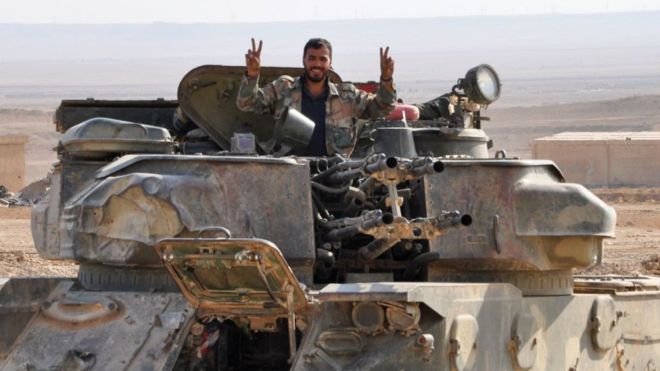
A soldier from the Syrian government forces flashes the 'V' for victory sign in the eastern Syrian city of Deir Ezzor during an operation against Islamic State (IS) group jihadistsGetty Images


Civil wars that spread devastation and suffering across a whole country have no real victors. But one war in Syria - that against the Islamic State (IS) group's so-called caliphate - is well on the way to being won. 

Earlier this week IS's last urban bastion in eastern Syria, Deir al-Zour, hard up against the Iraqi border, fell to Assad government forces. IS will remain in some form or another as an insurgency and source of ideological inspiration but as a territorial entity or physical caliphate, it is finished. 

But what of Syria's other war, the uprising against the Assad regime and its efforts - aided by Iran and Russia - to crush the opposition? 

The current situation on the ground means that forces from the above countries will be in close proximity to United States troops, who are supporting some of the anti-Assad groups.

Joshua Landis, a Syria expert and professor at Oklahoma University, summed it up in simple terms. "Assad has won the Syria war militarily," he told me. "He has defeated the original uprising or revolution. The rebel groups that remain have been pushed to the margins of Syria. 

"The international community has all but abandoned them as a lost cause. The rebel militias," he argues, "still have some teeth in defence, but cannot mount a credible offensive against Assad's military." 

Charles Lister, a senior fellow at the Middle East Institute, and another close watcher of Syria, has a slightly more cautious assessment. "President Assad," he notes, "sits more comfortably in Damascus than at any time since 2011."


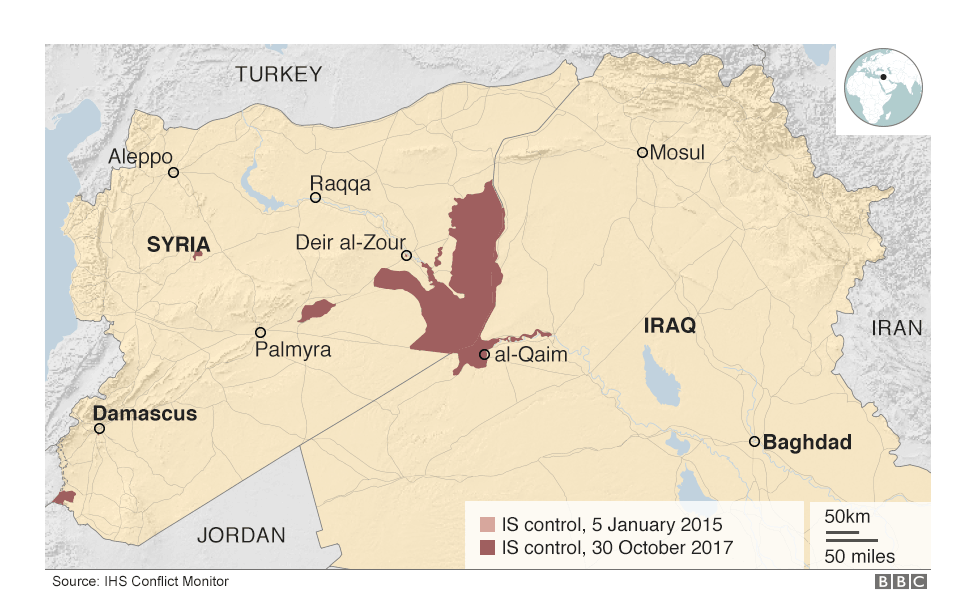
2017 

Area controlled by Islamic State group at the end of October 2017

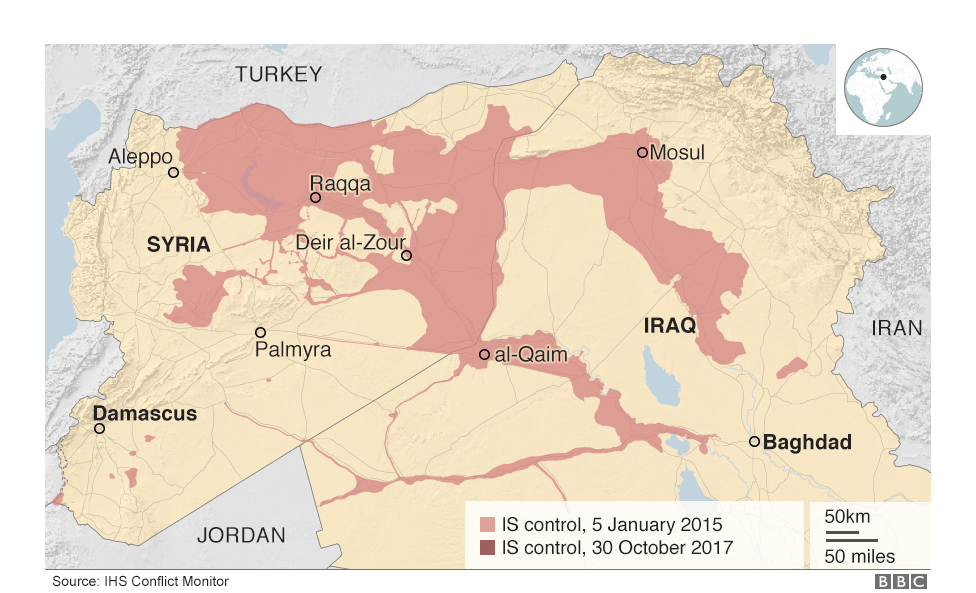
2015 

Area controlled by Islamic State group in January 2015
But having said that, he argues that "it would be inaccurate to suggest Assad had won the war. He's simply avoided losing it."

"The Assad regime has a stated intent to recapture every inch of Syria. If that goal is to ever be met, we're talking years at least," he explained.

But the crucial take-away from all this is that Syria is entering a new phase of conflict. The territorial defeat of IS, says Charles Lister, "will throw an awful lot of potential sources of hostility up into the air and nobody really knows right now how they'll land".

What is emerging is a new strategic map with Syria divided into different zones: One controlled by the Assad regime (with the support of Russia and Iran), another controlled by the Syrian Democratic Forces (an amalgam of Kurdish, Arab and other groups supported by the US), and others run by various elements of the Syrian opposition, backed to varying degrees by Turkey and Jordan.
Having helped Assad restore his control over a significant part of the Syrian population, Moscow has also manoeuvred itself into holding the best cards in the putative diplomatic end-game. 

As Joshua Landis told me, the Astana peace process, led by the Russians, "is the only one worth anything at the moment. 

"The Geneva process, led by the US," he notes, "has been about grandstanding and sticking to talking points that no longer have any relevance on the ground, such as demanding that Assad step aside and that democratic elections be held in Syria. Everyone knows this will not happen."

With the demise of IS, Syria's future will continue to be determined by a variety of external players, fighting out their own strategic battles and seeking local advantage. 

The four key actors are the US, Russia, Turkey and Iran.
  • The United States 

Western special forces, supporting the US-backed Kurdish-Arab forces, deploy on the frontline, one kilometre from the Syrian town of Ain Issa, some 50 kilometres (30 miles) north of Raqa, on November 6, 2016 as they launched an offensive on the Islamic State group's de facto Syrian capitalGetty Images
Special forces from Western countries, including the US, have supported Kurdish-Arab forces in Syria

Its initial half-hearted efforts to galvanise a democratic opposition to defeat the Syrian regime failed dramatically. Its focus has largely been on the defeat of the IS caliphate. 

But now, Joshua Landis says, Washington must make a decision: "Will it stay in Northern Syria to defend the gains of the Syrian Democratic Forces that it has armed, trained and propelled to victory in Raqqa and the region north of the Euphrates River?"

The difficulty, as Charles Lister told me, is that "beyond fighting IS, it is sadly very hard to determine whether the US really has a Syria policy." 

And he says that what policy there is is full of contradictions. For example, Washington continues to say Assad must leave and that his days are numbered, and yet the US has ceased all support to anyone opposed to Assad.
  • Turkey 

Turkish President Recep Tayyip ErdoganGetty Images
Turkish President Erdogan's main concern is with the Kurds

If US policy could be said to be in a mess, so too could that of Turkey.
Ankara's goal, says Joshua Landis, is to retrench. "It seriously overreached in Syria," he told me, "almost to the point of destabilising Turkey."

He believes that President Erdogan "must make sure that the Kurdish question in Turkey does not lurch toward civil war. He will increasingly normalise relations with Assad in order to contain the independence of Syria's Kurds." Turkish troops have moved a small way into northern Syria to achieve this goal. 

Indeed, after posing as a champion of the opposition against the Assad regime, Charles Lister says, that "at times, Turkey has directly betrayed the opposition groups it had stood by for so long, merely to secure a more favourable position against the Kurdish YPG, which it views as a terrorist organisation.
  • Iran

Iraqi PMF fighters on the Iraq-Syria border in Nineveh, Iraq in June 2017Getty Images
Shia militias, backed by Tehran, have played a prominent role in the campaign against IS

In backing the Assad regime (and offering significant support to the Shia-dominated government in Iraq) Tehran has had one clear goal - to secure its hegemony in the northern Middle East: the lands stretching from Lebanon through Syria and Iraq, all the way to Iran's own borders. 

"This," says Joshua Landis, "is the new security architecture that Iran has fought so vigorously for and it is within its reach today. This means that Iran can counter-balance Israel. It means that Iran can establish oil pipelines running to the Mediterranean coast, trade routes, highways, and pilgrimage routes." 
This, he says, means "Iran is no longer cut out of the Middle East."

And Tehran has troops to back up its position. Charles Lister notes that Iran "commands tens of thousands of Shia militiamen inside Syria, which gives Tehran more influence than any other actor, bar none."
  • Russia

Russian soldiers standing guard in a central street in Syria's eastern cityGetty Images
Russian troops have been on the ground in Syria

Russia, after Iran, is the other great winner from the Syrian conflict, reviving its role in the region, securing important military bases, and making itself a key diplomatic player. 

It wants to "solve" Syria on its terms and with its favoured actors ending up the victors and it seems to be well on the way to achieving this goal.

But the growing proximity of Russian and Iranian-backed pro-regime forces and those backed by the US raises the possibility of some dangerous encounters. The US and Russia can agree on the need to defeat IS but on little else. Moscow's "side" has the military and diplomatic advantage on the ground. 

Will the US seek to bolster its position in Syria, perhaps as part of a broader policy to "roll back" Iranian influence, as US conservatives are hoping? This may be easier said than done and might require many more resources and boots-on-the-ground than the Trump administration is prepared to put in harm's way.

Robert E Lee - A Great American


Asked in 1960 how he could keep a portrait of a man who tried to "destroy our government" in his Oval Office, President Eisenhower wrote his critic back:

"General Robert E. Lee was one of the supremely gifted men produced by our Nation. He believed unswervingly in the Constitutional validity of his cause which until 1865 was still an arguable question in America; he was a poised and inspiring leader, true to the high trust reposed in him by millions of his fellow citizens; he was thoughtful yet demanding of his officers and men, forbearing with captured enemies but ingenious, unrelenting and personally courageous in battle, and never disheartened by a reverse or obstacle. Through all his many trials, he remained selfless almost to a fault and unfailing in his faith in God. Taken altogether, he was noble as a leader and as a man, and unsullied as I read the pages of our history...

Their America, and Ours


"Meet you at Peace Cross."

In Northwest D.C. in the 1950s, that was an often-heard comment among high schoolers headed for Ocean City.

The Peace Cross, in Bladensburg, Maryland, was a 40-feet concrete memorial to the 49 sons of Prince George's County lost in the Great War. Paid for by county families and the American Legion, it had stood since 1925.

Before the Beltway was built, Peace Cross, at the junction of U.S. Route 1 and Maryland Route 450, was a landmark to us all.

Last month, two federal judges from the 4th Circuit ruled that Peace Cross "excessively entangles the government and religion" and must come down. A suggested compromise was to saw the arms off, so the monument ceases to be an offensive cross.

One wonders: At what moment did Peace Cross begin to violate the Constitution?
Answer: Never. No alteration has been made to the cross in a century. The change has come in the minds of intolerant judges and alienated elites where the dirty creek of anti-Christian bigotry now flows into the polluted stream of anti-Americanism.

Both are manifest in the rampage to rip down memorials to the men who brought Western Civilization to the New World and made America the great and good country we were blessed to inherit.

Monday, on Laura Ingraham's Fox News show, White House Chief of Staff Gen. John Kelly called Robert E. Lee "an honorable man," who chose to defend the people among whom he had been raised.

"It was always loyalty to state first in those days," said Kelly, when asked his view on Alexandria's Episcopal Church taking down plaques to its greatest parishioners, Lee and George Washington.

An explosion of outrage greeted Kelly's defense of Lee.

Yet, what has changed in half a century? As Ingraham noted, FDR, an icon of liberalism, referred to Lee as "one of our greatest American Christians and one of our greatest American gentlemen."

Asked in 1960 how he could keep a portrait of a man who tried to "destroy our government" in his Oval Office, President Eisenhower wrote his critic back:
"General Robert E. Lee was one of the supremely gifted men produced by our Nation. He believed unswervingly in the Constitutional validity of his cause which until 1865 was still an arguable question in America; he was a poised and inspiring leader, true to the high trust reposed in him by millions of his fellow citizens; he was thoughtful yet demanding of his officers and men, forbearing with captured enemies but ingenious, unrelenting and personally courageous in battle, and never disheartened by a reverse or obstacle. Through all his many trials, he remained selfless almost to a fault and unfailing in his faith in God. Taken altogether, he was noble as a leader and as a man, and unsullied as I read the pages of our history...

"To the degree that present-day American youth will strive to emulate his rare qualities, including his devotion to this land as revealed in his painstaking efforts to help heal the Nation's wounds once the bitter struggle was over, we, in our own time of danger in a divided world, will be strengthened and our love of freedom sustained.

"Such are the reasons that I proudly display the picture of this great American on my office wall."

Have some terrible new truths been unearthed about Lee we did not know in 1960?

No. The change has taken place in the poisoned minds of modernity.
Some will never concede there was principle or honor in the cause of a South that declared independence in 1860-61, emulating the 13 colonies that declared their independence in 1776.

In his tribute to Lee in 1960, Ike addressed what was at issue in 1860 that brought on the war.

"We need to understand that at the time of the War Between the States the issue of secession had remained unresolved for more than 70 years. Men of probity, character, public standing and unquestioned loyalty, both North and South, had disagreed over this issue as a matter of principle from the day our Constitution was adopted."

Ike refers not to a "Civil War," but to the "War Between the States." And correctly so. For the South did not seek to bring down the U.S. government, or overturn Lincoln's election, or seize power in the capital, but to leave the Union, to secede, as Jefferson and John Adams voted to secede from Britain in 1776.

Asked on Fox News about what is happening today with the public insults to our national anthem and the desecration of our monuments, Justice Clarence Thomas raises questions being asked by many Americans:

"What binds us? What do we all have in common anymore? ... We always talk about E pluribus unum. What's our unum now? We have the pluribus. What's the unum?"

The spirit that produced the war in the 1860s, and lasting division in the 1960s, is abroad again. A great secession of the heart is underway.

Thursday, November 02, 2017

The Democrats Discover Hillary Clinton is a Crook


Brazile says she found DNC deep in debt from Obama, controlled by Clinton a year before nomination

WASHINGTON TIMES 

Former Democratic National Committee Chairwoman Donna Brazile says President Obama decimated the party’s finances to win re-election in 2012 and that Hillary Clinton’s campaign took control of the DNC long before she defeated Sen. Bernard Sanders for the party’s presidential nomination last year.
In revelations from her upcoming book that are roiling an increasingly divided Democratic Party, Ms. Brazile said she was shocked at the sorry condition of the DNC’s finances when she took over in July 2016 for embattled Chairwoman Debbie Wasserman Schultz, who she said was “not a good manager.”
Ms. Brazile described a phone call she had with Gary Gensler, the chief financial officer of Mrs. Clinton’s campaign, on the morning after the Democratic National Convention ended in late July 2016.
“He told me the Democratic Party was broke and $2 million in debt,” Ms. Brazile wrote. “‘What?’ I screamed. ‘I am an officer of the party and they’ve been telling us everything is fine and they were raising money with no problems.’ That wasn’t true, he said.”
Also Thursday, the DNC dismissed its top fundraiser after five months on the job amid the party’s weak fundraising efforts. Finance director Emily Mellencamp Smith was let go in a shake-up.
The party had only $7 million on hand by the end of September. The DNC raised $51 million since January, but the Republican National Committee raised $104 million over the same period.
During eight years under Mr. Obama, Democrats lost more than 1,000 state and federal posts nationwide, including congressional and state legislative seats and governorships. Not as well-known was that Mr. Obama also left his party’s finances deep in the red.
“Officials from Hillary’s campaign had taken a look at the DNC’s books,” Ms. Brazile said. “Obama left the party $24 million in debt — $15 million in bank debt and more than $8 million owed to vendors after the 2012 campaign and had been paying that off very slowly.”
The manager of Al Gore’s presidential campaign in 2000 also described her shock at discovering a written agreement that proved what Mr. Sanders had been claiming — that the DNC was in the tank for Mrs. Clinton long before primary voting ended.
The joint fundraising agreement among the DNC, the Hillary Victory Fund and Hillary for America was signed by DNCofficial Amy Dacey and Clinton campaign manager Robby Mook.
The agreement “specified that in exchange for raising money and investing in the DNC, Hillary would control the party’s finances, strategy, and all the money raised,” Ms. Brazile said. “Her campaign had the right of refusal of who would be the party communications director, and it would make final decisions on all the other staff. The DNC also was required to consult with the campaign about all other staffing, budgeting, data, analytics, and mailings.”
The Clinton-DNC pact allowed donors who had maxed out their $2,700 individual contribution limit to write another check of up to $353,400 to Mrs. Clinton’s PAC. Of that, $10,000 would be given to the 32 state parties that were part of the agreement, for a total of $320,000.
The states then funneled the remaining $33,400 to the DNC.
“The funding arrangement with HFA and the victory fund agreement was not illegal, but it sure looked unethical,” Ms. Brazile wrote. “If the fight had been fair, one campaign would not have control of the party before the voters had decided which one they wanted to lead. This was not a criminal act, but as I saw it, it compromised the party’s integrity.”
The agreement was signed in August 2015, just four months after Mrs. Clinton announced her candidacy and almost a year before she secured the party’s nomination.
Ms. Brazile said, “I had been wondering why it was that I couldn’t write a press release without passing it by Brooklyn [site of Clinton campaign headquarters]. Well, here was the answer.”
The result was the Clinton campaign controlled the vast bulk of the party money and doled out small shares to the DNC to keep it afloat. Mr. Gensler told Ms. Brazile that the Clinton campaign “had to do it or the party would collapse.”
Ms. Brazile’s revelations produced a chorus of I-told-you-so’s from the Democratic Party’s grass roots and raised calls to end what many consider a “rigged game” of superdelegates controlled by the party establishment.
Asked by CNN’s Jake Tapper whether the Democratic primary was rigged, Sen. Elizabeth Warren, Massachusetts Democrat, said simply, “Yes.”
Nina Turner, president of Our Revolution, the outside group started by Mr. Sanders after the 2016 campaign, said Ms. Brazile “just told the world what millions of independents and progressives already suspected.”
“The presidential primary was rigged as far back as 2015, as then-chair Debbie Wasserman Schultz ceded all authority to the Clinton campaign,” she said in a fundraising email. “The DNC’s reliance on big money donors tipped the scales against progressives.”
Mrs. Turner said the DNC leadership “continues to alienate progressives.”
“Tom Perez, the current DNC Chair, just demoted supporters of Senator Bernie Sanders and Representative Keith Ellison, including Our Revolution Board Member Dr. Jim Zogby, the only Arab American, from the Executive Committee,” Mrs. Turner said. “The DNC’s preference for large campaign contributions over our revolutionary model of small-dollar donations goes against everything a grassroots organization is supposed to be about. Progressives, independents, and a growing number of Democrats feel that the party no longer works for them. That has to change.”
Republican National Committee Chairwoman Ronna Romney McDaniel said Mr. Sanders has every right to be upset about the Democratic primary race.
“To see that the Hillary Clinton campaign was funding the DNC and in return demanded total control of the DNCbefore she was the nominee shows how truly broken the DNC was,” Mrs. McDaniel said on Fox News. “Donna Brazilehas shed light on the total dysfunction of the DNC and how clearly they put their thumb on the scale for Hillary Clinton.”
Judicial Watch President Tom Fitton tweeted, “Will Justice Department investigate Hillary Clinton’s takeover of the DNC?”
Adam Green, co-founder of the Progressive Change Campaign Committee, said the developments add urgency to the pending recommendations of the party’s Unity Reform Commission, which was created at the national convention as a last-minute compromise with Sanders supporters who were demanding the elimination of superdelegates from presidential primaries.
“When it comes to fostering trust in the DNC, the entire ballgame is the Unity Reform Commission’s forthcoming proposals and whether they are strong and adopted by DNC leadership,” Mr. Green said. “Those proposals should include dramatically scaling back the role of unelected superdelegates in skewing the nomination process, making primaries open to more people, making caucuses less time-consuming for working families, and mandating more DNC budget transparency and oversight.”
He said in light of Ms. Brazile’s revelations, “reforms should also include barring joint fundraising agreements that give an advantage to one candidate over another during a primary.”
⦁ Sally Persons contributed to this report.

The New Face of German Police - Imagine the "EU Army"

‘Enemy in our ranks’: German police trainer blasts immigrant recruits in leaked audio message


‘Enemy in our ranks’: German police trainer blasts immigrant recruits in leaked audio message
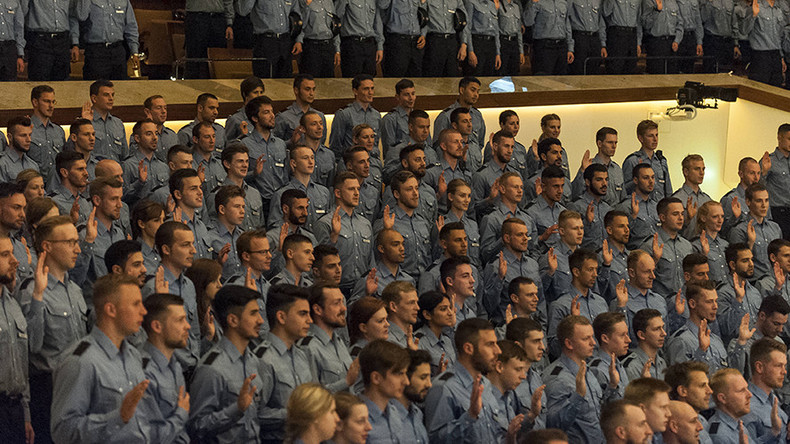
In a leaked recording from the Berlin Police Academy, a lecturer bemoaned the poor language skills, lack of respect, and disloyalty of ethnic Turks and Arabs who will form a sizeable part of the next generation of German police officers.

The audio message was recorded by a paramedic lecturer, who intended to pass it on to Berlin Police chief Klaus Kandt. It was subsequently circulated in private chats between officers on a messaging app last week, and has now been shared with RT. Police officials have previously confirmed that the recording is authentic to several German media, but have not disclosed the identity of the tape’s author.

In the voice message, the lecturer complains about a class of 16 and 17-year-old recruits, who are just beginning their vocational training.

“I’ve never experienced anything like this,” the trainer says on the minute-long recording. “The classroom looked like hell, half Arabs and Turks, disrespectful as hell. Stupid. Unable to speak articulately. I had been close to knocking out two or three of them because they only disturbed the class or literally slept. German colleagues have said that they were threatened with violence.”

The “shocked” lecturer reported that he had “never felt such hostility before” and believed that many of the trainers are scared to discipline the students as “they will trash the place.”

About 1,200 students graduate from the academy in Spandau each year, most of whom proceed to join the Berlin police force, which already consists of 30 percent ethnic minorities. This number is expected to increase, reflecting demographic trends in Germany.

“These are not colleagues, that’s the enemy in our ranks,” the paramedic lecturer said in the message for Kandt, complaining that the recruits will produce “a second-rate police force that will only be corrupt.”

“Criticism is acceptable, but the form and tone of it was inappropriate,” said Berlin police spokesman Thomas Neuendorf. “The person in question was overwhelmed by the situation.”

At the same time, Neuendorf promised that “insolence and indiscipline will not be tolerated” and vowed to improve relations between the student body and the staff.
The German Police Union, which comprises 180,000 law-enforcement staff, said that it had been aware of rumors concerning the institution, but was unable to act, as there were “no specific complaints, and only hearsay” until the latest incident.
Nonetheless, the Berlin Police Academy has been rocked by a series of damaging revelations, which have been reported in the media. This year alone, a student was discovered to have starred in a pornographic film, an officer was caught selling stolen cameras out of his trunk, and two students were caught taking drugs inside the academy premises.

Wednesday, November 01, 2017

The Faces of Diversity

WHICH OF THE THREE HAS DONE THE MOST DAMAGE TO THE USA?


The Cult Of Diversity: An Ideology Without Foundation

U.K. political writer sees diversity among casualties in Westminster.
George Eaton, political editor at the New Statesman, was so moved by Wednesday’s terrorist incident in Westminster that he tweeted, “A snapshot of London’s magnificent diversity in those injured: French, Romanian, Korean, German, Polish, Irish, Chinese, US, Italian, Greek.” I’m not sure if Eaton realized that 14 of those injured were tourists, but what’s striking is that he’s so obsessed with diversity that even casualties on the ground prompted him to celebrate the cultural mosaic he envisions as the apotheosis of a society. In fact, Khalid Masood, the perpetrator, also represents diversity, but the writer didn’t mention that. Like religion, diversity’s backers promote the strengths while ignoring the weaknesses.
Eaton’s macabre observation is an example of the fetishization of diversity on the political left. “Our diversity is our strength” is a liberal mantra repeated mindlessly, often as a poor substitute for a reasoned argument. Diversity’s just a fact. The call for diversity could work to consistently strengthen society if it included an insistence on immigrants leaving the negative aspects of their culture at home. Importing only strengths guarantees a net positive societal gain, but the diversity crowd welcomes every aspect of all cultures.

Diversity pushers want their “marginalized groups” to live separately in tribes whose cultures belong exclusively to themselves. Diversity’s seen as such a virtue on the left that people compete to attain its perfection, just as intersectionality’s adherents vie amongst themselves to achieve maximum victimhood. Last year, the University of Arizona had narrowed the job search for chief diversity officer down to two candidates, but then decided to hire both of them at salaries higher than their predecessor had received. University officials said that both candidates were so strong that they just couldn’t just take one. Try to imagine another job a university would say such a thing about. How can the average student possibly benefit from two fulltime diversity czars making a total of $429,000 (the median salary for a chief diversity officer is $165,000) when that money could be used in so many other ways to improve their campus experience?

Diversity has become a cult whose orthodoxies may not be questioned. But where did it come from? It has no charismatic leader, nor is it moored in academic studies or philosophy. It’s more or less emerged over time from the absurd culture of political correctness on college campuses. Views with no factual basis became axiomatic, slowly forging a worldview that was to be celebrated for reasons mostly unknown. That’s how faith works.

The diversity craze is a fad. It’s a bumper sticker slogan made for the back of a Volvo. Its real purpose is to assuage liberal guilt over past iniquities visited on marginalized groups. Robert Putnam is a liberal academic and author of Bowling Alone, an examination of declining civic engagement in the U.S. He conducted a study of diversity and found that the degree of diversity in a community is inversely proportional to voting, volunteering, donating to charity, and working on community projects. He discovered a lack of trust among members of diverse communities.

It’s not that diversity won’t have long-term benefits for a nation. Putnam isn’t making the case to seal the borders like the Trumpists are. He recognizes the positives immigrants can bring with them while also seeing some of the issues diversity produces, providing a refreshing alternative to all the jingoism. Putnam’s study found that in diverse communities, blacks even trust blacks less. His research revealed that diversity, while not necessarily provoking hostility, produces a withdrawal from the fabric of society, like a turtle going into its shell.
Diversity as an ideology is the creation of white, educated people who are cloistered from its downsides where they live. You don’t hear black people in their communities talking about how diversity makes them stronger. Donald Trump as president isn’t a sign of national health. Putting more emphasis into cohesion, instead of diversity, would be a positive step for an ailing nation. In the age of post-truth politics, communication is emotion-based. Talking points defeat facts now as we slide towards the abyss where words mean very little. Hard-selling diversity just exacerbates an already dire situation where we’re balkanized into separate tribes.