“Soft despotism is a term coined by Alexis de Tocqueville describing the state into which a country overrun by "a network of small complicated rules" might degrade. Soft despotism is different from despotism (also called 'hard despotism') in the sense that it is not obvious to the people."
Bernie Sanders is not giving up. He is still in this to win, and his campaign is ramping up its rhetoric.
In an email sent out on Wednesday, Bernie 2016 campaign manager Jeff Weaver declared plans to push for a contested convention in Philadelphia in July.
By nominating Hillary Clinton, Weaver insisted, the Democratic Party would be risking “disaster simply to protect the status quo” in the U.S.
“We’re going to have a contested convention where the Democratic Party must decide if they want the candidate with the momentum who is best positioned to beat Trump, or if they are willing to roll the dice and court disaster simply to protect the status quo for the political and financial establishment of this country,” he wrote.
The U.S. political and financial establishment has long made it clear that Clinton is its preferred candidate.
Wall Street has overwhelmingly backed Clinton, an extremely hawkish multimillionaire. Financial executives, including many of those who previously backed GOP presidential hopefuls Jeb Bush and Marco Rubio, have poured millions of dollars into Clinton’s campaign in order to help her defeat Trump.
In the latest Sanders campaign email, Weaver cited three polls released on Tuesday that show Clinton facing a potential tough race with Trump in a national election.
A Quinnipiac University poll of crucial swing states found Clinton narrowly winning Florida and Pennsylvania, but losing to Trump by 4 percent in Ohio. Sanders would more comfortably win all three, according to the poll.
“This is pretty scary,” the Bernie 2016 campaign manager said. He posed Sanders as the biggest threat to Trump.
“For months, Bernie Sanders has out-polled Hillary Clinton against Donald Trump, and often by extraordinarily large margins,” Weaver wrote.
He blasted the Democratic establishment for using right-wing talking points to criticize Sanders’ left-wing policies.
“We’ve been told our goals for the future are Utopian, and that our plans would raise taxes on middle class families. We just never thought those attacks would come in a Democratic primary,” Weaver said.
“Yet somehow we keep winning,” he added.
Sanders has won 19 states in the primary — more than Clinton. Hillary, however, has won many of the more populated states, giving her more delegates.
Clinton has 1,716 pledged delegates, or 54 percent of the total, whereas Sanders has 1,433, or 46 percent.
The undemocratic superdelegate system has, in particular, given Clinton an unfair edge. She has repeatedly lost states by double digits, but still come out on top with more total delegates, because the unelected party elites who serve as unpledged delegates have overwhelmingly thrown their weight behind her.
Joe Scarborough, host of the popular MSNBC program “Morning Joe” joined countless frustrated Americans in pillorying the “rigged” electoral system.
“Why does the Democratic Party even have voting booths? This system is so rigged,” Scarborough exclaimed in a segment in April.
Sanders is mathematically unable to win with pledged delegates alone, however, so his campaign has recently changed course and begun trying to woo superdelegates to his side.
The Bernie 2016 campaign has asserted that it is still in this win, and sees a contested convention as the way forward.
“Because we must do everything we can to defeat Trump in November our mission is to win as many pledged delegates as we can between now and June 14th,” Weaver wrote.
He closed the latest email with an expression of solidarity.
“We are the best chance to defeat Trump because people united can never be defeated,” the message concluded. “That is why we must keep fighting.” __________________________________________ __________________________________________ WHAT ABOUT THIS:
Hillary Clinton's 'hacked' Benghazi emails: FULL RELEASE
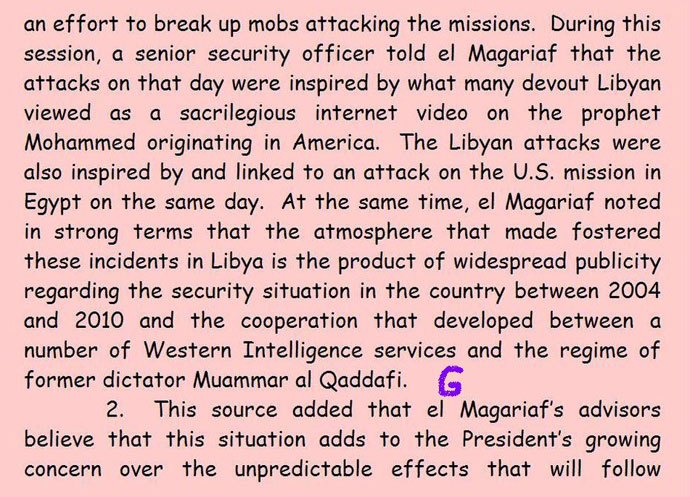
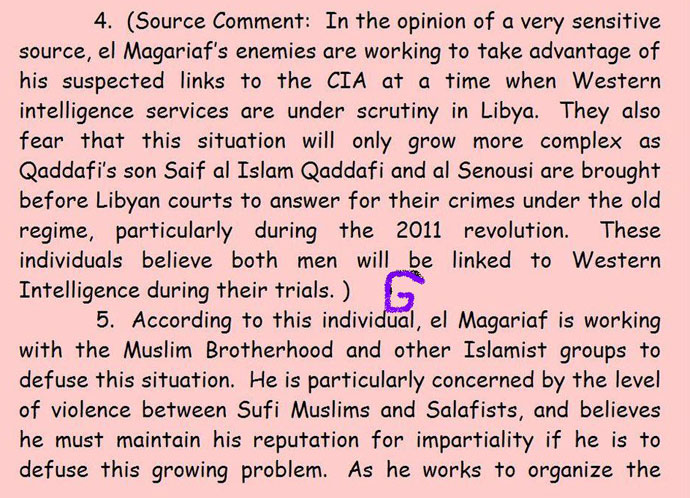
On the back of widespread public interest RT has decided to publish in their entirety a series of memos which were allegedly sent from a one-time White House aide to former Secretary of State Hillary Clinton.
The emails, which were allegedly sent by former political adviser Sidney Blumenthal to Secretary of State Hillary Clinton, were forwarded to RT by a hacker using the alias “Guccifer.”
Guccifer was credited with hacking the AOL email account of Blumenthal last week, though the authenticity of the emails has not been verified.
The purported memos appear to contain sensitive information regarding the September 11, 2012 attacks on the US diplomatic mission in Benghazi, Libya, as well the January 2013 hostage crisis in In Amenas, Algeria.
Blumenthal has been refraining from comments so far. RT reached Blumenthal's son Max, who confirmed that his father will not be making any remarks about the leak.
In the leaked emails distributed to the media, Guccifer copied and pasted the correspondences into new files using bold Comic Sans text layered over a pink background, possibly as a security precaution. The letter 'G' on the memos appears to be the hacker's watermark.
Below are 4 letters dating from September 12, 2012-February 16, 2013. Any omissions are unintentional, as we are publishing all of the information that has been provided to us in the interest of full disclosure.
Below are 4 letters dating from September 12, 2012-February 16, 2013. Any omissions are unintentional, as we are publishing all of the information that has been provided to us in the interest of full disclosure.
“There are not two sides to an occupation. There are two sides to a conflict, but there are not two sides to an occupation,” she said. “There are occupied and the occupiers.”
Arriving aboard a tour bus, accompanied by a former Israeli machine-gunner turned human rights activist, an international delegation of pretty famous writers came to the heart of this old city to see for themselves how 850 hardcore Jewish settlers, protected by 650 young Israeli soldiers, live among 200,000 angry Palestinians.
The writers didn’t like what they saw.
The settlers didn’t like the writers much either, especially their hosts.
The Israeli military occupation is “the most grievous injustice I have seen in my life,” Michael Chabon, the American author of the Pulitzer Prize-winning novel “The Amazing Adventures of Cavalier & Clay,” told the Forward, a Jewish newspaper, a day after seeing Hebron.
“Liars!” the settlers shouted at the writers.
Through the summer, 25 novelists will journey to Israel, the West Bank and the Gaza Strip to gather material for a book of essays to be published by HarperCollins in June next year (and simultaneously released in a half-dozen other languages).
The book is designed to mark the 50-year anniversary of the Israeli occupation of the Palestinian territories — and to make a political splash.
The organizers hope their words will kindle reflection, outrage, change. They think that after five decades of daily news coverage, often numbing in its narrative of stalled “peace processes” and kill-reprisal-repeat, the Israel-Palestinian conflict needs a novelist’s chops to tell old stories in new ways.
Yet on a recent morning in Hebron, the Jewish settlers weren’t waiting for the book to come out. They were ready to pan the effort now.
A gray-bearded settler driving a beater down Shuhada Street hit the brakes, honked his horn and began to shout at the group and point at Yehuda Shaul, a burly former sergeant from the Israel Defense Forces who is a founder of an anti-occupation group called Breaking the Silence.
Israel: From independence to intifada
“Don’t believe him! He’s a traitor. The Israeli army is the best in the world. Don’t believe him.” Then the settler waved and called, “Shabbat shalom!” before he sped away.
It was the first of several slightly surreal mini-encounters — all scenes in the Hebron Show, which may have felt fresh to the writers, but is a rerun. Settlers here frequently taunt tours led by left-wing activists.
So the settler children, well-schooled in the routine, surrounded Shaul and tried to block his way, being careful not to touch him (physical assault against a Jewish Israeli would have probably been stopped by the soldiers).
Instead, the children called him “fatso,” stuck their hands over the lenses of cameras carried by the journalists accompanying the writers, including The Washington Post, and gave the Breaking the Silence support staff the finger.
The book project is being led by a husband-and-wife team, novelists Chabon and Ayelet Waldman, assisted by their éminence grise, Mario Vargas Llosa. Other visiting writers include Geraldine Brooks, Colm Tóibín, Cheryl Strayed, Assaf Gavron, Rachel Kushner, Taiye Selasi and Dave Eggers (who traveled to Gaza).
The visits are controversial in Israel, in part because they are organized by Breaking the Silence, a group of current and former Israeli soldiers who oppose the occupation and do so by revealing how it looks and feels to a conscript enforcing it. Many Israelis — especially the 600,000 Jewish settlers in the West Bank and East Jerusalem — despise the group and its tactics, which include anonymous testimonies.
Shaul led the writers through a sterilized zone where Palestinians are forbidden to walk. The Palestinian shops were all closed, the metal doors welded shut. The vegetable and meat markets are a memory. A few Jewish children kicked a soccer ball around. Soldiers roared past in armored jeeps, and a squad with automatic rifles and body armor followed the tour on foot, mostly to keep the settler children from harassing the writers.
At one point, Chabon stopped to thank the soldiers, saying he understood they were put into a difficult situation.
One of the young soldiers, a red-haired private with an American accent, told Chabon, “I’ve read your books, actually.” He was obviously a fan.
His commanding officer told him to knock it off.
A handful of Palestinian families remain in the area immediately around the Jewish settlements of Hebron. They must enter their houses through back entrances and rooftops. They did not appear.
“Welcome to downtown Hebron,” Shaul said, stopping at an empty intersection. “This was the busiest, most lively section of the city.” He held up a “before” photograph that showed throngs of shoppers. “Now it’s a ghost town.”
Shall related the basic history of Hebron to the writers.
This is where tradition says the patriarch Abraham bought a cave to serve as a tomb for his wife, Sarah, and where she and Abraham, along with Isaac and Rebecca, and Jacob and Leah, were buried. There is an ancient mosque and synagogue to mark the spot.
The Jews were marginalized but steadfast residents of Hebron for centuries, forbidden by Muslim conquerors to enter the Tomb of the Patriarchs. In 1929, an Arab mob slaughtered some 67 Jews here, mutilating their bodies. If the writers had entered the museum built by the settlers at the old Hadassah hospital here, they could have seen the photographs of the bloody stumps.
In 1967, after the Six-Day War, the Israel Defense Forces took control of Hebron and an army rabbi was the first Jew to enter the tomb in 700 years.
In 1994, an Israeli American physician named Baruch Goldstein entered the mosque and unloaded his machine gun, killing 29 Palestinians and wounding more than a hundred, until the crowd overwhelmed him and beat him to death. That event is not in the museum.
Goldstein’s grave is located a mile away in the nearby settlement of Kiryat Arba. Today it is a pilgrimage site for Jewish extremists, who leave pebbles on his tombstone; the inscription praises him as a martyr with clean hands and pure heart.
The writers visited the grave. Waldman said the tomb disgusted her.
Chabon said the couple sought out an international group of writers, young and established, most neither Jewish nor Muslim, to tell the story. They didn’t seek out conservatives or liberals — but it’s fair to say the group tilts left. “There’s no way such a diverse group of writers could have an agenda,” Chabon said.
Actually, they could have quite an agenda, one of the settlers, Danny Cohen, said. He had come out to watch one of his neighbors yell at Shaul.
Cohen asked, “Do they tell you why these two blocks are closed to Arabs?” Because of Palestinian attacks (there have been many). “Did they tell you this property was owned by Jews before the massacre? They don’t tell you that there’s been Jews living here for centuries.”
Chabon tells Cohen, yes, they did tell us that.
Each writer will pursue their own research, which could be the subject of their essay. Some of the topics include: Ramallah nightlife, Palestinian football, the separation barrier, West Bank hip-hop, child inmates in Israeli prisons and military courts.
“They’ll write what they want to write,” said Waldman, author of a series of self-described “mommy-track” mystery novels and the best-selling work of nonfiction “Bad Mother.”
Waldman was born in Jerusalem, the daughter of a kibbutznik. She immigrated to Canada and then the United States as a child.
Asked whether the tours are presenting a one-sided take on the Israel-Palestinian conflict, Waldman said no, not at all.
“There are not two sides to an occupation. There are two sides to a conflict, but there are not two sides to an occupation,” she said. “There are occupied and the occupiers.”
Walkman added that she wasn’t blind.
“I’m not denying the reality of terror, I’m not denying that buses blow up in Jerusalem, that there are knife attacks,” she said. “But what this book is designed to do is give the world a glimpse of what it is like to live for 50 years under a military occupation.”
BEIRUT — After months of unexpectedly swift advances, the U.S.-led war against the Islamic State is running into hurdles on and off the battlefield that call into question whether the pace of recent gains can be sustained.
Chaos in Baghdad, the fraying of the cease-fire in Syria and political turmoil in Turkey are among some of the potential obstacles that have emerged in recent weeks to complicate the prospects for progress. Others include small setbacks for U.S.- allied forces on front lines in northern Iraq and Syria, which have come as a reminder that a strategy heavily reliant on local armed groups of varying proficiency who are often at odds with one another won’t always work.
When President Obama first ordered U.S. warplanes into action against the extremists sweeping through Iraq and Syria in 2014, U.S. officials put a three- to five-year timeline on a battle they predicted would be hard. After a rocky start, officials say they are gratified by the progress made, especially over the past six months.
Since the recapture of the northern Iraqi town of Baiji last October, Islamic State defenses have crumbled rapidly across a wide arc of territory. In Syria, the important hub of Shadadi was recaptured with little resistance in February, while in Iraq, Sinjar, Ramadi, Hit and, most recently, the town of Bashir have fallen in quick succession, lending hope that the militants are on the path to defeat.
“So far, in terms of what we had hoped to do, we are pretty much on track,” said a U.S. official who spoke on the condition of anonymity in order to discuss sensitive subjects. “We’re actually a little bit ahead of where we wanted to be.”
Islamic State claims responsibility for truck bombing in Baghdad
The Islamic State group has claimed responsibility for a truck bombing on April 30 in southeastern Baghdad that killed more than 20 people and wounded more than 40 others. The terrorist group targeted Shiite pilgrims as they walked to a shrine. (AP)
The fight, however, is entering what Pentagon officials have called a new and potentially harder phase, one that will entail a deeper level of U.S. involvement but also tougher targets.
In an attempt to ramp up the tempo of the war, the U.S. military is escalating its engagement, dispatching an additional 450 Special Operations forces and other troops to Syria and Iraq, deploying hundreds of Marines close to the front lines in Iraq and bringing Apache attack helicopters and B-52s into service for the air campaign.
The extra resources are an acknowledgment, U.S. officials say, that the war can’t be won without a greater level of American involvement. The targets that lie ahead are those that are most important to the militants’ self-proclaimed caliphate, including their twin capitals of Raqqa in Syria and Mosul in Iraq and, to a lesser extent, Fallujah, a key concern because of its proximity to Baghdad.
The Islamic State will have occupied those cities for well over two years before the offensives begin, far longer than any of those it has lost so far. The battle for Mosul, long a Pentagon priority, has already been delayed by at least a year, in part because of the Islamic State’s seizure a year ago of the city of Ramadi in the province of Anbar. Ramadi was recaptured in December, but only after a significant diversion of resources and time.
“The defenses that they have there are much more developed than what they had the ability to do in Ramadi, so it’s going to get harder the closer we get to Mosul, there’s no doubt about it,” said Maj. Gen. Gary J. Volesky, who commands the land-forces component of the U.S.-led coalition out of Baghdad.
After being caught unprepared by the Ramadi upset, he and other U.S. officials now decline to put a time frame on the Mosul offensive. An early attempt to sever one supply route to the city in March did not go well, with two newly trained Iraqi army brigades forced to retreat under intense Islamic State fire from the small but strategically important village of Al-Nasr, about 40 miles to the south. It was a reminder, said Col. Steve Warren, a U.S. military spokesman, that “we’ve got a foot on his neck but he’s still got some fight in him.”
As the war cuts deeper into the militants’ core territories, the pace will inevitably slow, officials say. “Now we’re organizing Mosul, and we are going to organize some other things, too, so there will be a natural pause, which isn’t necessarily a strategic setback,” said the U.S. official. “We have to pause, reset a bit and do some things.”
The deepening U.S. military engagement won’t, however, untangle the web of political complexities that appears to be tightening around a strategy critics long have charged is too focused on short-term military gains.
While scoring some significant advances on the ground, the strategy has not yet found answers to the wider political disputes that helped fuel the rise of the Islamic State and could yet undermine the long-term sustainability of military gains, said Robert Ford, the last U.S. ambassador to Syria, who is now with the Washington-based Middle East Institute.
“The Americans are so happy every time a village falls, they lose sight of the forest while looking at all the trees,” he said.
The recent dramatic storming of Baghdad’s fortified Green Zone by supporters of the Shiite cleric Moqtada al-Sadr offered one example of the kind of conflicts that could erupt in Iraq well before the militants are defeated, he said.
“The problem in Baghdad underlines how tenuous the government situation is,” Ford said. “This isn’t something Apaches and F-16s can fix. You must deal with the politics as much as you deal with the military.”
U.S. officials say they have seen no fallout yet from the fracas in Baghdad, but they don’t rule out that there could be one if the political instability continues.
Of greater immediate concern, they say, is the upheaval in Turkey, where Prime Minister Ahmet Davutoglu last week announced his intention to step down after losing out in a feud with President Recep Tayyip Erdogan. Davutoglu has long worked closely with U.S. officials and had been seen as a moderating influence on the more unpredictable Erdogan, who frequently lashes out with criticisms of his American allies and has displayed fluctuating levels of enthusiasm for the fight against the Islamic State.
One major effort for which the United States needs Turkish engagement is a faltering offensive against the Islamic State in the northern Syrian countryside of Aleppo province, bordering Turkey. A force of Turkish and U.S.-backed rebels swiftly advanced last month into the key Islamic State town of Al-Rai, then was equally swiftly pushed back.
It was an early test of the fraught effort to train and equip a force of moderate Syrian rebels to take on the militants in northern Syria, which has now mostly been subcontracted to Turkey. Officials acknowledge that they were disappointed with the poor rebel performance, ascribed by both Syrians and U.S. officials more to divisions within the ranks of the rebels than any external factors.
Cutting the Islamic State’s vital supply route to Turkey is considered an essential prerequisite for any eventual offensive to retake Raqqa. The 250 Special Operations troops dispatched to Syria last month are charged with training an Arab force to lead the Raqqa offensive — but there won’t be a Raqqa offensive until the northern Aleppo part of the puzzle has been solved, U.S. officials say.
The recent resumption of fighting around the nearby city of Aleppo has come as a fresh reminder that the war in Syria will continue to draw resources away from the Islamic State fight. Peace talks in Geneva aimed at ending the conflict have deadlocked, eroding hopes that a political solution is in sight.
Russia, though not part of the U.S.-led coalition, had contributed to the building of pressure on the Islamic State by supporting the Syrian government’s recapture in March of the ancient city of Palmyra. But Russia has diverted its military resources from the Islamic State front toward Aleppo, considered a greater priority for the government than the Islamic State-held territories to the east, according to a person familiar with the discussions between Syria and its allies Iran, Hezbollah and Russia over military operations.
As a Russian orchestra played Bach and Prokofiev in celebration of the Palmyra victory at the city’s Roman amphitheater last week, Islamic State fighters overran the nearby gas field of Shaer, their first conquest in many months.
One concern is that any hiatus in the fight could give the Islamic State a chance to regroup, refresh and revive its badly dented image of invincibility by launching new assaults, such as the one last week that killed U.S. Navy SEAL Charles H. Keating IV. Warren characterized the attack as an effort to “detract from the beat-down they’ve taken everywhere else.”
It was repelled, however, only with the help of intense U.S. airstrikes, underscoring the vital role the United States plays in securing recaptured territory.
“In the short term, as long as the Americans are there, I don’t think they’re going to rampage like they did in 2013 and 2014,” Ford said of the militants. “But were you to remove that air power and the capabilities the Americans bring, I could imagine them making gains again on the ground.”
Loveday Morris in Baghdad contributed to this report.
Once a Clinton stronghold, Appalachia now Trump country
By LISA LERER Associated Press
ASHLAND, Ky. (AP) - When President Bill Clinton rolled into the small Appalachian town of Ashland, Kentucky, in 1996, cheering crowds lined the streets. Local boy-turned-country music star Billy Ray Cyrus performed a special version of his hit, “Achy Breaky Heart" before nearly 20,000 supporters at a riverfront re-election rally.
Back then, this was Clinton country. Today, it looks an awful lot more like Trump town.
Hillary Clinton was met in Ashland on Monday by just a handful of supporters and a lone heckler, who shouted: "Go home, Hillary!" Later on, hundreds of protesters stood in pouring rain, waved Donald Trump signs and chanted “Kill-ary" as Clinton toured a health center in Williamson, West Virginia.
The unwelcome reception marks a striking political shift for the Clintons, who've long staked their electoral fortunes on working class white voters. Bill Clinton won the White House in 1992 by wooing Southern swing voters in places such as Kentucky, West Virginia and Tennessee, and his wife swept all three states in her primary run in 2008 against then-Illinois Sen. Barack Obama.
Eight years later, Trump’s connection with those voters could pose a threat to Clinton in the coal mining communities of Appalachia she visited on Monday, but also in parts of the Rust Belt and upper Midwest hit hard by the decline of domestic manufacturing.
"I am well aware of the politics in West Virginia," she told MSNBC in Charleston, W.Va on Tuesday. “It's gotten increasingly challenging for Democrats to be successful."
As she increasingly focuses her efforts on the general election, Clinton is trying to replicate the electoral strategy that twice boosted Obama into the White House by concentrating on wooing young, minority and female voters.
Trump may afford them new opportunities to expand what’s known as the Obama coalition: Her aides calculate the billionaire's penchant for controversy could put traditionally Republican-leaning states such as Georgia, North Carolina and Arizona into play.
"As an old duck hunter, I know the truth of the saying, 'You gotta hunt where the ducks are at,'" said Paul Begala, who helped engineer Clinton's victory in 1992. “President Obama understood this, as does Secretary Clinton."
But at the same time, Clinton's long history with the region means she and her husband aren't willing to give up on places such as Ashland. Her campaign explained her swing through the coal-mining region as one that highlights her willingness to speak to the entire country - even those people who don't support her bid. Aides say she’s unlikely to win either Kentucky or West Virginia in the primaries later this month or the general election next fall.
Democrats have lost support in Appalachia as the region has shed jobs in industries such as coal mining and as union membership has declined, said Democratic strategist Dave "Mudcat" Saunders. The leftward shift of the Democratic Party during the Obama administration on social issues, including gay marriage and gun control, hasn't helped. “In those areas, it has become culturally unacceptable for a white male to admit he's a Democrat," Saunders said.
On Sunday, Bill Clinton was booed at an event in Logan, West Virginia. Before he arrived, the town's mayor sent an email to West Virginia Sen. Joe Minchin’s office, saying the couple wasn't welcome to use city fire department facilities for their political events.
Clinton's waning popularity in the region was further hurt by a remark she made in a March interview with CNN, when she said she would "put a lot of coal miners and coal companies out of business." She was responding to a question about how her policies would benefit poor white people in Southern states.
"I can't take it back and I certainly can't get people who for politically reasons or personal reasons, very painful reasons, are upset with me," said Clinton, who called the comment a "misstatement." ‘'I'm going to do whatever I can to try to help."
Outside her event, protesters weren’t buying.
"Hillary Clinton should be in prison," said Dionne Collins, who backed Bill Clinton in 1992. “The only hope is Donald Trump."
Associated Press reporter Catherine Lucey contributed to this report from Des Moines, Iowa.
This Former Fisherman Is Now Farming the Most Sustainable Food on Earth—Underwater
“For the first time in generations, we have an opportunity to grow food the right way, provide good middle-class jobs, restore ecosystems, and feed the planet.”
[From the introduction by Lisa Holmes, president of the board of CitySeed and member of the board of GreenWave:]By designing a small-scale, affordable, and open-sourced solution to what often feels like an insurmountable challenge, Bren Smith gives us all the precious gift of possibility and hope. The co-founder and executive director of GreenWave, he has pioneered the development of a model of regenerative ocean farming that restores biodiversity and ecosystems, mitigates climate change, and creates blue-green jobs—all the while growing nourishing and delicious food as well as fertilizer, animal feed, and more.
Like so many working to transform the food system, my perception of farming ended at the shoreline, so Bren’s work building the nation’s first multi-species vertical ocean farm in Long Island Sound off of Stony Creek, Connecticut, was a total revelation. It took only one trip to see the demonstration farm off the Thimble Islands and listen to the story that you’re about to hear to realize that this was something—and someone!—revolutionary. The farm’s simple and accessible infrastructure supports sea vegetables and bivalves, humble plants and creatures that we should be grateful for because they have the potential to be our ecological salvation. And Bren’s reverence for the commons and his innovative model of scaling by means of replication are radical, yet have the pragmatic ability to effect real change. Please join me in welcoming Bren Smith.
I’m here as a fisherman who dropped out of high school. I’ve spent many nights in jail over my lifetime; I’m an epileptic; I’m asthmatic; I don’t even know how to swim. So I’m here today, humbled in many ways, and I told my wife, Tamanna, that I don’t feel as though I deserve to be here. But since I’ve snuck in the back door somehow, I’ll tell you my story. It’s a story of ecological redemption.
I was born and raised in Newfoundland, Canada, in a little fishing village with fourteen salt-box houses painted in greens, blues, and reds so that fishermen could find their way home in the fog. At age 14 I left school and headed out to sea. I fished the Georges Banks and the Grand Banks for tuna and lobster, then headed to the Bering Sea, where I fished cod and crab. The trouble was I was working at the height of the industrialization of food. We were tearing up entire ecosystems with our trawls, chasing fish further and further out to sea into illegal waters. I personally have thrown tens of thousands of by-catch back into the sea.
It wasn’t just that we were pillaging. Most of my fish was going to McDonald’s for their fish sandwiches. There I was, still a kid, working one of the most unsustainable forms of food production on the planet, producing some of the most unhealthy food on the planet. But, God, how I loved that job! The humility of being in 40-foot seas, the sense of solidarity that comes with being in the belly of a boat with 13 other people working 30-hour shifts, and a sense of meaning and pride in helping to feed my country. I miss those days so, so much.
But then in the early 1990s the cod stocks crashed back home: thousands of fishermen thrown out of work, boats beached, canneries shuttered. This situation created a split in the industry: The captains of industry, who wanted to fish the last fish, were thinking 10 years down the road, but there was a younger generation of us thinking 50 years out. We wanted to make our living on the ocean. I want to die on my boat one day—that’s my measure of success.
So we all went on a search for sustainability. I ended up in Northern Canada on an aquaculture farm. At that point aquaculture was supposed to be the great solution to overfishing, but when I got there I found more of the same, only using new technologies to pollute local waterways with pesticides and pumping fish full of antibiotics. We used to say that what we were growing was neither fish nor food. We were running the equivalent of Iowa pig farms at sea.
So I kept searching, ending up on Long Island Sound, where there was a new program in place to attract young fishermen back into the industry by opening up shell-fishing grounds for the first time in 150 years. I signed up, leased some grounds from the state, and remade myself as an oysterman. I did this for seven years. Then the storms hit. Hurricane Irene and Hurricane Sandy thrashed the East Coast. Two years in a row the storms buried 90 percent of my crops in three feet of mud, and 40 percent of my gear was washed away in a sea of death. At the same time, lobster was being driven northward by warming waters, and acidification was increasing faster than at any other time in 300 million years, killing billions of oyster seed up and down our coasts.
Suddenly I found myself on the front lines of a climate crisis that had arrived one hundred years earlier than expected. For a long time I’d seen climate change only as an environmental issue because environmentalists were always framing it in terms of birds, bears, and bees, but I’m a fisherman. I kill things for a living; I grew up shooting moose out of my kitchen window. I never thought climate change had anything to do with my life. But it does. From my vantage point, climate change is not an environmental issue at all—it’s an economic issue.
The same years my farm was wiped out by hurricanes, 83,000 people lost their jobs in New York City because of flooding, many of those in manufacturing. Unemployment claims doubled in Vermont along the storm’s path, and 80 percent of US farmland was shriveled by drought, driving up food prices for middle and working class families. It turns out there will be no jobs on a dead planet.
After my farm was destroyed, it was clear to me that I had to adapt because I was facing a serious threat to my livelihood. I began to re-imagine my occupation and farm. I began experimenting and exploring new designs and new species. I lifted my farm off the sea bottom to avoid the impact of storm surges created by hurricanes and started to grow new mixes of restorative species. Now, after 29 years of working on the oceans, I’ve remade myself as a 3D ocean farmer, growing a mix of seaweeds and shellfish for food, fuel, fertilizer, and feed.
That’s how I got to where I am today. Now let’s dive in and take a look at the farm and deconstruct why it’s designed the way it is. Imagine a vertical underwater garden with hurricane-proof anchors on the edges connected by floating horizontal ropes across the surface. From these lines kelp and Gracilaria and other kinds of seaweeds grow vertically downward next to scallops in hanging nets that look like Japanese lanterns and mussels held in suspension in mesh socks. Staked below the vertical garden are oysters in cages and then clams buried in the sea floor.
If you look for my farm from ashore, there’s almost nothing to see, which is a good thing. Our underwater farms have a low impact aesthetically. That’s important because our oceans are beautiful pristine places, and we want to keep them that way. Because the farm is vertical, it has a small footprint. My farm used to be 100 acres; now it’s down to 20 acres, but it produces much more food than before. If you want “small is beautiful,” here it is. We want ocean agriculture to tread lightly.
Our 3D farms are designed to address three major challenges: first, to bring to the table a delicious new seafood plate in this era of overfishing and food insecurity; second, to transform fishermen into restorative ocean farmers; and third, to build the foundation for a new blue-green economy that doesn’t recreate the injustices of the old industrial economy.
First, food production. As ocean farmers, we reject aquaculture’s obsession with monoculture, similar to that of land farming. Our goal is diversity. It’s a sea-basket approach: we grow two types of seaweeds, four kinds of shellfish, and we harvest salt. But with over 10,000 edible plants in the ocean, we’ve barely scratched the surface. We eat only a few species, and we grow basically none in the United States. We intend to de-sushify seaweed and invent a new native cuisine, not around our industrial palate of salmon and tuna but around the thousands of undiscovered ocean vegetables that are right outside our backdoor. Native seaweeds contain more vitamin C than orange juice, more calcium than milk, more protein than soybeans. And it might surprise those of you on the hunt for Omega-3s to learn that many fish do not create these heart-healthy nutrients by themselves—they consume them. By eating the plants fish eat, we get the same benefits while reducing pressure on fish stocks. So it’s time to eat like fish.
We’re working with chefs to cook up kelp noodles with parsnips and bread crumbs in barbeque sauce; green sea butters and cheeses; kelp-based umami-filled bouillons. Our new ocean dinners are fun, they’re creative, and they’re delicious. This is our opportunity to completely rearrange the seafood plate by moving ocean plants and bivalves to the center and wild fish to the edges. Imagine being a chef in 2015 and discovering that there are thousands of vegetable species you’ve never cooked with before. It’s like discovering corn, arugula, tomatoes, lettuce for the first time. As one of my partner chefs, Brooks Headley, says, “As a chef it feels frightening, daunting, and exciting all at once.” Ocean greens such as kelp are not small boutique crops. We can grow incredible amounts of food in small areas: 25 tons of greens and 250,000 shellfish per acre in five months. If you were to create a network of our ocean farms totaling the size of Washington state, technically you could feed the planet.
This is zero-input food that requires no fresh water, no fertilizer, no feed, no arid land—making it hands down the most sustainable food on the planet. And as the price of fertilizer, water, and feed goes up, zero-input food is going to be the most affordable food on the planet. The economics of it will drive us to eat ocean greens. The question is, will it be delicious food or will it be like being force-fed cod liver oil? As farmers, it’s our job to grow this new cuisine, and for chefs it’s their job to make it beautiful.
Ocean farming isn’t just about food. It’s about transforming an entire workforce, transforming fishers into restorative ocean farmers. My job has never been to save the seas; it’s to figure out how the seas can save us. I say that because millions of years ago Mother Nature created two technologies designed to mitigate our harm: shellfish and seaweeds. Oysters filter up to 50 gallons of water a day, pulling nitrogen, which is the cause of our oceans’ spreading dead zones, from the water column. Our farmed kelp, called the Sequoia of the sea, soaks up five times more carbon than land based plants. Seaweeds are a powerful source of zero-input biofuel; we can produce 2,000 gallons of ethanol per acre—that’s a 30 times higher yield than soybeans and five times more than corn. According to the Department of Energy, if you were to take a network of our farms equaling half the size of the state of Maine, you could replace all the oil in the United States.
Our farms function as storm-surge protectors, breaking up wave action to reduce the impact of hurricanes and rising tides. And they serve as artificial reefs, attracting over 150 species. Sea horses, striped bass, and grey seals come to eat, hide, and thrive on our farms. My farm used to be a barren patch of ocean, now it’s a flourishing ecosystem. As fishermen, we’re no longer pillagers, hunting the last fish. We are a new generation of climate farmers who have joined the fight to restore our planet. We’re trying to break down the seawalls that separate our land-based and ocean-based food systems. Even the best land-based farms pollute, sending nitrogen into our waterways, so we use our kelp to capture that nitrogen, turn it into liquid fertilizers, and send it back to organic farmers to grow their wonderful vegetables. When the nitrogen then runs back into Long Island Sound, we capture it again.
We are also working on new forms of livestock feeds. For example, when cattle are fed a majority kelp-based diet, there is a 90 percent reduction in methane output. The idea is to build a bridge between land and sea in order to close the loop between our food systems. As Lisa said in her introduction, too often our thinking stops at the water’s edge.
Our goal is to build a just foundation for the blue-green economy. Saving the seas is not enough. There is 40 percent unemployment in my town. I wouldn’t be doing this work unless it created jobs for my people, unless it opened up new opportunities for the three billion folks who depend on our oceans to make a living.
Our old economy is crumbling. I can’t get cell service in half of the country, let alone decent healthcare or a healthy meal. The old economy is built on the arrogance of growth at all costs, profiting from pollution, and the refusal to share economic gains with 99 percent of Americans. But out of the ashes of the old economy, together we are building something new based on new-economy principles of collaboration, community-driven innovation, shared profits, and meeting social needs. Because ocean agriculture is still in its infancy, we have the unprecedented opportunity to build a model from scratch, to build from the bottom up an economy that works for everyone, not just a few. We have the opportunity to learn from the mistakes of industrial agriculture and aquaculture. This is our chance to do food right.
For this to happen, our team at GreenWave, an organization created to build out the new ocean agricultural system and replicate it, is working to address three major questions: First, how do we replicate and scale our farming model so that it doesn’t become a carbon copy of industrial factory farming? Second, how do we build the infrastructure to create new ownership models to ensure that farmers capture the value chain and that the principles of equity and social justice are woven into the fabric of the ocean economy? Third, how do we create new kinds of economic relationships among growers and buyers and consumers?
We addressed the first question of farm replication and scale, not by patenting or franchising—those are tools of the old economy—but by open-sourcing our farming model so that anybody with 20 acres and a boat and $30,000 can start his or her own farm. One of our new farmers is a third-generation lobsterman who was unemployed because climate change had pushed lobsters northward. We got him up and running, growing and selling the first year. Among our other farmers are former Alaskan salmon fishermen, an Iraq war veteran, and a Latino family whose ancestors were driven off their farmlands in Mexico. We replicate and scale by specifically designing our farms to require low capital costs and minimal skills. We seek simplicity not complexity. We believe that replication is driven by setting low barriers to entry so that people from all walks of life can grow and prosper with us. At the same time our farmers receive start-up grants, access to free seed, gear donated by Patagonia, and two years of free consulting from GreenWave. What is most important, we guarantee to purchase 80 percent of their crops for the first five years at triple the market rate.
We intend to create stable and secure markets that give our beginning farmers time to learn the trade and to scale up their farms. They keep farming because they know they’ll get paid well for what they grow. Our vision is hundreds of small-scale ocean farms dotting our coastlines, surrounded by conservation zones. Imagine a Napa valley of ocean mirrors dotting out coastlines.
We envision 3D farms embedded in wind farms, harvesting not only wind but also food, fuel, and fertilizers. We envision using shuttered coal plants—like the one closing in Bridgeport, Connecticut—for processing animal feed and salt. We want to repurpose the fossil-fuel and fishing industries so that they will protect rather than destroy our oceans.
The second question is how to build the infrastructure needed to ensure that ocean farmers and communities will reap the rewards of the blue-green economy. For too long, farmers and fishermen have been caught in the beggar’s game of selling raw commodities while others soak up the profits; too many of us are locked in the boutique food economy, selling as CSAs and at farmer’s markets, with the majority of us not making an adequate living and having to hold down multiple jobs to make ends meet. But now, in our unexplored oceans we have a chance to plan ahead and to build an infrastructure in the right way. As one of our new farmers, a 65-year-old fisherman, whose family has fished in Rhode Island for 300 years, told me, “The last thing we want to do with 3D farming is re-create the fishing industry.”
Instead of repeating history we’re building infrastructure from seed to harvest to market. We’re starting nonprofit hatcheries so that our farmers can access low-cost seed. We’re creating ocean seed banks so that the Monsantos of the world can’t privatize the source of our food and livelihoods. We cap the price of a sublease at $50 an acre per year so that low-income ocean farmers can access property. But by “property” we do not mean privatization. Our farmers don’t own their patch of ocean; they own only the right to grow shellfish and seaweeds there, which means that anyone can boat, fish, or swim on their farms. I own the process of farming but not the property, and this keeps my farm as shared community space. We’re also building in levers of community control. Leases are up for review every five years so that, if I’m farming unsustainably, my rights can be revoked.
At the same time, we’re building the country’s first farmer-owned seafood hub, which is not only a place to process, package, and ship the raw commodities we raise but also a space to leverage the unique qualities of our seaweeds. The power of kelp is that it’s not just food; there is a whole range of products we can produce that meet environmental and social needs: organic fertilizers, new livestock feeds, kelp biofuels, and even medicine. With thousands of yet undiscovered ocean plants, farmers and scientists can join together to discover and grow new forms of medicine.
We believe that if we provide our communities with the right mix of low-cost, open-source infrastructure, our hub will become an engine for job creation and the basis for inventing entirely new industries. It will also be an engine for food justice, a place where we embed good jobs, food access, and nutrition into the DNA of ocean agriculture. This means, for example, working with local grassroots groups like CitySeed in New Haven, Connecticut, to ensure that low income folks can use food stamps to carry double the value at our Community Supported Fisheries and our Beyond Fish retail store. It also means using our hub as a hiring hall where local workers can find jobs on our farms, in our start-ups, in our kitchens. And if you come to the hub for a job, don’t bring your resumé. We don’t care if you are a former felon or an undocumented immigrant; we’re going to put you to work.
The final challenge is how to rearrange the relationships between those of us who produce food and those of us who buy it. Failure would be to recreate the power dynamics of the old economy. Just as we need to rearrange what’s on our dinner plates by moving ocean greens to the center, we need to move farmers, food workers, communities, and protection of the planet to the center of our plate and push the destructive, unjust old economy off the table. We’re putting farmers and buyers on equal footing by negotiating with institutions to guarantee forward contracts so that we get paid before we grow, and if our crops fail, then both the farmer and the buyer share the loss. It’s time for everyone to share the risk in the risky business of growing food in the era of climate change and globalization.
The relationship between farmer and buyer has to go even deeper. Reformatting the food system is going to be costly; it’s going to be complex. Simply using purchasing power will not be enough. Anchor institutions such as hospitals, universities, wholesalers, and retailers have a new role, a new set of responsibilities in the new economy. They have a duty to invest aggressively in our farmers, our infrastructure, and our communities. This involves donating a portion of their profits and their endowment to building hatcheries, seafood hubs, logistical and transport systems, incubation, and R&D. This will mean less profit for the private sector and a lower rate of return for universities but more value in terms of social and environmental good. All around us we can see that “business as usual” will not save this planet. It’s time to divest from the old economy and invest in the new.
Finally, we are insisting that markets reward the positive externalities of our farms. We’re working in places like Connecticut to include ocean farmers in existing nitrogen-trading programs. New farms are being built in polluted areas like Bridgeport and the Bronx River in order to soak up the nitrogen and carbon, pull out heavy metals, and rebuild reefs. Instead of harvesting food, these farms harvest ecosystem services. While others pollute, we restore—and as farmers we should be paid for the positive externalities of our work. In the new economy, markets have to reflect the environmental benefits we provide.
In 1979 Jacques Cousteau, the father of ocean conservation, wrote: “We must plant the sea and herd its animals using the ocean as farmers instead of hunters. That is what civilization is all about— farming replacing hunting.” This dream of Cousteau’s and of GreenWave’s is frightening to some environmentalists. The idea of hundreds of ocean farms dotting our coastlines and the idea of 3D farms embedded in wind farms are unsettling to many because of the scale. As a result, the instinct of environmentalists is to do everything they can to protect the oceans from any and all forms of economic development. They shield themselves with a “politics of no.” I’m very sympathetic to these fears, especially given the history of industrial aquaculture in the 1980s; yet in the era of climate change, it’s an illusion for environmentalists to think they can save our seas by relying on a conservation strategy alone while continuing to ask the oceans to feed our hunger for wild seafood.
Conservation represents its own form of climate-change denial. We all know it’s real, but the true significance, the implications, the urgency haven’t sunk in. Just look at what’s happening on land and sea: rising water temperatures and acidification threatening one out of four marine species with extinction; drought and extreme weather expected to make US corn prices go up by 140 percent in the next 15 years alone, while agriculture is responsible for one-third to one-half of all carbon emissions and uses 80 percent of the fresh water in some areas, making it the primary cause of droughts, rising food prices, and food insecurity. If there is one lesson we should learn from the water wars in California in 2015, it’s that our food system is going to be driven out to sea. Yes, we need marine parks, but we could set aside the entire world’s oceans, and our ocean ecosystems would still die. Conservation alone is no longer environmentalism.
The climate crisis demands that we use our fears as a catalyst for change. For the first time in generations, we have an opportunity to grow food the right way, provide good middle-class jobs, restore ecosystems, and feed the planet. This is the new face of environmentalism. As our food system gets pushed out to sea, we can come together to block privatization, to protect our commons, to spread the seeds of justice. We can invent new occupations, shift entire workforces out of the old economy into the new restorative economy. This is our chance to recruit an army of ocean farmers to grow a new climate cuisine that is both beautiful and hopeful so that all of us can make a living on a living planet.