COLLECTIVE MADNESS


“Soft despotism is a term coined by Alexis de Tocqueville describing the state into which a country overrun by "a network of small complicated rules" might degrade. Soft despotism is different from despotism (also called 'hard despotism') in the sense that it is not obvious to the people."

Monday, January 25, 2016

“Do you realize now what you have done?”

‘We had to destroy the Country to save it, Sir!’ The US Imperial Treadmill in Iraq etc.

By Tom Engelhardt | ( Tomdispatch.com)

One of the charms of the future is its powerful element of unpredictability, its ability to ambush us in lovely ways or bite us unexpectedly in the ass. Most of the futures I imagined as a boy have, for instance, come up deeply short, or else I would now be flying my individual jet pack through the spired cityscape of New York and vacationing on the moon. And who, honestly, could have imagined the Internet, no less social media and cyberspace (unless, of course, you had read William Gibson’s novel Neuromancer 30 years ago)? Who could have dreamed that a single country’s intelligence outfits would be able to listen in on or otherwise intercept and review not just the conversations and messages of its own citizens — imagine the totalitarian regimes of the twentieth century — but those of just about anyone on the planet, from peasants in the backlands of Pakistan to at least 35 leaders of major and minor countries around the world?  This is, of course, our dystopian present, based on technological breakthroughs that even sci-fi writers somehow didn’t imagine. 

And who thought that the Arab Spring or Occupy Wall Street were coming down the pike or, for that matter, a terror caliphate in the heart of the former Middle East or a Donald Trump presidential run that would go from success to success amid free media coverage the likes of which we’ve seldom seen? (Small career tip: don’t become a seer. It’s hell on Earth.)

All of this might be considered the bad but also the good news about the future.  On an increasingly grim globe that seems to have failure stamped all over it, the surprises embedded in the years to come, the unexpected course changes, inventions, rebellions, and interventions offer, at least until they arrive, grounds for hope.  On the other hand, in that same grim world, there’s an aspect of the future that couldn’t be more depressing: the repetitiveness of so much that you might think no one would want to repeat.  I’m talking about the range of tomorrow’s headlines that could be written today and stand a painfully reasonable chance of coming true.

I’m sure you could produce your own version of such future headlines in a variety of areas, but here are mine when it comes to Washington’s remarkably unwinnable wars, interventions, and conflicts in the Greater Middle East and increasingly Africa.

What “Victory” Looks Like

Let’s start with an event that occurred in Iraq as 2015 ended and generated headlines that included “victory,” a word Americans haven’t often seen in the twenty-first century — except, of course, in Trumpian patter.  (“We’re going to win so much — win after win after win — that you’re going to be begging me: ‘Please, Mr. President, let us lose once or twice. We can’t stand it any more.’ And I’m going to say: ‘No way. We’re going to keep winning. We’re never going to lose. We’re never, ever going to lose.’”)  I’m talking about the “victory” achieved at Ramadi, a city in al-Anbar Province that Islamic State (IS or ISIL) militants seized from the Iraqi army in May 2015.  With the backing of the U.S. Air Force — there were more than 600 American air strikes in and around Ramadi in the months leading up to that victory — and with U.S.-trained and U.S.-financed local special ops units leading the way, the Iraqi military did indeed largely take back that intricately booby-trapped and mined city from heavily entrenched IS militants in late December. The news was clearly a relief for the Obama administration and those headlines followed.

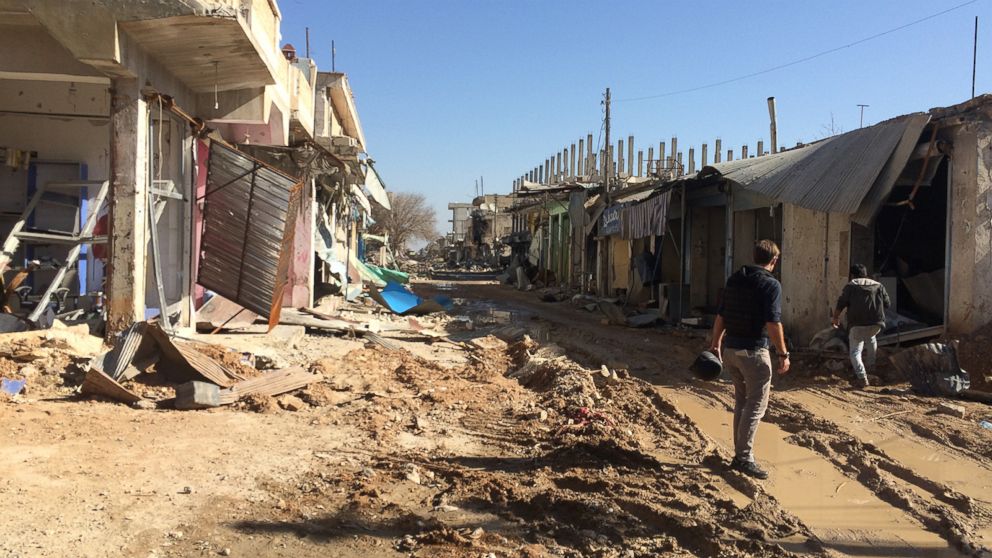
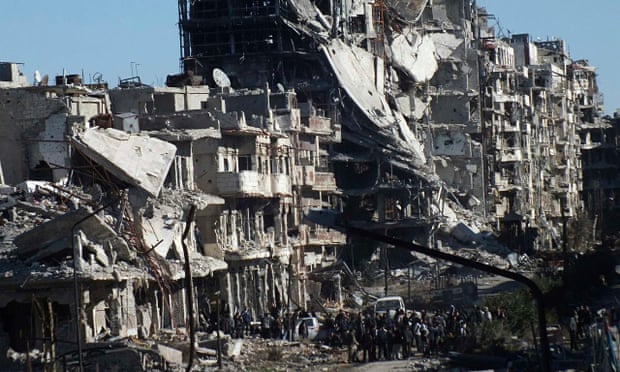
And here’s what victory turned out to look like: according to the Iraqi defense minister, at least 80% of the city of 400,000 was destroyed.  Rubblized.  Skeletized.  “City” may be what it’s still called, but it’s hardly an accurate description.  According to New York Times reporter Ben Hubbard, who visited Ramadi soon after the “victory,” few inhabitants remained.  Of an Iraqi counterterrorism general there with him, Hubbard wrote:
“In one neighborhood, he stood before a panorama of wreckage so vast that it was unclear where the original buildings had stood. He paused when asked how residents would return to their homes. ‘Homes?’ he said. ‘There are no homes.’”
Hubbard also cited the head of the Anbar provincial council as estimating that “rebuilding the city would require $12 billion.” (Other Iraqi officials put that figure at $10 billion.) That’s money no one has, including an Iraqi government increasingly strapped by plummeting oil prices — and keep in mind that that’s only a single destroyed community.  The earlier, smaller victories of the Kurds at Kobane and Sinjar in Syria, also backed by devastating U.S. air power, destroyed those towns in a similar fashion, as for instance has Bashar al-Assad’s barrel bombing air force and military in parts of the city of Aleppo and in the now thoroughly devastated city of Homs in central Syria.  The Russians have, of course, entered the fray, too, in the American style, bombing and advising.
Let’s add one more thing before we write our future headlines.  The day after President Obama gave his final State of the Union address, Secretary of Defense Ashton Carter visited the 101st Airborne Division at Fort Campbell, Kentucky.  Eighteen hundred of that division’s members are soon to be deployed to Iraq to aid Iraqi military units in their drive to retake parts of their country from the Islamic State.  For those future advisers, Carter elaborated on the president’s plans, laying out in some detail how he (and presumably Obama) saw the conflict playing out.  Favoring the image of the Islamic State as a metastasizing cancer, he said:
“The ISIL parent tumor has two centers — Raqqa in Syria, and Mosul in Iraq. ISIL has used its control of these cities and nearby territories as a power base from which to derive considerable financial resources, manpower, and ideological outreach. They constitute ISIL’s military, political, economic, and ideological centers of gravity. 
“That’s why our campaign plan’s map has got big arrows pointing at both Mosul and Raqqa. We will begin by collapsing ISIL’s control over both of these cities and then engage in elimination operations through other territories ISIL holds in Iraq and Syria.”
In fact, such a campaign would give “elimination operations” new meaning, since it would clearly involve quite literally eliminating the urban infrastructure of significant parts of the region.  Three cities are, in fact, at present targeted: Fallujah (population perhaps 300,000), the other major IS-controlled city in al-Anbar Province, Mosul (the second largest city in Iraq, with a population presently estimated at 1 to 1.5 million), and Raqqa, the Syrian “capital” of the Islamic State, now reportedly stuffed with refugees (population 200,000-plus).  Put them together and you have a 2016 plan for a U.S.-backed set of campaigns in Iraq and Syria based on the same formula as the taking of Ramadi: massive American air power in support of heavily trained and advised Iraqi special ops forces and army units or, in Syria, Kurdish peshmerga outfits and assorted Kurdish and Syrian rebels.  Add in the Islamic State’s urge to turn the urban areas it holds into giant bombs and what you have is a plan for the rubblization of yet more cities in the region.

There has, of course, been much talk about an offensive to retake Mosul since relatively small numbers of Islamic State fighters captured the city from tens of thousands of fleeing Iraqi troops in June 2014.  There was, for instance, a highly touted spring offensive against Mosul that was much discussed in early 2015 but never happened, so it’s impossible to be sure that the overstretched, generally underperforming Iraqi military will even make it to Mosul in 2016 or that there will be any non-American “boots” available to take Raqqa, especially since that city sits well outside any imaginable future Kurdistan. Still, assuming all went “well,” we essentially know what the future holds: Ramadi-style “victories.”
As a result, the end of the year headline for American/Iraqi/Kurdish/Syrian rebel operations — adapted from an infamous 1968 line by an anonymous American officer in Vietnam after U.S. planes had pummeled the provincial capital of Ben Tre — would be: “We Destroyed the Cities to Save Them.”

Based on Ramadi, you could then perhaps offer these “ballpark” (not that any stadiums would be left standing) future estimates for rebuilding: Falluja, $10 billion; Raqqa, $7 billion; Mosul, $20 to $25 billion. Those are obviously fantasy figures, but the point is that “success” against and “victory” over the Islamic State would undoubtedly leave much of the region a modern Carthage. And who would pay for a new Ramadi, or Mosul, or Fallujah, or Raqqa, no less all of them and more?

Put another way, “victory” would mean that Iraq will have far fewer habitable cities and a far larger number of displaced people whose resettlement will undoubtedly be subject to the ethnic tensions that helped fuel the Islamic State in the first place.  This represents a reasonably predictable future, one that should be obvious enough to anyone who took a half-serious look at the situation.  It certainly should be obvious to Ashton Carter, as well as to American planners at the Pentagon and in the Obama administration.  And yet the planning goes on as if “victory” were a meaningful category under the circumstances.

And here’s the thing: you can join the Islamic State in blowing up the physical plant of Syria and parts of Iraq and then eject its fighters from the rubble, but you’ll be destroying the means of existence of a vast, increasingly unsettled population.  What you may not be able to do in the process is destroy a movement that began in an American military prison in Iraq and has always been a set of ideas. You may simply create a legend.

Unleashing the Special Operators and the Drones

Now, let’s consider another set of potential future headlines linked to present planning and past experience.  Secretary of Defense Carter claims that the U.S. strategy against the Islamic State is focused on creating “sustainable political stability in the region,” by which he means not just the battlefields of Iraq and Syria, but all of the Greater Middle East.  As he said to the members of the 101st Airborne:
“Next, let me describe the fight outside of Iraq and Syria. As we work to destroy the parent tumor in Iraq and Syria, we must also recognize that ISIL is metastasizing in areas such as North Africa, Afghanistan, and Yemen. The threat posed by ISIL, and groups like it, is continually evolving, changing focus and shifting location. It requires from us, therefore, a flexible and nimble response with a broad reach.”
For this, he clearly plans to let loose American Special Operations forces not just in Syria but elsewhere on assassination missions against key Islamic State figures or those heading their distant franchises.  He’s also intent on sending in the drones across the region in “counter-terror operations and strikes on high-value targets” to “act decisively to prevent ISIL affiliates from becoming as great of a threat as the parent tumor itself.”

As with the future taking of cities in Iraq and Syria, there is an experiential baseline for such operations across the region.  In his book Kill Chain, Andrew Cockburn has called this approach to the enemy “the kingpin strategy.”  It was first used in the drug wars in Latin America and Central America in the 1990s and then, after 9/11, adapted to the weaponized drone and special operations forces.  The idea was to dismantle drug cartels or later terror outfits from the top down by taking out their leadership figures.

In fact, in both the drug wars and the terror wars, as Cockburn shows, the results of this strategy have been repetitiously calamitous.  The drone, for instance, has proven remarkably capable of “eliminating” both the top leadership of terror groups and key “lieutenants” as well as other influential figures in those organizations — with the grimmest results: under the pressure of the drones and those special ops raids, such organizations (like the drug cartels before them) simply replaced their dead leaders with often younger and even more aggressive figures, while attacks rose and the groups themselves, instead of folding up, spread across the Greater Middle East and deep into Africa.  The drones, bringing with them relatively widespread “collateral damage,” including the deaths of significant numbers of children, have terrorized the societies over which they cruise and so proved an ideal recruitment poster for those spreading terror groups.

Hence, first in the Bush era in a seat-of-the-pants way and then in the Obama years in a highly organized fashion, drone assassination campaigns in Pakistan, Afghanistan, Yemen, Iraq, Syria, Libya, and Somalia killed leadership figures while functionally helping to spread the terror organizations they directed.  They have, that is, been engaged not in a war on terror, but in a war for terror.  When you look at the expansion of those terror outfits, including the growing numbers of “franchises” of the Islamic State, it should be obvious that, from special ops missions to drone assassinations, from full-scale invasions to the destruction of cities, the 14-plus years of varied American strategies and military tactics have repetitively contributed to one horror after another, sucking much of the region into the vortex.

What’s striking when you listen to Secretary of Defense Carter is that, obvious as this may be, none of it seems to truly penetrate in Washington.  Otherwise how do you explain the lack of any serious recalibration of American actions, the only debate being between those in the Obama administration, including the president, who favor a version of mission creep and their Republican critics who favor doing more in a bigger way?  In other words, in 2016 we’re clearly going to witness further rounds of the utterly familiar with — somehow — the expectation that something different will happen.  Since that’s not likely, for the next set of future headlines just reach into the familiar past, substituting, when necessary, the future terror kingpin’s name: “AQAP [al-Qaeda on the Arabian Peninsula] announces death of [fill in name] in U.S. drone strike,” “U.S.: ISIS no. 2 killed in U.S. drone strike in Iraq,” “Army elite Delta Force kills top ISIS official, [fill in name], in daring Syria raid,” “Pentagon says senior al-Qaeda leader killed in drone strike,” and so on more or less ad infinitum.

The Arc of Instability

Recently, with Ashton Carter’s strategy for “stability” on my mind, I caught a phrase in a news report that I hadn’t heard for quite a while.  A journalist, perhaps on NPR, was discussing the recent al-Qaeda in the Islamic Maghreb (AQIM) terror attack on a hotel in Burkina Faso, a previously relatively stable country in West Africa, where at least 30 died, mainly foreigners.  He spoke of a spreading “arc of instability” in the region.

Back in the early years of the century, officials of the Bush administration and supportive neocons regularly used that phrase to describe the Greater Middle East, from Pakistan to North Africa. Strangely enough, it disappeared in the post-Iraqi invasion years and remained largely absent in the Obama years as the disastrous Libyan intervention, presidentially orchestrated drone assassination campaigns, and other actions helped further transform the Greater Middle East into a genuine “arc of instability.”

Today, in a way that would have been unimaginable back in 2002-2003, the region is filled with failing or failed states from Afghanistan and Syria to Libya, Yemen, and Mali.  While Iraq may not quite be a failed state, it is no longer exactly a country either, but something like a tripartite entity.  And so it goes, and so it evidently will go if the U.S., as in 2015, drops another 23,000 bombs and thousands of additional munitions on the region — or far more, as seems likely under the mission-creep pressure of the war with the Islamic State.

We can’t, of course, know just what countries will fail next.  However, it’s safe to assume that, as long as the Obama strategy — and the Hillary Clinton or Ted Cruz or Donald Trump or Marco Rubio one that may follow — involves more (or much more) of the same, more (or much more) of the same is likely to happen.  As a result, similar predictable headlines will appear, as countries dissolve in various ways and the Islamic State, groups like al-Qaeda in the Islamic Maghreb, or newly founded terror outfits gain footholds amid the chaos.  In that case, you only have to look into the recent past for headlines-to-come and adapt them slightly: “ISIS Is Building ‘Little Nests’ in [name of country here], U.S. Defense Secretary Warns,” “ISIS Is Gaining Ground in [name of country here], Competing with al-Qaeda,” “Islamic State Gained Strength in [name of country] by Co-opting Local Jihadists,“ and so on.

Amid the grimly predictable, there are, of course, many unknowns. Above all, we have no idea what it means at this point in history to turn a region, city by city, country by country, into something like a vast failed state and then continue to bomb the rubble.  How do we begin to imagine what could emerge from the ruins of such a failed region in such a world, from an arc of instability far vaster than anything we have contemplated since World War II?  I wouldn’t want to predict the headlines that could someday emerge from that situation, but whatever surprises are in store for us, the mere prospect of such a future should make your blood run cold.

Tom Engelhardt is a co-founder of the American Empire Project and the author of The United States of Fear as well as a history of the Cold War, The End of Victory Culture. He is a fellow of the Nation Institute and runs TomDispatch.com. His latest book is Shadow Government: Surveillance, Secret Wars, and a Global Security State in a Single-Superpower World.
Follow TomDispatch on Twitter and join us on Facebook. Check out the newest Dispatch Book, Nick Turse’s Tomorrow’s Battlefield: U.S. Proxy Wars and Secret Ops in Africa, and Tom Engelhardt’s latest book, Shadow Government: Surveillance, Secret Wars, and a Global Security State in a Single-Superpower World.
Copyright 2016 Tom Engelhardt
——-
Related video:

Rank and File Union Members of The International Association of Machinists and Aerospace Workers (IAM) Get Screwed By Union Leaders Supporting Neocon Hillary Clinton - Iran to buy 114 Airbuses to revamp aging fleet

BACKGROUND:

The International Association of Machinists and Aerospace Workers (IAM) announced Friday that it would endorse Hillary Clinton as its preferred Democratic presidential candidate. The machinists are now the third AFL-CIO union to endorse a candidate, following National Nurses United’s endorsement of Senator Bernie Sanders four days ago and the American Federation of Teachers’ Clinton endorsement on July 11.

WHY WOULD THE IRANIANS CHOOSE US AIRCRAFT WITH HILLARY CLINTON BEING SUPPORTED BY THE IAM?


Sunday, January 24, 2016

The Axis of Weasel - Turkey - Israel - Saudi Arabia and The Hub of The Wheel: The US Government and the CIA


Saudi Arabia, the CIA and the arming of Syrian rebels

US support for Syrian rebels is the latest chapter in its relationship with Saudi Arabia 

Saudi foreign minister Adel al-Jubeir  and US Secretary of State John Kerry: there has been a decades-long relationship between the spy services of Saudi Arabia and the United States. Photograph: Jacquelyn Martin/AFP/Getty Images
Saudi foreign minister Adel al-Jubeir and US Secretary of State John Kerry: there has been a decades-long relationship between the spy services of Saudi Arabia and the United States. Photograph: Jacquelyn Martin/AFP/Getty Images
When President Barack Obama secretly authorised the Central Intelligence Agency to begin arming Syria’s embattled rebels in 2013, the spy agency knew it would have a willing partner to help pay for the covert operation. It was the same partner the CIA has relied on for decades for money and discretion in far-off conflicts: the Kingdom of Saudi Arabia
Since then, the CIA and its Saudi counterpart have maintained an unusual arrangement for the rebel-training mission, which the Americans have code-named Timber Sycamore. Under the deal, current and former administration officials said, the Saudis contribute both weapons and large sums of money, and the CIA takes the lead in training the rebels on AK-47 assault rifles and tank-destroying missiles.
The support for the Syrian rebels is only the latest chapter in the decades-long relationship between the spy services of Saudi Arabia and the United States, an alliance that has endured through the Iran-Contra scandal, support for the mujahideen against the Soviets in Afghanistan and proxy fights in Africa. Sometimes, as in Syria, the two countries have worked in concert. In others, Saudi Arabia has simply written cheques underwriting US covert activities.
The joint arming and training programme, which other Middle East nations contribute money to, continues as America’s relations with Saudi Arabia – and the kingdom’s place in the region – are in flux. The old ties of cheap oil and geopolitics that have long bound the countries together have loosened as America’s dependence on foreign oil declines and the Obama administration tiptoes towards a diplomatic rapprochement with Iran
And yet the alliance persists, kept afloat on a sea of Saudi money and a recognition of mutual self-interest. In addition to Saudi Arabia’s vast oil reserves and role as the spiritual anchor of the Sunni Muslim world, the long intelligence relationship helps explain why the US has been reluctant to openly criticise Saudi Arabia for its human rights abuses, its treatment of women and its support for the extreme strain of Islam, Wahhabism, that has inspired many of the very terrorist groups the US is fighting. 
The Obama administration did not publicly condemn Saudi Arabia’s public beheading this month of a dissident Shia cleric, Sheikh Nimr al-Nimr, who had challenged the royal family.

Direct financial support

Although the Saudis have been public about their help arming rebel groups in Syria, the extent of their partnership with the CIA’s covert action campaign and their direct financial support had not been disclosed. Details were pieced together in interviews with a half-dozen current and former US officials and sources from several Persian Gulf countries. Most spoke on the condition of anonymity because they were not authorised to discuss the programme.
From the moment the CIA operation was started, Saudi money supported it. “They understand that they have to have us, and we understand that we have to have them,” said Mike Rogers, the former Republican congressman from Michigan who was chairman of the House Intelligence Committee when the CIA operation began. Rogers declined to discuss details of the classified programme.
US officials have not disclosed the amount of the Saudi contribution, which is by far the largest from another nation to the programme to arm the rebels against President Bashar al-Assad’s military. But estimates have put the total cost of the arming and training effort at several billion dollars.
The White House has embraced the covert financing from Saudi Arabia – and from QatarJordan and Turkey – at a time when Obama has pushed gulf nations to take a greater security role in the region. Spokesmen for both the CIA and the Saudi embassy in Washington declined to comment. When Obama signed off on arming the rebels in the spring of 2013, it was partly to try to gain control of the apparent free-for-all in the region. The Qataris and the Saudis had been funnelling weapons into Syria for more than a year. The Qataris had even smuggled in shipments of Chinese-made FN-6 shoulder-fired missiles over the border from Turkey.
The Saudi efforts were led by the flamboyant Prince Bandar bin Sultan, at the time the intelligence chief, who directed Saudi spies to buy thousands of AK-47s and millions of rounds of ammunition in Eastern Europe for the Syrian rebels. The CIA helped arrange some of the arms purchases for the Saudis, including a large deal in Croatia in 2012.

Cash and weapons

By the summer of 2012, a freewheeling feel had taken hold along Turkey’s border with Syria as the gulf nations funnelled cash and weapons to rebel groups – even some that US officials were concerned had ties to radical groups such as al-Qaeda. 
The CIA was mostly on the sidelines during this period, authorised by the White House under the Timber Sycamore training programme to deliver nonlethal aid to the rebels but not weapons. In late 2012, according to two former senior US officials, David H Petraeus, then the CIA director, delivered a stern lecture to intelligence officials of several gulf nations at a meeting near the Dead Sea in Jordan. He chastised them for sending arms into Syria without coordinating with one another or with CIA officers in Jordan and Turkey.
Months later, Obama gave his approval for the CIA to begin directly arming and training the rebels from a base in Jordan, amending the Timber Sycamore programme to allow lethal assistance. Under the new arrangement, the CIA took the lead in training, while Saudi Arabia’s intelligence agency, the General Intelligence Directorate, provided money and weapons, including TOW anti-tank missiles.
The Qataris have also helped finance the training and allowed a Qatari base to be used as an additional training location. But US officials said Saudi Arabia was by far the largest contributor to the operation. 
While the Saudis have financed previous CIA missions with no strings attached, the money for Syria comes with expectations, current and former officials said. “They want a seat at the table, and a say in what the agenda of the table is going to be,” said Bruce Riedel, a former CIA analyst and now a senior fellow at the Brookings Institution
The CIA training programme is separate from another programme to arm Syrian rebels, one the Pentagon ran that has since ended. That programme was designed to train rebels to combat Islamic State fighters in Syria, unlike the CIA’s programme, which focuses on rebel groups fighting the Syrian military.

Supporting terror

While the intelligence alliance is central to the Syria fight and has been important in the war against al-Qaeda, a constant irritant in US-Saudi relations is just how much Saudi citizens continue to support terrorist groups, analysts said. 
“The more that the argument becomes, ‘We need them as a counterterrorism partner,’ the less persuasive it is,” said William McCants, a former state department counterterrorism adviser and the author of a book on Islamic State. “If this is purely a conversation about counterterrorism cooperation, and if the Saudis are a big part of the problem in creating terrorism in the first place, then how persuasive of an argument is it?”
In the near term, the alliance remains solid, strengthened by a bond between spy masters. Prince Mohammed bin Nayef, the Saudi interior minister who took over the effort to arm the Syrian rebels from Prince Bandar, has known the CIA director, John O Brennan, from the time Brennan was the agency’s Riyadh station chief in the 1990s. Former colleagues say the two men remain close, and Prince Mohammed has won friends in Washington with his aggressive moves to dismantle terrorist groups like al-Qaeda in the Arabian Peninsula.
The job Brennan once held in Riyadh is, more than the ambassador’s, the true locus of US power in the kingdom. Former diplomats recall that the most important discussions always flowed through the CIA station chief. Current and former intelligence officials say there is a benefit to this communication channel: the Saudis are far more responsive to US criticism when it is done in private, and this secret channel has done more to steer Saudi behaviour toward America’s interests than any public chastising could have.
The roots of the relationship run deep. In the late 1970s, the Saudis organised what was known as the “Safari Club” – a coalition of nations including MoroccoEgypt and France – that ran covert operations around Africa at a time when Congress had clipped the CIA’s wings over years of abuses.
“And so the kingdom, with these countries, helped in some way, I believe, to keep the world safe at a time when the United States was not able to do that,” Prince Turki al-Faisal, a former head of Saudi intelligence, recalled in a speech at Georgetown University in 2002.
In the 1980s, the Saudis helped finance CIA operations in Angola, where the United States backed rebels against the Soviet-allied government. While the Saudis were staunchly anticommunist, Riyadh’s primary incentive seemed to be to solidify its CIA ties. “They were buying good will,” recalled one former senior intelligence officer who was involved in the operation.
In perhaps the most consequential episode, the Saudis helped arm the mujahideen rebels to drive the Soviets out of Afghanistan. The US committed hundreds of millions of dollars each year to the mission, and the Saudis matched it, dollar for dollar.
The money flowed through a CIA-run Swiss bank account. In the book Charlie Wilson’s War, the journalist George Crile III describes how the CIA arranged for the account to earn no interest, in keeping with the Islamic ban on usury. In 1984, when the Reagan administration sought help with its secret plan to sell arms to Iran to finance the Contra rebels in Nicaragua, Robert C McFarlane, the national security adviser, met with Prince Bandar, who was the Saudi ambassador to Washington at the time. The White House made it clear that the Saudis would “gain a considerable amount of  favour” by cooperating, McFarlane later recalled.
Prince Bandar pledged $1 million a month to help fund the Contras, in recognition of the administration’s past support to the Saudis. The contributions continued after Congress cut off funding to the Contras. By the end, the Saudis had contributed $32 million, paid through a Cayman Islands bank account.
When the Iran-Contra scandal broke, and questions arose about the Saudi role, the kingdom kept its secrets. Prince Bandar refused to cooperate with the investigation led by Lawrence E Walsh, the independent counsel. In a letter, the prince declined to testify, explaining that his country’s “confidences and commitments, like our friendship, are given not just for the moment but the long run”. – New York Times

After the Ass-stabbing Turks shot down a Russian plane, Russia deployed its cutting-edge air defense systems, S-400s, to an air base near Latakia: It looks as if Turkey stabbed itself in the ass.


Turkey-Russia Tensions Spike as Russia moves into Northern Syria

By Juan Cole | (Informed Comment) | – –

Russian air strikes in Syria are coming closer and closer to the Turkish border in Latakia in the northwest, and there are rumors that Russia is looking at establishing an airbase at Qamishli in the largely Kurdish northeast of Syria. Turkey risks having Russia as a neighbor all along the Syrian border to Turkey’s south, as well as beyond the Black Sea to its north.

Turkish President Tayyip Erdogan said at a news conference, “We have said this from the beginning: we won’t tolerate such formations (in northern Syria) along the area stretching from the Iraqi border up to the Mediterranean. . .”

Over on the Mediterranean side, Russian air strikes have enabled the Syrian Arab Army of the Bashar al-Assad regime to move back into northern Latakia Province, taking a large number of villages in the far northern areas of Turkmen Mountain and Kurd Mountain. 

The strategic city of Rabia was surrounded on three sides by government troops.

Syrian government sources maintained that 150 rebels had been killed in the fighting, including guerrillas of the Nusra Front, while others had fled across the border into Turkey.

It was to protect the anti-regime Turkmen fighters of Turkmen mountain that last fall the Turkish air force shot a Russian fighter jet out of the air. 

The SAA has also retaken Salma in the east of Latakia Province. Salma had been in rebel hands for 3 years and is in higher land and so was a useful way for the rebels to dominate the surrounding area.

Russian strategy since last October has been to intervene from the air to give courage to the Syrian troops and allow them to push back the rebels from the key port city of Latakia in the province of the same name. The al-Qaeda-allied Army of Conquest (Jaysh al-Fateh) has the neighboring province of Idlib to the east and has a key position in Jisr al-Shughour, a town in the highlands overlooking Latakia from which an assault could easily be launched. One of the Army of Conquest coalition partners is the Nusra Front or the Support Front, the chief al-Qaeda franchise in Syria, which reports to Ayman al-Zawahiri (one of the masterminds of the 9/11 attacks on the US).

The Nusra Front has been flooding fighters also into northern, mountainous Latakia, where Turkmen villages are split, with about half in the ranks of the anti-regime rebels. Turkmen speak a language close to Turkish and came into the Arab world as nomads from the 8th century forward, originating in Inner Asia.

The Syrian Arab Army on Friday made substantial advances in Turkmen Mountain in the far north of Latakia Province near the Turkish border, taking numerous villages and expelling al-Qaeda and allied fighters. This drive to reestablish regime control so close to the Turkish border has alarmed the Turkish government, which had been arming and supporting the rebellious Turkmen.

As of Friday, Turkey’s proxies seemed to be losing very badly, and it is unclear what options Ankara now has except Erdogan’s bluster.
——

Saturday, January 23, 2016

America’s Mercenary Army Making US More Unsafe on a Daily Basis


The Pentagon’s Progress
Will American “Successes” Lead to More Iraqi Military Failures? 

By Nick Turse
 Tom’s Dispatch
There’s good news coming out of Iraq... again. The efforts of a 65-nation coalition and punishing U.S. airstrikes have helped local ground forces roll back gains by the Islamic State (IS). 
Government forces and Shiite militias, for example, recaptured the city of Tikrit, while Kurdish troops ousted IS fighters from the town of Sinjar and other parts of northern Iraq. Last month, Iraqi troops finally pushed Islamic State militants out of most of the city of Ramadi, which the group had held since routing Iraqi forces there last spring.
In the wake of all this, Secretary of Defense Ashton Carter touted “the kind of progress that the Iraqi forces are exhibiting in Ramadi, building on that success to… continue the campaign with the important goal of retaking Mosul as soon as possible.”  Even more recently, he said those forces were “proving themselves not only motivated but capable.”  I encountered the same upbeat tone when I asked Colonel Steve Warren, a U.S. military spokesman in Baghdad, about the Iraqi security forces.  “The last year has been a process of constructing, rebuilding, and refitting the Iraqi army,” he explained. “While it takes time for training and equipping efforts to take effect, the increasing tactical confidence and competence of the ISF [Iraqi security forces] and their recent battlefield successes indicate that we are on track.”
“Progress.”  “Successes.”  “On track.”  “Increasing tactical confidence and competence.”  It all sounded very familiar to me.

By September 2012, after almost a decade at the task, the U.S. had allocated and spent nearly $25 billion on “training, equipping, and sustaining” the Iraqi security forces, according to a report by the Special Inspector General for Iraq Reconstruction.  Along the way, a parade of generals, government officials, and Pentagon spokesmen had offered up an almost unending stream of good news about the new Iraqi Army.  Near constant reports came in of “remarkable,” “big,” even “enormous” progress for a force that was said to be exuding increasing “confidence,” and whose performance was always improving.  In the end, the U.S. claimed to have trained roughly 950,000 members of the “steady,” “solid,” Iraqi security forces.
And yet just two and a half years after the U.S. withdrawal from Iraq, that same force collapsed in spectacular fashion in the face of assaults by Islamic State militants who, by CIA estimates, numbered no more than 31,000 in all.  In June 2014, for example, 30,000 U.S.-trained Iraqi troops abandoned their equipment and in some cases even their uniforms, fleeing as few as 800Islamic State fighters, allowing IS to capture Mosul, the second largest city in the country. 
Blaming the Victim
“When U.S. forces departed Iraq in 2011, it was after helping the Iraqi government create an entirely new Iraqi Security Force following the fall of Saddam Hussein's regime,” Major Curtis Kellogg, a spokesman with U.S. Central Command, explained to me last year.  It almost sounded as if the old regime had toppled of its own accord, a new government had arisen, and the U.S. had generously helped build a military for it.  In reality, of course, a war of choice -- based on trumped up claims of nonexistent weapons of mass destruction -- led to a U.S. occupation and the conscious decision to dissolve Iraqi autocrat Saddam Hussein’s military and create a new army in the American mold.  “[T]he Iraqi security forces were a fully functioning element of the Iraq Government,” Kellogg continued, explaining how such an Iraqi military collapse could occur in 2014.  “However, the military standards established and left in place were allowed to atrophy following the departure of U.S. troops.” 
More recently, Colonel Steve Warren brought up another problem with Iraq’s forces in an email to me.  “The Iraqi army that we left in 2011 was an army that had been trained for counterinsurgency. That means route clearance, checkpoint operations, and IED [improvised explosive device] reduction, for example.  The Iraqi army that collapsed in 2014 was... not trained and... not ready for a conventional fight -- the conventional assault that ISIL brought to Mosul and beyond.”
Both Kellogg and Warren stopped short of saying what seems obvious to many.  Kalev Sepp, the adviser to two top American generals in Iraq and a former deputy assistant secretary of defense for special operations and counterterrorism, shows no such hesitation. “We had 12 years to train the Iraqi Army... We failed.  It’s obvious.  So when this lightly-armed insurgent group, the so-called Islamic State, invaded the country, the Iraqi army collapsed in front of it.” 
It’s taken billions of dollars and a year and a half of air strikescommando raids, advice, and training to begin to reverse the Islamic State’s gains.  According to Warren, the U.S. and its partners have once again trained more than 17,500 ISF troops, with another 2,900 currently in the pipeline.  And once again we’re hearing about their successes. Secretary of Defense Carter, for example, called the fight for Ramadi “a significant step forward in the campaign to defeat this barbaric group,” while Secretary of State John Kerry claimed the Islamic State had “suffered a major defeat” there. 
Still, the tiny terror group seems to have no difficulty recruiting new troops, is ramping up attacks in the district of Haditha, carrying out complex attacks in Baghdad and the town of Muqdadiya, and continues to hold about 57,000square miles of Syrian and Iraqi territory, including Mosul. With questions already being raised by Pentagon insiders about just how integral the Iraqi security forces were to the retaking of Ramadi and doubts about their ability to clear cities like Mosul, it’s worth taking a look back at all those upbeat reports of “progress” during the previous U.S. effort to build an Iraqi Army from scratch. 
Nothing “Succeeds” Like “Success” 
After the U.S. toppled Saddam Hussein's government in April 2003 as part of Operation Iraqi Freedom, the Bush administration began remaking the battered nation from the ground up.  One of the first acts of L. Paul Bremer III, the top American civilian official in the occupied country, was to dissolveIraq’s military.  His plan: to replace Saddam Hussein’s 350,000-man army with a lightly armed border protection force that would peak at around 40,000 soldiers, supplemented by police and civil defense forces.  In an instant, hundreds of thousands of well-trained soldiers were unemployed, providing a ready source of fighters for a future insurgency.
"In less than six months we have gone from zero Iraqis providing security to their country to close to a hundred thousand Iraqis... Indeed, the progress has been so swift that... it will not be long before [the Iraqi security forces] will... outnumber the U.S. forces,” Secretary of Defense Donald Rumsfeld suggested in a cheery assessment in October 2003. 
Major General Paul Eaton, tasked with rebuilding the Iraqi Army, similarly articulated his upbeat vision for the force.  Schooled by Americans in “fundamental soldier and leadership skills” and outfitted with all the accoutrements of modern Western troops, including body armor and night-vision equipment, the new military would be committed to “defend[ing] Iraq and its new-found freedom,” he announced at a Baghdad briefing in January 2004.  Soon, Iraqis would even take over the task of instruction.  “I would like to emphasize that this will be an Iraqi Army, trained by Iraqis," he said. "As Iraq is reborn,” he added, “we believe that her armed forces can lead the way in unifying" the country. 
“Paul Eaton and his team did an extraordinary amount for the Iraqi Security Force mission,” his successor Lieutenant General David Petraeus would say a couple of years later.  “They established a solid foundation on which we were able to build as the effort was expanded very substantially and resourced at a much higher level."
Retired Special Forces officer Kalev Sepp, who traveled to Iraq as an adviser five times, had a different assessment. “General Eaton was direct in letting me know that he wanted to be remembered as the father of the new Iraqi Army,” he told me. “I thought his approach was conceptually wrong,” Sepp recalled, noting that Eaton “understood his mission was to create an army to defend Iraq from foreign invasion, but he completely overlooked the internal insurgency.” (A request to interview Eaton, sent to the American Security Project, a Washington D.C.-based think tank with which the retired general is affiliated, went unanswered.) 
General Eaton would later blame the Bush administration for initial setbacks in the performance of the Iraqi Army, thanks to poor prewar planning and insufficient resources for the job.  "We set out to man, train, and equip an army for a country of 25 million -- with six men," General Eaton told the New York Times in 2006.  He did, however, accept personal responsibility for the most visible of its early failures, the mutiny of a freshly minted Iraqi battalion en route to its first battle in April 2004.
In the years that followed, America’s Iraq exploded into violence as Sunni and Shiite militants battled each other, the U.S. occupiers, and the U.S.-backed Baghdad government.  On the fly, U.S. officials came up with new plans to build a large, conventional, heavily armed force to secure Iraq in the face of sectarian strife, multiple raging insurgencies, and ultimately civil war.  “The Iraqi military and police forces expanded rapidly from 2004 to 2006, adapting to the counterinsurgency mission,” according to a report by the U.S. Special Inspector General for Iraq Reconstruction.  As chaos spread and death tolls rose, estimates of the necessary numbers of Iraqi troops, proposals concerning the right types of weapons systems for them, and training stratagems for building the army were amended, adjusted, and revised, again and again.  There was, however, one constant: praise. 
In September 2005, as violence was surging and more than 1,400 civilians were being killed in attacks across the country, General George W. Casey Jr., commander of Multinational Force-Iraq, reported that the security forces were "progressing and continuing to take a more prominent role in defending their country."  He repeatedly emphasized that training efforts were on track -- a sentiment seconded by Defense Secretary Rumsfeld.  “Every single day, the Iraqi security forces are getting bigger and better and better trained and better equipped and more experienced,” he said.
“I think we did a very effective job of training the Iraqi military recruits that were brought to us,” Casey told me last year, reflecting on U.S. efforts during his two and a half years in command.  The trouble, he said, was with the Iraqis.  “The political situation in Iraq through 2007 and even to this day is such that the leadership of the Iraqi government and the military never could instill the loyalty of the troops in the government.”
At the time, however, American generals emphasized progress over problems.  After Petraeus finished his own stint heading the training effort, he was effusive in his praise. “The bottom line up front that I'd like to leave with you today is that there has been enormous progress with the Iraqi security forces over the course of the past 16 months in the face of a brutal insurgency,” he boasted in October 2005, adding that “considerable work” still lay ahead. “Iraqi security force readiness has continued to grow with each passing week.  You can take a percentage off every metric that's out there, whatever you want -- training, equipping, infrastructure reconstruction, units in the fight, schools, academies reestablished -- you name it -- and what has been accomplished... would still be remarkable.”  (Messages seeking an interview sent to Petraeus at Kohlberg, Kravis, Roberts & Co., the investment firm where he serves as chairman of the KKR Global Institute, were not answered.) 
In November 2005, President Bush voiced the same sentiments.  “As the Iraqi security forces stand up, their confidence is growing,” he told midshipmen at the Naval Academy.  “And they're taking on tougher and more important missions on their own.”  By the following February, General Peter Pace, chairman of the Joint Chiefs of Staff, was similarly lauding that military, claiming “the progress that they've made over this last year has been enormous.”
The next month, Lieutenant General Martin Dempsey, who succeeded Petraeus as commander of the Multinational Security Transition Command-Iraq (MNSTC-I) and later served as chairman of the Joint Chiefs, chimed inwith glowing praise: “What we're seeing now is progress on a three-year investment in Iraq's security forces.  It's been a big investment, and it's yielding big progress.”
I asked retired Army Colonel Andrew Bacevich, a professor of history and international relations emeritus at Boston University’s Pardee School of Global Studies, how so many American officials could have seen so much progress from a force that would later collapse so rapidly and spectacularly.  “I think there’s a psychological need to see progress and, of course, it’s helpful to parrot the party line.  I do think that, psychologically, you need to be able to persuade yourself that your hard-earned efforts -- this time spent away from home in lousy conditions -- actually produced something positive.”
Kalev Sepp, who traveled all over Iraq talking to the commanders of more than 30 U.S. units while conducting a seminal counterinsurgency study known simply as the “COIN Survey,” told me that when he asked about the progress of the Iraqi units they were working with, U.S. officers invariably linked it to their own tour of duty. “Almost every commander said exactly the same thing.  If the commander had six months left in his tour, the Iraqis would be combat-capable in six months.  If the commander had four months left, then the Iraqis would be ready in four months.  Was a commander going to say ‘I won’t accomplish my mission.  I’m not going to be done on time'?  All the other units were saying their Iraqis were going to be fully trained.  Who was going to be the one commander who said ‘I don’t think my Iraqi unit is really ready’?”
Official praise continued as insurgencies raged across the country and monthly civilian death tolls regularly exceeded 2,000, even topping 3,000 in 2006 and 2007.  “The Iraqi security force continues to develop and grow, assisted by embedded transition teams,” Lieutenant General Ray Odierno, commander of the Multinational Corps-Iraq, announced to the press in May 2007.  “Yes, there are still problems within the Iraqi security forces -- some sectarian, some manning, and some to do with equipping.  But progress is being made, and it's steady.”  A 2008 Pentagon review also indicatedremarkable progress with 102 out of 169 Iraqi battalions being declared “capable of planning, executing, and sustaining counterinsurgency operations with or without Iraqi or coalition support,” up from just 24 battalions in 2005.
Years later, Odierno, still in charge of the command, then known as United States Forces-Iraq, continued to tout improvement.  “Clearly there's still some violence, and we still need to make more progress in Iraq," he told reporters in July 2010. "But Iraqi security forces have taken responsibility for security throughout Iraq, and they continue to grow and improve every day.” 
The Special Inspector General for Iraq Reconstruction, Stuart Bowen, was also upbeat, noting in 2010 that the $21.3 billion already spent to build up the then-660,000-man security force had “begun to pay off significantly.”  Don Cooke, head of the State Department's Iraq assistance office, agreed.  “We have built an Iraqi security force which is capable of maintaining internal security in Iraq... And four or five or six years ago, there were people who were saying it was going to take decades." 
In October 2011, as U.S. forces were preparing to end eight years of occupation, Secretary of Defense Leon Panetta offered up his own mission-accomplished assessment.  “You know, the one thing... we have seen is that Iraq has developed a very good capability to be able to defend itself.  We've taken out now about a hundred thousand [U.S.] troops [from Iraq], and yet the level of violence has remained relatively low.  And I think that's a reflection of the fact that the Iraqis have developed a very important capability here to be able to respond to security threats within their own country,” he said of the by then 930,000-man security forces.
Winners and Losers
As the U.S. was training recruits at bases all over Iraq -- including Camp Bucca, where Iraqi cadets attended a U.S.-run course for prison guards -- another force was also taking shape.  For years, U.S.-run prison camps were decried by many as little more than recruiting and training sites for would-be insurgents, with innocents -- angered by arbitrary and harsh detentions -- housed alongside hardcore militants.  But Camp Bucca proved to be even more dangerous than that.  It became the incubator not just for an insurgency, but for a proto-state, the would-be caliphate that now lords over significant portions of Iraq and neighboring Syria.   
Nine top commanders of the Islamic State did prison time at America’s Camp Bucca, including Abu Bakr al-Baghdadi, the group’s leader who spent nearly five years there.  “Before their detention, Mr. al-Baghdadi and others were violent radicals, intent on attacking America,” Andrew Thompson, an Iraq War veteran, and academic Jeremi Suri wrote in a 2014 New York Times piece. “Their time in prison deepened their extremism and gave them opportunities to broaden their following... The prisons became virtual terrorist universities: The hardened radicals were the professors, the other detainees were the students, and the prison authorities played the role of absent custodian.”
So how could U.S. officials have so successfully (if inadvertently) fostered the leadership of what would become a truly effective fighting force that would one day best the larger, far more intensively trained, better-armed military they had built to the tune of tens of billions of dollars?  “The people we imprisoned didn’t leave with skills when they finally got out of prison, but they did leave with will,” says Andrew Bacevich.  “What we were doing was breeding resentment, anger, determination, disgust, which provided the makings of an army that turns out to be more effective than the Iraqi Army.”
General George Casey, who went on to serve as Army Chief of Staff before retiring in 2011, sees the failure of Iraq’s Shiite government to reach out to minority Sunnis as the main driver of the collapse of significant portions of the country’s army in 2014.  “You hear all kinds of reasons why the Sunni forces [of the Iraqi military] ran out of Mosul, but it wasn’t a surprise to any of us who had been over there.  If your country doesn’t support what you’re doing, there’s no reason to fight for them,” Casey explained in a phone interview last year.  “People probably give short shrift to what we in the military call ‘the will to fight.’  When it comes right down to it, that’s what it’s all about.  And we can’t instill the will to fight in the heart of a soldier from another country.  We just can’t do it.”
“We can talk about how appalling Daesh is,” adds Kalev Sepp, using the Arabic acronym for the Islamic State, “but their fighters believe in what they’re doing and that adds a particular steel to one’s backbone.”  Bacevich, who has recently finished writing a military history, America’s War for the Greater Middle East, echoed this sentiment, noting the stark difference between U.S.-trained Iraqi forces and their brutal opponents.  “Whatever else we may think of ISIS, their forces appear to be keen to fight and willing to die in order to promote their cause.  The same cannot be said of the Iraqi Army.”
And yet, in the wake of the implosion of Iraq’s security forces, the United States -- as part of Operation Inherent Resolve, its campaign against IS -- began a new advisory and training effort to assist and re-rebuild Iraq’s army.  In June 2014, President Obama announced that up to 300 advisors would be sent to Iraq.  The size of the U.S. presence has increased steadily ever since to roughly 3,500. 
“As per policy we do not disclose specific numbers of troops and their roles,” Colonel Warren, the U.S. military spokesman in Baghdad, explained to me.  He did, however, note that there are approximately 5,500 Coalition personnel from 17 partner nations including the United States conducting advise and assist missions and training at “Building Partner Capacity sites.” 
Despite the poor results of the prior training effort, even some of its critics are hopeful that the current mission may succeed.  “American advisors could have a positive effect,” Sepp, now a senior lecturer in defense analysis at the Naval Postgraduate School, told me.  He explained that a pinpoint mission of training Iraqis to take back a particular city or defend a specific area stands a real chance of success.  Casey, his former boss, agreed but insisted that such success would not come easily or quickly.  “This is going to take a long time.  This is not a short-term thing.  People want to see ISIS defeated -- whatever that means -- quickly.  But it’s not going to be ‘quickly’ because the problems are political more than military and that’s going to take the Iraqis some time to come to grips with.”
Doomed to Repeat It?
History suggests that time is no panacea when Washington attempts to prop up, advise, or build armies.  In the early 1950s, the U.S. provided extensive support to the French military in Indochina -- eventually footing nearly 80% of the cost of its war there -- only to see that force defeated by a less advanced, less well-equipped Vietnamese army.  Not long after, the U.S. began an expensive process that continued into the mid-1970s of building, advising, equipping, and bankrolling the South Vietnamese military.  In those years, it ballooned into a million-man army, only to disintegrate two years after the U.S. ended its own long, unsuccessful combat effort in that country. 
“The assumption that we know how to create armies in other parts of the world is a pretty dubious proposition,” Andrew Bacevich, a veteran of that war, told me.  “Yes, Vietnam was a vivid demonstration of a failed project to build an effective army, but you don’t even have to cite Vietnam.  Iraq obviously is another case.  And more generally, the Pentagon exaggerates its ability to create effective fighting forces in parts of the developing world.” 
Indeed, recent U.S. training efforts around the globe have been marked by a string of scandals, setbacks, and failures.  Last year, for example, the Obama administration scrapped a $500 million program to train anti-Islamic State Syrian rebels.  It was supposed to yield 15,000 fighters over three years but instead produced only a few dozen.  Then there’s the 13-year$65 billion effort in Afghanistan that has yielded a force whose rolls are filled with nonexistent “ghost” troops, wracked by desertions, and hobbled by increasing casualties.  It has been unable to defeat a small, unpopular, Taliban insurgency now growing in strength and reach. The short-term loss by U.S.-backed Afghan forces of the city of Kunduz late last year and recent Taliban gains in Helmand province have cast a bright light on this slow-motion fiasco.  
These efforts have hardly been anomalies. A U.S.-trained Congolese commando battalion was, for example, implicated by the United Nations in mass rapes and other atrocities.  One effort to train Libyan militiamen ended up stillborn; another saw militants repeatedly raid a U.S. training camp and loot it of high-tech equipment, including hundreds of weapons; and still another saw advisers run out of the country by a militia soon after touching down. Then there were the U.S.-trained officers who overthrew their governments in coups in Mali in 2012 and Burkina Faso in 2014.  In fact, a December 2015 report by the Congressional Research Service noted:
“Recent events, particularly the battle between the Afghan government and the Taliban over K[u]nduz, the inability of [Department of Defense]-led efforts to produce more than a ‘handful’ of anti-Assad, anti-Islamic State (IS) forces in Syria, and the collapse of U.S.-trained forces in Iraq in the face of the Islamic State, have called into question -- including in the Congress -- whether these [building partner capacity] programs can ever achieve their desired effects.”
Despite all of this, the Pentagon remains committed to creating another Iraqi Army in the American mold with, as Colonel Warren recently explained to me, “modern American equipment, modern conventional training, and of course, supported by air power.”  The U.S. has, he notes, already spent $2.3 billion arming and equipping this new force. 
Andrew Bacevich once again sees crucial flaws in the American plan.  “Our trainers, I suspect, are probably pretty good at imparting technical skills... I’m sure that they can teach them marksmanship, how to conduct a patrol, how to maintain their weapons, but I can’t imagine that we have much of a facility for imparting fighting spirit, sense of national unity, and that’s where Iraqi forces have been deficient. It’s this will versus skill thing.  We can convey skills.  I don’t think we can convey will.”
For his part, Secretary of Defense Carter seems singularly focused on the skills side of the equation. “ISIL’s lasting defeat still requires local forces to fight and prevail on the ground.  We can and will continue to develop and enable such local forces,” he told the House Armed Services Committee in June 2015.  “That’s why [the Department of Defense] seeks to bolster… Iraq’s security forces to be capable of winning back, and then defending and holding the ISIL-controlled portions of the Iraqi state.”  Last month, Carter assured the Senate Armed Services Committee that he was still “urging the Iraqi government to do more to recruit, train, arm, and mobilize Sunni popular mobilization fighters in their communities.”
This presumes, however, that there is a truly functioning Iraqi state in the first place.  Andrew Bacevich isn’t so sure.  “It may be time to admit that there is no Iraq.  We presume to be creating a national army that is willing to fight for the nation of Iraq, but I don’t think it’s self-evident that Iraq exists, except in the most nominal sense.  If that’s true, then further efforts -- a second decade’s worth of efforts to build an Iraqi army -- simply are not likely to pan out.” 
Nick Turse is the managing editor of TomDispatch and a fellow at the Nation Institute. He is the author, most recently, of Tomorrow's Battlefield: U.S. Proxy Wars and Secret Ops in Africa, as well as Kill Anything That Moves: The Real American War in Vietnam. He has written for the New York Times, the Los Angeles Times, and the Nation, and is a contributing writer for the Intercept.