“Soft despotism is a term coined by Alexis de Tocqueville describing the state into which a country overrun by "a network of small complicated rules" might degrade. Soft despotism is different from despotism (also called 'hard despotism') in the sense that it is not obvious to the people."
Trump understands Poland is leader in Central Europe: Polish president
05.07.2017 11:48
US President Donald Trump is coming to Warsaw on Wednesday because he understands Poland is a leader in Central Europe, Polish President Andrzej Duda has said.
Andrzej Duda. Photo: PAP/Jacek Turczyk
“For our country, President Trump's visit is really extremely important. I would even say that if one looks at the context of the whole situation, it cannot be ruled out that it will be of a historical nature as a whole,” Duda said in an interview with the PAP news agency.
Duda said: “We are simply an important country in this part of the world. We are one of the bigger European countries, we are a leader in Central Europe and that is why President Trump is coming to us, because he sees that and understands that.”
Duda told PAP that among the issues he aimed to discuss with Trump was energy security “and therefore also a future contract with some US entity, with a supplier of LNG gas.
“The first delivery has already been made, and it was a test. It arrived, it was introduced to our LNG terminal, so it is possible, feasible... for a long-term contract to be struck.”
Poland entitled to aid because of history, party leader says
Kaczynski says Poland has never given up claims on war damages
Poland’s ruling party hardened its position against refugees, saying the nation’s past, including the Nazi invasion in World War II, give it a moral claim to continue to receive European Union development funds regardless of its stance on immigrants.
Jaroslaw Kaczynski, head of the ruling Law & Justice Party and the power behind Prime Minister Beata Szydlo’s government, also said Poland had a right to assistance because it opened its markets to richer Western economies before joining the EU in 2004.
Speaking at his party’s conference in the central Polish town of Przysucha on Saturday before this week’s visit by U.S. President Donald Trump, Kaczynski doubled down on an anti-refugee message that has worsened ties with Brussels while helping revive flagging support at home. Already facing criticism that his government is backsliding on democracy, Kaczynski rejected suggestions by western leaders, including French President Emmanuel Macron, that EU members may suffer economic consequences if they don’t uphold the bloc’s values.
“We appreciate EU funds very much, as they’ve enabled much needed investments, but the fact that we appreciate them doesn’t mean that we lose rights to our views on historical and economic context,” Kaczynski told about 1,000 party members to loud applause. “Poland was the first country that opposed Nazi Germany, followed by the invasion of the totalitarian Soviet regime. Have we been compensated for that? No.”
The country of 38 million people is by far the biggest recipient of EU funds, with it set to get more than 250 billion euros ($286 billion). That’s the equivalent in today’s dollars of more than the U.S.-funded Marshall Plan provided to all of western Europe after World War II.
Halfway through its four-year term, Law & Justice has renewed its vow to “protect” Poles from immigration and keep them safe from terrorist attacks. It has rejected a plan under which its predecessor agreed to host about 7,000 immigrants from the Middle East and Africa to help tackle the worst migration crisis since World War II.
‘Social Disaster’
“Nobody will force us to accept a social disaster because we receive EU funds,” Kaczynski said. “You all know I’m talking about immigrants who are flooding Europe. There’s no reason for us to lower our standard of life.”
Combined with generous social handouts to parents with multiple children and a pledge to return Poland to its Catholic roots, the anti-immigration pledge has kept the party atop opinion polls. It had support of 42 percent of voters, compared with 21 percent for the biggest opposition party, the Civic Platform, according to a June 8 survey by CBOS.
The stance hasn’t come without consequences. The European Commission has launched infringement procedures against Poland, Hungary and the Czech Republic for rejecting refugee quotas, highlighting a divide in the 28-member trading bloc after anti-immigrant political parties lost French, Dutch and Austrian elections earlier this year.
Questioning EU solidarity may turn out to be short-sighted if the conflict in Ukraine escalates and Poland needs help to cope with a real flood of refugees, according to Ryszard Schnepf, Poland’s former ambassador in the U.S from 2012 to 2016.
“Reheating the issue of war damages, even if meant for domestic political consumption, is dangerous as it may open Pandora’s box,” Schnepf said on Monday. “What if the other side starts questioning post-war treaties with Poland?”
Polish Truckers
Finance Minister Mateusz Morawiecki, who’s in charge of economic policy, also criticized comments last week from Macron, who scolded some eastern members for treating the EU as a “supermarket” by accepting aid but not upholding all of its ideals.
Morawiecki, an advocate of a bigger state role in the economy, said richer countries can’t complain that cheap Polish workers have entered their markets when their businesses operate in Poland and crowd out local competitors. He has orchestrated the “repolonization” of the nation’s banks, buying the nation’s second-biggest lender from Italy’s UniCredit SpA in a deal that was completed last month.
“There are many Polish truck drivers in parking lots near Paris or Amsterdam, but there are also many French supermarkets, Dutch banks, and media companies controlled by Germans on the streets of Polish towns,” Morawiecki said, to loud applause. “We would eagerly swap.”
Before it's here, it's on the Bloomberg Terminal.LEARN MORE
Pat Buchanan: 'Are we passing on the house we inherited – or observing its demolition?'
INDEPENDENCE DAY
In the first line of the Declaration of Independence of July 4, 1776, Thomas Jefferson speaks of “one people.” The Constitution, agreed upon by the Founding Fathers in Philadelphia in 1789, begins, “We the people …”
And who were these “people”?
In Federalist No. 2, John Jay writes of them as “one united people … descended from the same ancestors, speaking the same language, professing the same religion, attached to the same principles of government, very similar in their manners and customs. …”
If such are the elements of nationhood and peoplehood, can we still speak of Americans as one nation and one people?
We no longer have the same ancestors. They are of every color and from every country. We do not speak one language, but rather English, Spanish and a host of others. We long ago ceased to profess the same religion. We are evangelical Christians, mainstream Protestants, Catholics, Jews, Mormons, Muslims, Hindus and Buddhists, agnostics and atheists.
Federalist No. 2 celebrated our unity. Today’s elites proclaim that our diversity is our strength. But is this true, or a tenet of trendy ideology?
After the attempted massacre of Republican congressmen at that ball field in Alexandria, Fareed Zakaria wrote: “The political polarization that is ripping this country apart” is about “identity … gender, race, ethnicity, sexual orientation (and) social class.” He might have added – religion, morality, culture and history.
Zakaria seems to be tracing the disintegration of our society to that very diversity that its elites proclaim to be its greatest attribute: “If the core issues are about identity, culture and religion … then compromise seems immoral. American politics is becoming more like Middle Eastern politics, where there is no middle ground between being Sunni or Shiite.”
Among the issues on which we Americans are at war with one another – abortion, homosexuality, same-sex marriage, white cops, black crime, Confederate monuments, LGBT rights, affirmative action.
Was the discovery of America and conquest of this continent from 1492 to the 20th century among the most glorious chapters in the history of man? Or was it a half-millennium marked by mankind’s most scarlet of sins: the genocide of native peoples, the enslavement of Africans, the annihilation of indigenous cultures, the spoliation of a virgin land?
Is America really “God’s Country”? Or was Barack Obama’s pastor, Rev. Jeremiah Wright, justified when, after 9/11, he denounced calls of “God Bless America!” with the curse “God Damn America!”?
With its silence, the congregation seemed to assent.
In 1954, the Pledge of Allegiance many of us recited daily at the end of noon recess in the schoolyard was amended to read, “one nation, under God, indivisible.”
Are we still one nation under God? At the Democratic Convention in Charlotte to renominate Barack Obama, a motion to put “God” back into the platform was hooted and booed by half the assembly.
With this July 4 long weekend, many writers have bewailed the animus Americans exhibit toward one another and urged new efforts to reunite us. Yet, recall again those first words of Jefferson in 1776:
“When in the Course of human events it becomes necessary for one people to dissolve the political bands which have connected them …”
Are we approaching such a point? Could the Constitution, as currently interpreted, win the approval of two-thirds of our citizens and three-fourth of our states, if it were not already the supreme law of the land? How would a national referendum on the Constitution turn out, when many Americans are already seeking a new constitutional convention?
All of which invites the question: Are we still a nation? And what is a nation? French writer Ernest Renan gave us the answer in the 19th century:
“A nation is a soul, a spiritual principle. Two things … constitute this soul, this spiritual principle. One is the past, the other is the present. One is the possession in common of a rich legacy of memories; the other is present consent, the desire to live together, the desire to continue to invest in the heritage that we have jointly received.
“Of all cults, that of the ancestors is the most legitimate: our ancestors have made us what we are. A heroic past with great men and glory … is the social capital upon which the national idea rests. These are the essential conditions of being a people: having common glories in the past and a will to continue them in the present; having made great things together and wishing to make them again.”
Does this sound at all like us today?
Watching our Lilliputians tearing down statues and monuments, renaming buildings and streets, rewriting history books to replace heroes and historical truths with the doings of ciphers, are we disassembling the nation we once were?
“One loves in proportion to the sacrifices that one has committed and the troubles that one has suffered,” writes Renan, “One loves the house that one has built and that one passes on.”
Are we passing on the house we inherited – or observing its demolition?
Pat Buchanan was twice a candidate for the Republican presidential nomination and the Reform Party's candidate in 2000. He is also a founder and editor of The American Conservative. Buchanan served three presidents in the White House, was a founding panelist of three national TV shows, and is the author of 11 books. His latest book is "Nixon's White House Wars."
Sunday on “Fox & Friends Weekend,” conservative talk show host Mark Levin criticized progressivism, saying the “entire progressive moment rejects the Declaration of Independence.”
Levin went on to explain that progressives believe that rights come from the government, adding that those who fought in the Revolution would be “appalled” by people with the same mindset as Sen. Bernie Sanders (I-VT).
“You can’t have health care unless the government controls it and redistributes it. You can’t have education unless the government controls it and redistributes it. It’s nonsense,” he argued.
FILE PHOTO: U.S. President Donald Trump arrives at the Leonardo da Vinci-Fiumicino Airport in Rome, Italy, May 23, 2017. REUTERS/Remo Casilli/File Photo Reuters
By Justyna Pawlak
WARSAW (Reuters) - A trip to Poland by U.S. President Donald Trump next week may feel like a diplomatic coup for the right-wing government, but western European nations are uneasy it will encourage Warsaw's defiance towards Brussels.
Trump visits Poland for one day - en route to a G20 summit in Hamburg, Germany - to take part in a gathering of leaders from central Europe, Baltic states and the Balkans, an event convened by Poland to bolster regional trade and infrastructure.
Brussels diplomats view the July 6 gathering, dubbed the Three Seas summit because the countries involved border the Baltic, Black and Adriatic seas, as a Polish bid to carve out influence outside the European Union with which the nationalist government has repeatedly clashed.
Trump plans to promote U.S. natural gas exports to the leaders from central and eastern Europe, a region heavily reliant on Russian supplies, his top economic adviser said. Poland received its first shipment of U.S. liquefied natural gas (LNG) this month.
Most diplomats in Brussels dismiss the importance of the Three Seas project, co-hosted by Croatia, but are wary over Trump's high-profile visit to participate in a project one senior EU official called Poland's push towards "self-ghettoisation".
"One cannot but feel a bit suspicious if it isn't an attempt to break up European unity," another EU diplomat said about the Three Seas project.
Poland's ruling Law and Justice (PiS) party has played a major role in fuelling a deepening rift between ex-communist and Western members of the European Union, at a time when the bloc is struggling with the aftermath of Britain's decision to leave.
Since winning a parliamentary election in 2015, the PiS has angered France over a canceled army procurement deal, brought relations with Germany to their worst in nearly a decade, and is facing EU action over what critics call its authoritarian tilt.
Poland is one of the leading voices in the region against migration, a view it shares with Trump alongside a disregard for climate change and suspicion of international bodies.
"A MADNESS OF ELITES"
Underscoring Warsaw's mistrust towards the EU, Prime Minister Beata Szydlo recently called an EU quotas policy for relocation of refugees from the Middle East "a madness of Brussels elites", in a speech in parliament.
In turn, EU leaders delivered a snub to Poland's government by steamrolling its objections and reappointing former Polish premier Donald Tusk to chair summits. Szydlo, acting on orders from party boss and long-time Tusk adversary Jaroslaw Kaczynski, had vowed to stop him securing a second 30-month term.
Warsaw portrayed the issue as one of fundamental principle, in which vital national interests had been ignored by a Brussels machine dominated by "German diktat". Its crushing defeat showed how far the biggest of the ex-communist states that joined the EU after the Cold War appears isolated, even in Eastern Europe.
Deeply distrustful of Moscow, Poland hopes Trump, who once called NATO "obsolete", will reconfirm his commitment to the alliance's military build-up in eastern Europe, a deterrence policy against Russia, and possibly promise more.
The United States has about 900 troops on Polish soil as part of a rotating NATO contingent in eastern Europe.
NATO AND TRUMP
But Western diplomats are wary that Trump could use his trip to Warsaw to repeat criticism of Europe's low defense spending, which has irritated many Western leaders.
Trump denounced some NATO members' failure to meet a joint target of two percent of economic output, at a meeting of alliance leaders in Brussels last month. Poland, alongside the United States, is one of the few members who meet the goal.
"We are not sure what Trump's message is going to be ... If he is here to reinforce Washington's commitment to (NATO's mutual defense principle)? Great!," one EU diplomat said.
"What if he makes it conditional, to be based on meeting the ... spending goal? This would cause a lot of damage."
Diplomatic observers who watch Washington say Trump may want to use the trip to deliver a message that he is serious about countering threats from Russia.
"Most of the countries (at the Warsaw summit) see Russia as their main security threat and most strongly support NATO and would like a stronger U.S. force presence in their countries," said Heather Conley, who was a State Department official in the George W. Bush administration.
"GET OUT AND TRAVEL"
Some western European officials view Trump's nod to the Warsaw government as counter-productive at a time when European unity is wavering.
"We encourage Mr Trump to get out and travel as much as he can. He needs to understand Europe and he can do that by getting out and speaking to people, to European leaders," said one European official, who declined to be named.
"(But) he can't do deals with individual countries over the head of the European Union," he said. "In Hamburg, he will hear different arguments, we can clear up anything that has been misconstrued."
Poland has expressed hopes Trump can persuade U.S. business to invest in a network of north-south rail and road links central to the regional initiative, something U.S. diplomats and many economists dismiss as unrealistic.
Much commerce in eastern Europe is done along east-west trade routes rather than between north and south, to a large degree a reflection of German economic dominance.
Some governments in the east may also view Poland's ambitions of regional leadership with suspicion, cautious not to damage relations with trade partners in Berlin.
"We are monitoring it," said a Czech government source. "But we don't put much weight on it at the moment."
(Additional reporting by Pawel Sobczak in Warsaw, Alastair Macdonald and Robin Emmott in Brussels, Michel Rose in Paris, and Roberta Rampton in Washington, editing by Peter Millership)
A Replacement of Population is Taking Place in Europe
by Giulio Meotti
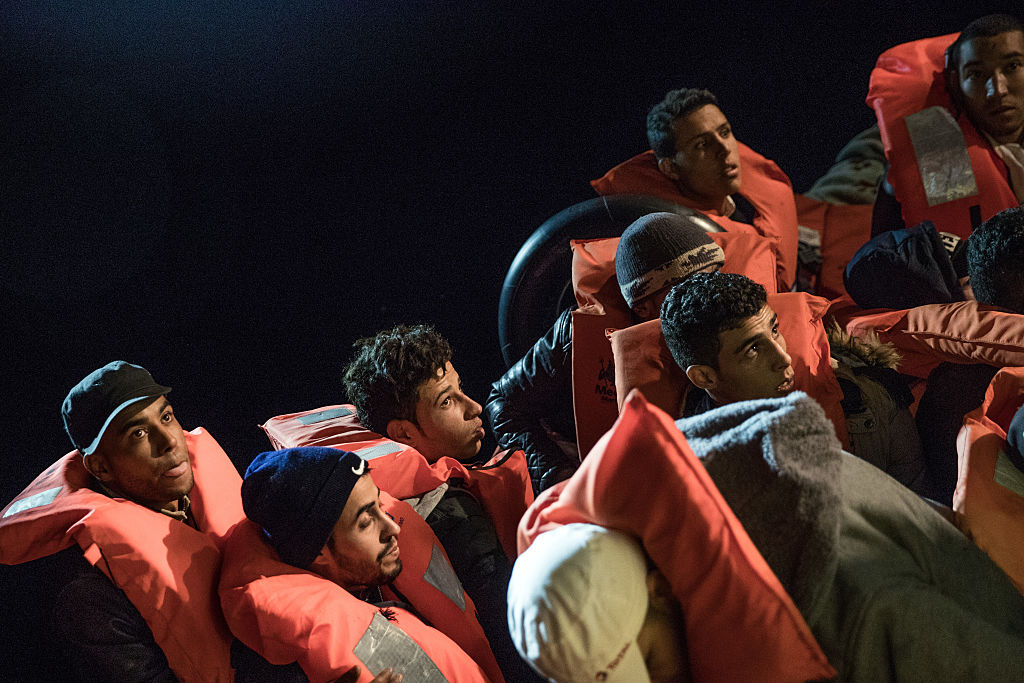
First, it was the Hungarian route. Then it was the Balkan route. Now Italy is the epicenter of this demographic earthquake, and it has become Europe's soft underbelly as hundreds of thousands of migrants arrive.
With nearly 10,000 arrivals in one recent three-day period, the number of migrants in 2017 exceeded 60,000 -- 48% more than the same period last year, when they were 40,000. Over Easter weekend a record 8,000 migrants were rescued in the Mediterranean and brought to Italy. And that is just the tip of the iceberg: during the summer, the number of arrivals from Libya will only increase.
A wooden boat carrying migrants waits to be escorted to the Topaz Responder vessel, as members of the Migrant Offshore Aid Station make a rescue at sea on November 21, 2016 in Pozzollo, Italy. (Photo by Dan Kitwood/Getty Images)
A replacement of population is under way in Italy. But if you open the mainstream newspapers, you barely find these figures. No television station has dedicated any time to what is happening. No criticism is allowed. The invasion is considered a done deal.
In 2016, 176,554 migrants landed in Italy -- an eight-fold increase since 2014. In 2015, there were 103,792. In 2014, there were 66,066. In 2013, there were just 22,118. In the last four years, 427,000 migrants reached Italy. In only the first five months of this year, 2017, Italy received 10% of the total number of migrants of the last four years.
There are days when the Italian navy and coast guard rescue 1,700 migrants in 24 hours. The country is exhausted. There are Italian villages where one-tenth of the population is already made up of new migrants. We are talking about small towns of 220 residents and 40 migrants.
One of the major aspects of this demographic revolution is that it is taking place in a country which is dramatically aging. According with a new report from the Italian Office of Statistics, Italy's population will fall to 53.7 million in half a century -- a loss of seven million people. Italy, which has one of the world's lowest fertility rates, will lose between 600,000 to 800,000 citizens every year. Immigrants will number more than 14 million, about one-fourth of the total population. But in the most pessimistic scenario, the Italian population could drop to 46 million, a loss of 14 million people.
In 2050, a third of Italy's population will be made up of foreigners, according to a UN report, "Replacement Migration: Is It a Solution to Decline and Aging Populations", which designs a cultural melting-pot that could explode in cultural and social tensions. The level of arrivals will fall from 300,000 to 270,000 individuals per year by 2065; during the same period, it is expected that 14.4 million people will arrive. Added to the more than five million immigrants currently in Italy, 37% of the population is expected to be foreigners: more than one out of every three inhabitants.
In addition, the humanitarian-aid system has been hit by new scandals. "The investigative hypothesis to be verified is that subjects linked to ISIS act as logistical support to migration flows", was a warning just delivered in front of the Schengen Committee, to the Italian anti-mafia and counterterrorism prosecutor, Franco Roberti. There are now judges investigating the connection between the migrants' smugglers in North Africa and the Italian NGOs rescuing them in the Mediterranean. People-smugglers bring the migrants to the NGOs' ships, which then reach Italian seaports. Another legal enquiry has been opened about the mafia's economic interests in managing the migrants after their arrival.
Only 2.65 percent of those migrants who arrived in Italy were granted asylum as genuine refugees, according to the United Nations. The other people are apparently not fleeing wars and genocide. Yet, despite all this evidence, one cannot compare the migrants to the Jews fleeing Nazism. Pope Francis, for example, recently compared the migrants' centers to Nazi "concentration camps". One wonders where are the gas chambers, medical "experiments," crematoria, slave labor, forced marches and firing squads. Italian newspapers are now running articles about the "Mediterranean Holocaust", comparing the migrants dead by trying to reach the southern of Italy to the Jews gassed in Auschwitz. Another journalist, Gad Lerner, to support the migrants, described their condition with the same word coined by the Nazis against the Jews: untermensch, inferior human beings. These comparisons are spread by the media for a precise reason: shutting down the debate.
To understand how shameful these comparisons are, we have to take a look at the cost of every migrant to Italy's treasury. Immigrants, once registered, receive a monthly income of 900 euros per month (30 euros per day for personal expenses). Another 900 euros go to the Italians who house them. And 600 euros are needed to cover insurance costs. Overall, every immigrant costs to Italy 2,400 euros a month. A policeman earns half of that sum. And a naval volunteer who saves the migrants receives a stipend of 900 euros a month. Were the Nazis so kind with their Jewish untermenschen?
The cost of migrants on Italy's public finances is already immense and it will destroy the possibility of any economic growth. "The overall impact on the Italian budget for migrant spending is currently quantified at 2.6 billion [euros] for 2015, expected to be 3.3 billion for 2016 and 4.2 for 2017, in a constant scenario", explains the Ministry of the Economy. If one wants to put this in proportion, these numbers give a clearer idea of how much Italy is spending in this crisis: in 2017, the government is spending 1.9 billion euros for pensions, but 4.2 billion euros for migrants, and 4.5 billion euros for the national housing plan against 4.2 billion euros for migrants.
The Italian cultural establishment is now totally focused on supporting this mass migration. The Italian film nominated at the Academy Awards last year is Fire at Sea, in which the main character is a doctor treating the migrants upon their arrival. Italian Prime Minister Matteo Renzi carried with him 27 DVDs of the film to a session of the European Council. Italy's commercial television channels produced many television programs about the migrants, such as "Lampedusa", from the name of the Italian island. 100,000 Italians even took the streets of Milan for a "rally of solidarity" with the migrants. What "solidarity" can there be if half a million people have been rescued by the Italian government and the whole country seems determined to open its doors to all of North Africa?
Winston Churchill was convinced that the Mediterranean was the "soft underbelly" of Hitler's Europe. It has now become the soft underbelly of Europe's transformation into Eurabia.
Giulio Meotti, Cultural Editor for Il Foglio, is an Italian journalist and author.
The Superiority of Western Values in Eight Minutes
By: Ibn Warraq
In a public debate in London against Tariq Ramadan, Ibn Warraq was given eight minutes to argue the superiority of Western values. Here is his defense of the West, which forms the basis for his new book,
Why the West is Best: A Muslim Apostate’s Defense of Liberal Democracy.
The great ideas of the West—rationalism, self-criticism, the disinterested search for truth, the separation of church and state, the rule of law, equality before the law, freedom of conscience and expression, human rights, liberal democracy—together constitute quite an achievement, surely, for any civilization. This set of principles remains the best and perhaps the only means for all people, no matter what race or creed, to live in freedom and reach their full potential.[1] Western values—the basis of the West’s self-evident economic, social, political, scientific and cultural success—are clearly superior to any other set of values devised by mankind. When Western values have been adopted by other societies, such as Japan or South Korea, their citizens have reaped benefits.
Life, liberty, and the pursuit of happiness: this triptych succinctly defines the attractiveness and superiority of Western civilization.
In the West we are free to think what we want, to read what we want, to practice our religion, to live as we choose. Liberty is codified in human rights, a magnificent Western creation but also, I believe, a universal good. Human Rights transcend local or ethnocentric values, conferring equal dignity and value on all humanity, regardless of sex, ethnicity, sexual preference, or religion. At the same time, it is in the West that human rights are most respected.
It is the West that has liberated women, racial minorities, religious minorities, and gays and lesbians, recognizing their rights. The notions of freedom and human rights were present at the dawn of Western civilization, as ideals at least, but have gradually come to fruition through supreme acts of self-criticism. Because of its exceptional capacity for self-criticism, the West took the initiative in abolishing slavery; the calls for abolition did not resonate even in black Africa, where rival African tribes took black prisoners to be sold as slaves in the West.
Today, many non-Western cultures follow customs and practices that are clear violations of the Universal Declaration of Human Rights (1948). In many countries, especially Islamic ones, you are not free to read what you want. Under sharia, or Islamic law, women are not free to marry whom they wish, and their rights of inheritance are circumscribed. Sharia, derived from the Koran and the practice and sayings of Muhammad, prescribes barbaric punishments such as stoning to death for adultery. It calls for homosexuals and apostates to be executed. In Saudi Arabia, among other countries, Muslims are not free to convert to Christianity, and Christians are not free to practice their faith. The Koran is not a rights-respecting document.
Under Islam, life is a closed book. Everything has been decided for you, the dictates of sharia and the whims of Allah set strict limits on the possible agenda of your life. In the West, we have the choice to pursue our desires and ambitions. We are free as individuals to set the goals and determine the contents of our own lives, and to decide what meaning to give to our lives. As Roger Scruton remarks, “The glory of the West is that life is an open book.”[2] The West has given us the liberal miracle of individual rights and responsibility and merit. Rather than the chains of inherited status, Western societies offer unparalleled social mobility. The West, Alan Kors writes, “is a society of ever richer, more varied, more productive, more self-defined, and more satisfying lives.”[3]
Instead of the mind-numbing certainties and dictates of Islam, Western civilization offers what Bertrand Russell called liberating doubt.[4] Even the process of politics in the West involves trial and error, open discussion, criticism, and self-correction.[5] This quest for knowledge, no matter where it leads, a desire inherited from the Greeks, has produced an institution that is rarely equaled outside the West: the university. And the outside world recognizes this superiority of Western universities. Easterners come to the West to learn not only about the sciences developed in the last five hundred years, but also about their own cultures, about Eastern civilizations and languages. They come to Oxford and Cambridge, to Harvard and Yale, to Heidelberg and the Sorbonne to acquire their doctorates because these degrees confer prestige unrivalled by similar credentials from Third World countries.
Western universities, research institutes, and libraries are created to be independent institutions where the pursuit of truth is conducted in a spirit of disinterested inquiry, free from political pressures. The basic difference between the West and the Rest might be summed up as a difference in epistemological principles. Behind the success of modern Western societies, with their science and technology, and their open institutions, lies a distinct way of looking at the world, interpreting it, and rectifying problems: by lifting them out of the religious sphere and treating them empirically, finding solutions in rational procedures. The whole edifice of modern science is one of Western man’s greatest gifts to the world.[6] The West is responsible for almost every major scientific discovery of the last 500 hundred years, from heliocentrism and the telescope, to electricity, to computers.
The West has given the world the symphony and the novel. A culture that engendered the spiritual creations of Mozart and Beethoven, Wagner and Schubert, of Raphael and Michelangelo, Leonardo Da Vinci and Rembrandt does not need lessons in spirituality from societies whose vision of heaven resembles a cosmic brothel stocked with virgins for men’s pleasure.
The West gave us the Red Cross, Doctors without Borders, Human Rights Watch, Amnesty International and many other manifestations of the humanitarian impulse. It is the West that provides the bulk of the aid to beleaguered Darfur, while Islamic countries are conspicuous by their absence.
The West does not need lectures on the superior virtue of societies where women are kept in subjection, endure genital mutilation, are married off against their will at the age of nine, have acid thrown on their faces or are stoned to death for alleged adultery, or where human rights are denied to those regarded as belonging to lower castes.[7] The West does not need sanctimonious homilies from societies that cannot provide clean drinking water or sewage systems for their populations, that cannot educate their citizens, but leave 40-50 percent of them illiterate, that make no provisions for the handicapped, that have no sense of the common good or civic responsibility, that are riddled with corruption.
No Western politician would be able to get away with the kind of racist remarks that are tolerated in the Third World, such as the anti-Semitic diatribes of the Malaysian leader Mahathir Mohamad. Instead, there would be calls for resignation, both from Third World leaders and from Western media and intellectuals. Double standards? Yes, but also a tacit acknowledgement that we expect higher ethical standards from the West.
The Ayatollah Khomeini once famously said there are no jokes in Islam. The West is able to look at its own foibles and laugh, even make fun of its own fundamental principles. There is no Islamic equivalent to Monty Python’s Life of Brian. Can we look forward to seeing The Life of Mo anytime in the future?
The rest of the world recognizes the virtues of the West in concrete ways. As Arthur Schlesinger remarked, “When Chinese students cried and died for democracy in Tiananmen Square, they brought with them not representations of Confucius or Buddha but a model of the Statue of Liberty.”[8] Millions of people risk their lives trying to get to the West—not to Saudi Arabia or Iran or Pakistan. They flee from theocratic or other totalitarian regimes to find tolerance and freedom in the West, where life is an open book.
[1]Bruce Thornton. “Golden Threads: Former Muslim Ibn Warraq Stands Up for the West,” City Journal, August 17, 2007.
[2] Roger Scruton. “The Glory of the West is that Life is an Open Book,” Sunday Times, May 27, 2007.
[4] Bertrand Russell, The Problems of Philosophy, London: Williams & Norgate, [Ist edn.1912] Chapter XV.
[5] Roger Scruton, “The Defense of the West,” A Lecture given at the Columbia Political Union, New York, Thursday, April 14th, 2005.
[6] Caroline Cox & John Marks, The ‘West’, Islam and Islamism: Is Ideological Islam Compatible with Liberal Democracy? (London: Civitas, 2003) pp.12-13.
[7] A.M.Schlesinger, Jr. The Disuniting of America. Reflections on a Multicultural Society ( New York: Norton, 1992) p.128.
Silvio Berlusconi, 80, is set for an astonishing comeback after sweeping election victories for Italy's right-wing, as critics admit the former prime minister is 'politically immortal'
Italy's right-wing parties won 16 out of 22 cities in Sunday's local elections
Berlusconi's Forza Italia and the far-right Northern League dominated
It positions the former Prime Minister as a kingmaker in Italian politics
Berlusconi was forced out six years ago after a sex scandal
Published: 10:26 EDT, 26 June 2017 | Updated: 20:42 EDT, 26 June 2017
Italy's right celebrated Monday after big victories in local elections, with all eyes on a potential comeback for former prime minister Silvio Berlusconi - just months before the country holds national elections.
The 80-year-old billionaire's Forza Italia (Go Italy) party and the far-right Northern League won 16 of the 22 cities up for grabs Sunday.
Their victory was a shock setback for the governing centre-left Democratic Party.
Berlusconi's Forza Italia and the far-right Northern League dominated the local elections
The loss of the city of Genoa was a particularly big blow. The northern city has traditionally been a bastion of the left, but it passed to the centre-right for the first time.
Former centre-left prime minister Matteo Renzi, dismissed the wins as having little bearing on national voter sentiment.
But the mood on the left was sombre. Editorialist Riccardo Barenghi wrote in the left-leaning Italian newspaper La Stampa that it 'couldn't have gone worse'.
He added: 'Not just for Matteo Renzi, not just for the [Democratic Party]. But for the whole of the Italian left.'
'[It was] as if we'd gone back 23 years to when the left was beaten by the Cavaliere ('The Knight', Berlusconi's nickname), who appeared on the scene like a rabbit from a magician's hat, and today reappears like a castigating ghost.'
The next general election must be held by spring 2018, but the coalition supporting Prime Minister Paolo Gentiloni is fragile and many experts say the government could call elections for late in the year.
Left-leaning Italian newspaper La Stampa that it 'couldn't have gone worse' for the left
At the national level, the PD and the populist Five Star Movement (M5S) are running neck-and-neck in the polls, each with about 30 percent of voter intentions, while Forza Italia and the Northern League are each hovering at around 14 percent.
Political commentator Stefano Folli called Sunday's results 'a searing and very painful loss for the left.'
He wrote in the left-leaning La Republica: 'Berlusconi reveals himself to be politically immortal.
Berlusconi, 80, had been largely absent from politics - though not the gossip pages - following his ousting in 2011 and his party had since struggled with internal divisions and corruption scandals.
TO SURVIVE ITALY MUST TURN RIGHT: Lefties always have no sympathy for their own national needs
THE EU POLITICAL CLASS ( This video will be too much for most progressives and political cowards to endure)
 Andrzej Duda. Photo: PAP/Jacek Turczyk