COLLECTIVE MADNESS


“Soft despotism is a term coined by Alexis de Tocqueville describing the state into which a country overrun by "a network of small complicated rules" might degrade. Soft despotism is different from despotism (also called 'hard despotism') in the sense that it is not obvious to the people."

Sunday, May 18, 2014

On Second Thoughts: Vietnam smothered anti-China protests on Sunday with a massive security clampdown after deadly riots triggered by a territorial dispute with Beijing spooked investors and the country's authoritarian leadership alike.


China evacuates 3,000 nationals from Vietnam as conflict simmers
Vietnamese government clamps down on demonstrations after attacks on Chinese and other foreign businesses

China has evacuated more than 3,000 of its nationals from Vietnam, state media reported on Sunday, after a wave of anti-China unrest following Beijing's deployment of an oil rig in contested waters.
But the anti-China protests planned for Sunday in Ho Chi Minh City, originally sanctioned by the Vietnamese government, were quickly stopped by scores of uniformed and secret police.
Armed with batons and walkie talkies, they contained the small group of protesters holding up notebook-sized banners reading "Vietnam is small but no coward" and chanting "Vietnam! Vietnam!".
About 15-20 demonstrators were seen to be detained and pushed into unmarked vans.
The government has been sending daily text messages to all mobile phone users in Vietnam, urging them to exercise restraint and not engage in violent behaviour. The latest message, sent on Sunday, warned citizens against joining in the planned protests.
The Vietnamese government is obviously keen to control the situation – Chinese-Vietnamese trade is worth some $50b – but much of the damage may have already been done. In Ho Chi Minh City's Chinese-majority District 5, shopkeepers have begun dismantling, or covering up, any Chinese characters on their storefronts, out of fear that the anti-China aggression may turn directly on them.
"The government sent us a letter telling us to do this," said Van Vuy, the manager of a silkscreen-printing business. "I don't want to, but the owner is scared of what might happen if we don't."
The evacuees "returned to China with the assistance of [the] Chinese embassy to Vietnam," Xinhua news agency said, citing China's foreign ministry.
The Chinese government was also arranging for a chartered plane and vessel to evacuate the staff of China 19th Metallurgical Corporation, a contractor of one of the plants badly hit by the recent violence, Agence France-Presse reported, citing Xinhua.
In a later update the agency reported: "Sixteen critically injured Chinese nationals were evacuated from Vietnam early on Sunday morning aboard a chartered medical flight arranged by [the] Chinese government."
It did not specify which company they were working for.
On Sunday China dispatched a further five ships to speed up the evacuation of its citizens, the Associated Press reported. The first ship left on Sunday morning from the southern island of Hainan, Xinhua said.
Beijing on Saturday advised its nationals against travelling to Vietnam, which has seen its worst anti-China unrest in decades over the past week, AFP reported.
China's positioning of an oil rig in waters also claimed by Vietnam in the South China Sea has ignited long-simmering enmity between the two communist neighbours.
Demonstrations spread to 22 of Vietnam's 63 provinces in the last week, according to the Vietnamese government, with enraged mobs torching foreign-owned factories.
Hong Kong also updated its travel advisory on Saturday, warning its residents to avoid "non-essential travel" to Vietnam.
On Saturday Xinhua reported that security chief Guo Shengkun had spoken to his Vietnamese counterpart and urged the authorities there to quell the violence. Xinhua also said commerce minister Gao Hucheng had called on officials to "bring relevant issues under control".
An alliance of 20 vocal Vietnamese NGOs has called for fresh protests in Hanoi, Ho Chi Minh City and other areas against China's "aggressive actions" in the South China Sea.
However, it urged participants to remain peaceful following the chaos on Tuesday and Wednesday.
"Those violent actions created a bad image for patriotic demonstrations and the people of Vietnam; therefore, they must be stopped," said a statement issued on social media late on Friday.
The alliance largely comprises anti-government organisations and is believed to have played a role in stirring the recent protests.
The oil-rig confrontation is the latest to spark alarm among China's south-east Asian neighbours, which complain of increasing maritime intimidation by Beijing.

China claims nearly all of the South China Sea, which is believed to hold significant offshore energy reserves.

A real conservative would ask questions like: What about the suspension of habeas corpus and other constitutional rights that the Lincoln administration inflicted on American citizens, even in states that had not seceded, during the War Between the States? What about the government-incited attacks on German Americans and their property that began even before President Wilson managed to get us into WWI?


Why Does Jonah Goldberg Want To Block The Backlash Against Political Correctness?
By Paul Gottfried on May 17, 2014

Whenever I read a syndicated column by Jonah Goldberg that touches on the historical past, I expect to find nothing of substance. And I’m rarely disappointed. A widely-featured mouthpiece of Conservatism, Inc., Jonah has about the same relation to historical erudition that Jay Z has to Mozart’s minuets: a bit less than none. In Jonah’s latest pronouncement, he tries to block the growing backlash to rampant Political Correctness:
[I]t’s good to understand that things have been worse than they are today. There’s a tendency to think our government has only become more intrusive and censorial than ever. That’s simply untrue.
Last, we should be wary of thought-crime panics.
Again, things are not nearly so bad as when Wilson’s Attorney General Mitchell A. Palmer [sic—he means Alexander Mitchell Palmer] set about to eradicate the ‘disease of evil thinking.’ That’s a pretty low bar for an open and tolerant society.”
[Be wary of thought-crime panics, May 7, 2014. Links added.]
Although two of Goldberg’s heartthrobs, former secretary of state Condoleezza Rice and Somali feminist Ayaan Hirsi Ali, were recently disinvited by universities as speakers, even these horrors, Jonah inform, should not occasion the outrage we should feel for those attacks on (mostly) foreign residents unleashed by the notorious “Palmer Raids.”
It’s not surprising that Jonah should single out the Palmer Raids as the non plus ultra of American political intolerance. He has simply internalized the Leftist indoctrination given to his generation—which is a particularly necessary professional qualification for Conservatism Inc. apparatchiks, who (I have long argued) are basically Judas goats, leading the faithful to accept liberalism.
A real conservative would ask questions like:
Whoops, I forgot! Those were outrages that Jonah’s neoconservative patrons approve, Therefore they are not as worthy of condemnation as the Palmer Raids (which could also well have targeted his patrons’ Leftist forebears).
The Palmer Raids took place for about three months, between November 1919 and January 1920, with presidential and congressional authorization. No doubt they did involve excesses, but they seem on their face to have been far more justified than the assaults on war-opponents and German Americans that took place before and during World War I and World War II.
In 1919, thirty bombs were sent to government officials by Anarchists, led by an Italian radical who was then resident in the US, Luigi Galleani. Agents of the Soviet Comintern were active in the US and Western Europe openly inciting violent revolution—and making no pretense about what they were doing.
In the end, Palmer and his assistants managed to get 500 “foreign citizens” deported. All or at least most of these deportees had certainly engaged in revolutionary activities—people like Emma Goldman—exactly as Palmer and his agency believed.
If the objects of the raids had been right-wingers, nobody would now be calling attention to them. We know this because there is never any mention by journalists and fashionable historians of those alleged right-wingers who were hounded by the House Un-American Committee during World War II, before that Committee began investigating Communists and Communist sympathizers after 1945.
Last—if I may borrow this misused adjective which is supposed to serve as an adverb in Jonah’s much-admired prose style—it is ridiculous to compare the three-month Palmer Raids to the black night of PC intolerance that has been descending on the US and the onetime West since the 1960s.
I have spent decades of my life investigating and writing about this pervasive thought-control, which government administrators, putative educators, and the Main Stream Media have all sedulously advanced. We have all been put permanently on guard against any new threat to Leftist activities. But this has not brought to an end the crusade against “bigotry.” The Palmer Raids have been blended into the Cultural Marxist narrative that supports this expanding crusade, together with the now-conventional account of what we are told was the McCarthy White Terror.
From Jonah’s abbreviated account of thought- and speech control in modern America, it would seem that he is ignorant of the dangers we face. When PC comes up, our publicist turns the conversation to academic speech codes and which Republican celebrity or feminist critic of Islam has been recently snubbed by a university. But what about the vast array of “anti-discrimination” laws that operate on the state and national level and which (as I argued at length in my After Liberalism) have effectively imported speech and thought restraints on educational institutions? Government surveillance for the purpose of maintaining ideological orthodoxy would be there even if our universities weren’t looney-tunes Leftist.
The plain fact is that Jonah buys into the Left’s war against “bigotry,” both principle and in many of its details—see Rand Paul’s Civil Rights Act Comments Revisited [NRO, May 26, 2010] witness his joining the National Review’s John Derbyshire lynch mob. Government at all levels has been restricting our commercial and social activities since the 1960s. What is now happening in both the public and private spheres is simply icing on the cake, and there may be no practical way of getting rid of the cake or the icing after fifty years.
For Jonah, the iron fist of PC is not really a problem at all, except for trivial cases of Leftist campus intolerance that can serve the GOP in the next election—and then be conveniently dropped. Is Brandeis’ disinviting a Third World feminist who has made a career out of bashing Islamists the worst Jonah can cite as evidence of thought control? What about the fact that in England, which for neoconservatives is the sacred source of Anglophone “liberal democracy,” it is now apparently a criminal offense to read Winston Churchill’s warnings about Islam?
Apparently this is not be the kind of thing that Jonah wants to notice. It has only limited value to his patrons. They wish to stress the goodness of the “liberal democracies” as they prepare for war against the next Hitler of the month. Otherwise, they want to continue Electing A New People—and dispossessing the old.

Paul Gottfried [ email him ] recently retired as Professor of Humanities at Elizabethtown College, PA. He is the author of After Liberalism, Multiculturalism and the Politics of Guilt and The Strange Death of Marxism His most recent book is Leo Strauss and the Conservative Movement in America.

Wednesday, May 14, 2014

Do you have a “Right to be Forgotten?” - I don't think the content of the right to privacy should be defined by reference to the inconvenience caused to companies that profit from the collection and indexing of other people's personal information.


MASHABLE

The one-sentence summary

Google will have to remove some search results upon request because the European Union's highest court believes that old information about a person can be not only irrelevant but misleading.

What did the court say?

The ECJ ruled that a search engine like Google has a responsibility to delete links concerning personal information upon request as long as that information is not relevant or in the public interest.
The search engine must remove the links even if the original source of the information, in this case the newspaper, doesn't have the obligation to do the same.
Why this distinction between newspapers and search engines? Because search engines make it easy to find information and are responsible when that information is outdated or inaccurate, the court said.
"Without the search engine," reads the summary of the court's full decision, "the information could not have been interconnected or could have been only with great difficulty."
The case was based on a complaint by Mario Costeja González, who argued that an auction note on his repossessed home damaged his reputation. The Spanish newspaper La Vanguardia published that information in 1998.

So what is this "right to be forgotten"?

The right to be forgotten is a legal concept in Europe that maintains that a person has a right to leave his or her past behind. The concept originated from the French "droit à l’oubli" (right of oblivion), which allows a convicted criminal to avoid having the details of a conviction and incarceration published after serving prison time.
Applied to the Internet, this concept would give individuals the right to ask Internet companies to erase their personal data when it is outdated, inaccurate or simply not relevant anymore, if there is no public interest in preserving the data.

"That does not mean that everybody has the right to be forgotten whenever they'd like to have their data forgotten,"Douwe Korff, a law professor at the London Metropolitan University who specializes in data privacy, tells Mashable. "The right to be forgotten, it's really a balance. It doesn't say you have the right to have your transgressions forgotten. It says if there is no public interests in those transgressions being exposed, then they shouldn't be exposed."
The right to be forgotten is not regulated in detail in European law, although the EU is working on a comprehensive new law that would regulate it explicitly. Today's decision, however, is based on a 1995 directive that says the EU's members have an obligation to make sure personal data is accurate and up to date. If there's "inaccurate or incomplete" data, countries have to provide citizens with a way to have that data "erased or rectified."
The directive doesn't specifically refer to Internet data, but applies to all kinds of data. The ECJ ruled today that the obligation to erase or rectify inaccurate or outdated information amounts to a right to be forgotten.

Why are critics wary about this ruling?

That might all sound reasonable, as we all have parts of our past we'd like the Internet to forget, but there's a problem here: Who decides what information can be deleted and what information should be preserved? Where's the limit?
The ECJ ruled that a person who wants some of his or her personal data erased can demand so from a search engine, which in turn will have to decide if the request is reasonable, balancing the person's privacy rights with freedom of expression and the public interest. And that gets tricky.
"That's not a very easy judgment to make," says Jens-Henrik Jeppesen, the director of European Affairs for the Center for Democracy & Technology, a digital rights organization. "There is all the risk in the world that this will be used by all kinds of people to demand that various information that they find inconvenient should be taken down."
The risk, Jeppesen says, is that such requests might lead Internet companies to be overly conservative and accept most of the demands to avoid litigation.
In other words, the risk is pre-emptive self-censorship. And the result of that might be a situation in which the same search term gives completely different results in Europe and the United States.
"It almost sounds like China," Jeppesen says. "You get one sets of results if you search from China and another if you search from outside."
But not everyone is alarmed. Viktor Mayer-Schönberger, a professor of Internet governance and regulation at the Oxford Internet Institute, wrote in an email that concerns about censorship are "BS," since this is about information already out there and published many years prior.
Furthermore, he adds, "practical implications will be limited because it still requires individuals to make claims and vigorously pursue them not shying away from spending time and money. Only few will do so."
But the ruling opens up many other questions.

Monday, May 12, 2014

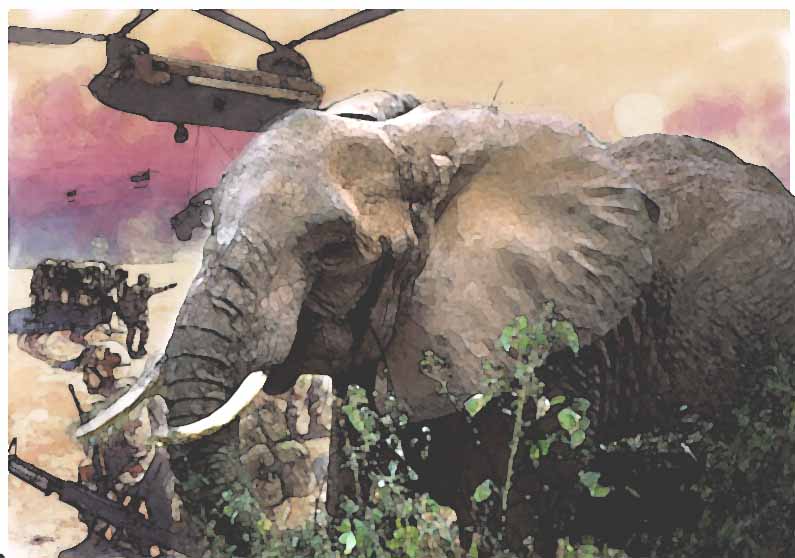
"How much longer do we have to play Wounded Elephant on the Euphrates?"-Trish - Published on 1/27/07 12:42 AM


The other night, Trish posed this question. "How much longer do we have to play Wounded Elephant on the Euphrates?" Did the arrogance of the Bush Administration and a misunderstanding of American history doom the venture? Was it ignorance of Iraq and the Middle East and a naive goal? The US people were asked to support a war and I believe they would have, but what kind of war?

The mantra after 911 was the long generational conflict. If the Administration knew that to be true, then they should have known the best way to win a long war was to sequence a linear campaign of demonstrably singular wins. A Roman style destruction of one enemy after another would work just fine. WWII was an example where The US systematically crushed one Japanese held island after another. Enormous losses were tolerated because they were followed with victories. The victories offset early losses and humiliations.

“My way or the highway” pushed potential allies away and events pealed active allies away, one at a time. "Old Europe vs. New Europe" delivered with a gleeful smirk may have been fun, but it established a policy of creating division, reluctance and outright rejection from a growing community opposed to the Bush way and it escalated into outright hatred. Instead of creating forward momentum, which would have brought new allies to the front, the Administration created adversaries. The most glaring example was the dismantling of the Iraqi bureaucracy and the Iraq military.

At one time the Administration estimated that about 400,000 people, mostly military personnel, lost their jobs when Saddam's military apparatus was dissolved in May 2003.

Initial plans for the interim defense force called for bringing about 30,000 Iraqi troops back to active duty. They were drawn from regular army units. This interim defense force was used primarily with coalition joint patrols and border patrols.. In a January 2006 interview between Bernard Gwertzman, Consulting Editor of the Council of Foreign Affairs and L. Paul Bremer we see this surprising exchange:

"In your new book, My Year in Iraq: The Struggle to Build a Future of Hope, you’re quite candid about the differences you had with Secretary of Defense [Donald H.] Rumsfeld and the Pentagon leadership over troop levels in Iraq, which you felt were too low. And in May, 2004, just before you departed for home you sent a personal message to Rumsfeld, again saying the troop levels in Iraq were inadequate. The troop levels since then have been about the same and the insurgency still continues. What is the problem with getting more troops into Iraq?Well, the disagreement here is a view that I had while I was there that our primary responsibility was for law and order. In particular, in the aftermath of the invasion, we had not cracked down on the looting, which set an example on our apparent unwillingness to enforce law and order. On the other side of it, military people in our government argued that, first of all, they believed they had enough forces to accomplish their mission, and secondly, that adding more forces would, in their view, make the situation worse because you’d have more soldiers on the street and in their Abrams tanks. That’s a respectable view but I just don’t happen to agree with it. So, that was the key argument: Do the American troops actually need more troops—and by the way, I never heard a military man while I was there say he needed more troops. And the president had said and still says if they ask for more he will give it to them. So those are the two sides of it.

Since then, the insurgency has continued at the same or higher levels. Of course, now the sovereign Iraq government is in charge and the quality of the Iraqi troops, I guess, will be the deciding factor.Yes."
The declared mission understood by the Administration was "law and order", and not military victory? Why did they think Americans would accept the role of policing Iraq? That does not sound like a war. That does does not ring in my memory as the stated goal, but to the man responsible on the ground, the goal was to establish law and order. How would that have worked in WWII? The metaphor proposed by Trish may be apt.


24 comments:

  1. This comment has been removed by a blog administrator.
    ReplyDelete
  2. The deletion was a bot advertisement.
    ReplyDelete
  3. 2164th: Did the arrogance of the Bush Administration and a misunderstanding of American history doom the venture?

    That's a two-pronged question, like "Have you stopped beating your wife yet?" The first question implied by your question is "Is the venture doomed?"

    If the answer is yes it is doomed, then prolonging the agony is criminal, we're losing at least a soldier a day, and concurrently pointing fingers in a blamestorming session while they die is grotesque.

    If the answer is no it is not doomed, and there's a way to salvage the war, and that plan is being put into action, then blamestorming becomes irrelevant, because the players and strategy become completely different. In that event it does nobody any good to blame Rumsfeld or Bremer or Cheney or Wolfowitz or the 2003 force levels or the 2005 rules of engagement.

    Only if the war is not doomed to fail, but there is no plan to salvage victory, or there is a victory plan but no motivation or leadership to put it into place, are we at liberty to assign blame. And that blame would rest squarely on the president if he did not present a plan to the American people. He knows all these calculations, and he has crafted a plan. But the majority of the American people believe option A is the case, and that the war is already lost.
    ReplyDelete
  4. This comment has been removed by a blog administrator.
    ReplyDelete
  5. barry, your point is well taken.In 2004 after the election Bush responded to a question from a reporter.

    "Let me put it to you this way: I earned capital in the campaign, political capital, and now I intend to spend it. It is my style. That's what happened in the -- after the 2000 election, I earned some capital. I've earned capital in this election -- and I'm going to spend it for what I told the people I'd spend it on, which is -- you've heard the agenda: Social Security and tax reform, moving this economy forward, education, fighting and winning the war on terror."

    The same thing applies to credibility.He probably spent most of it and even a good plan may be held hostage to that sad political fact of life.

    Welcome to the elephant.
    ReplyDelete
  6. You all know that I had my little hissy fit a few weeks, back, so I have to be careful, here; But, I think things are turning around, somewhat.

    It may just be a head-fake that Maliki is doing all the right things all of a sudden, and Moqtada, almost definitely, is engaging in "Hudna," and, obviously, Some of the Iraqi troops still aren't worth killing: however, some pretty smart people with knowledge on the ground are saying the we "just might" pull it off.

    Some of the Iraqi troops do seem to be performing pretty well, and we have kicked some pretty serious ass in some battles, recently, and the rules of engagement do seem to be being improved. Witnesses say that many "Insurgents" are deserting the "cover" of Baghdad and running for the hills. They WILL be easier to identify and kill in the less populated areas.

    Mookie's boys really do seem to be laying low. The Marines do report getting more help from the local Sheiks. Bush is, finally (why he took so long is unfathomable,) starting to stand up to the Iranians.

    I don't know; it seems like Americans just have to put themselves into a "Crisis" in order to function. I'm not saying this is "Valley Forge," and we just crossed the Delaware, but, just, maybe, this isn't a good time to be immobilized by despair, either.

    We should know more in a few weeks. If Maliki maintains his new-found resolve, and the Iraqi Army "Shows Up" we might be in for a better 07' than we had, 06'.

    Here's Hoping.
    ReplyDelete
  7. A few things :

    - This attack wearing US uniforms and english speak terrs really is a worrying indicator. The terrs would have got far more mileage keeping the captured soliders alive and parading them, but in any case it makes day to day operations that much more diffcult as it rachets up the paranoia/security hassle factor across the whole theatre. Well organized, clever, daring, ruthless, disciplined, sophisticated while conceptually simple - reminiscent of some of Shamil Basayev's better coups against Russia in the late 90's. Not good oponents to have. Like Israel against Hezbollah the longer the war drags on the more we train the enemy.

    - Another bad sign : Busting those guys for offing civilians under Colonel Michael Steele orders indicates quite strongly that a Roman solution is not in the offing. One of the most agressive, effective and unorthodox commanders was apparently tending towards Roman style ruthless kill-em-all operations. The leadership can stomach bombing a wedding party and killing a bunch of complete innocents along with a possible couple bad guys (After watching some of the AC-130 gun camera videos you gotta wonder), but going in with rifles and killing less innocents but more probable terrs is apparently not acceptable.

    Kinder, gentler warfare, where the nominally evil are bloodlessly pulverized by pushbutton but bayonetting the probably guilty is considered barbaric.

    No good will come of it all. Flee.
    ReplyDelete
  8. It is possible that the Senate Resolution may give the Iraqis some old time religion. They have to start thinking that if the Americans leave it will fall on them anyway.

    Maliki may have been sobered by the video of Saddam hanging. He has to stay on top to avoid a similar fate. Winning one neighborhood of a time may work. Sort of a virtual Katrina. Send them all to Houston.
    ReplyDelete
  9. Maliki may well be motivated - but is it to maneauver himself for stabbing us in the back? Keep the f***er where you can see his hands.
    ReplyDelete
  10. That was pretty much a one-off, Peacekeeper. They'll have a real hard time doing another one of those.

    Deuce, he (Maliki) found "Jesus" somewhere along the line. It might have woke him up when we showed him evidence that Iran was not only helping the Shi'ites, but was helping the Sunni, and AQ.

    And, you're right, He might have finally realized that he was about to be "on his own," and not ready for the experience.

    Or, maybe it's just "hudna."
    ReplyDelete
  11. Hard to keep track of their hands with those damned robes.
    ReplyDelete
  12. That was pretty much a one-off 

    Oh, I agree, but in the same way that Budyonnovsk was pretty much a one off (later attempts to do it again failed miserably). Like Basayev, vicious inventive guys with nerves of steel, you gotta be afraid what they will come up with next time, and the times after that. They really didn't exist previously - we are inadvertently making them.
    ReplyDelete
  13. My largest misgiving right now is, "can Maliki produce the troops in Baghdad?"
    ReplyDelete
  14. I believe that was an Iranian Quds operation. It was too slick for Iraqis. Kind of like the Samarra Mosque.

    I'll bet it turns out to be a "phyrric" victory. A lot of the people involved may not Work again.
    ReplyDelete
  15. Rufus, OT but you may have missed this on Iranian oil investment fx street.com
    ReplyDelete
  16. Rufus, the fingerprints may be Iranian, but it also brings to mind another Arab opponent we managed to train to a frightening level of competence : Hezzbolah.
    ReplyDelete
  17. I will remind everyone that Fellow peacekeeper also keeps an occasional blog. We need to poke into activity.
    ReplyDelete
  18. Yes, uncle Deuce. The blog will be back in circulation this spring.
    ReplyDelete
  19. Deuce, Iran has been a bit dismayed, recently to find that we have (with their help) managed to pretty much destroy any hope they had of getting Internatiional Bank financing for their oil field development. It's the kind of stuff that doesn't make the evening news, but it's an impressive "Victory," none the less.

    By the way, you might have noticed this line:

    And the US is a leading market for enhanced oil recovery techniques, including carbon dioxide floods and pumps

    Carbon Dioxide? When you refine a bushel of corn you get 1/3 back in Carbon Dioxide, which you can then use to produceMore Oil. Something that the "energy balance" talkers don't seem to ever take into consideration.
    ReplyDelete
  20. Let's face it O' Peaceable One, Bush WAS right about at least ONE thing. It WILL BE a LONG War.

    It will last as long as the OIL lasts.

    But, hardly a day, more.
    ReplyDelete
  21. Well, it's back to bed time, ladies. Have a Good Night (What's left of it, anyway.)

    Oh, throw some bud light in the cooler before you leave, okay?

    Nite
    ReplyDelete
  22. National Public Radio just reported that while thousands of anti-war protestors are on the National mall in Washington, Nancy Pelosi is "fact-finding" in the Green Zone. Nouri al-Maliki told her that he would like to see 50,000 US troops withdrawn from his country by the end of the year. He thinks it could happen sooner if the US would speed up training and equipping of the Iraqi army.
    ReplyDelete
  23. Rufus: Iran has been a bit dismayed, recently to find that we have (with their help) managed to pretty much destroy any hope they had of getting Internatiional Bank financing for their oil field development.

    Naturally this gives Iran all the cover they need to go full steam ahead on nuclear power. Ahmadinejad can even say he's doing it for the children.

    When you refine a bushel of corn you get 1/3 back in Carbon Dioxide, which you can then use to produce More Oil

    They are playing around with this in Alberta.
    but in that process, the CO2 is produced from an on-site coal plant and is used to squeeze methane out of another part of the local coal seam. Your idea would need a new corn refinery built at each depleted oil field, or an infrastructure of pipes to deliver the CO2 from a remote location. This may be too costly to justify.
    ReplyDelete
  24. Barry, CO2 can, I'm pretty sure be moved by truck, or rail. If I'm not mistaken they are using some of this CO2 in Kansas oil fields, and probably some others. I have to be careful, here, because I really haven't researched this but I'll try to find out something about it.
    ReplyDelete