“Soft despotism is a term coined by Alexis de Tocqueville describing the state into which a country overrun by "a network of small complicated rules" might degrade. Soft despotism is different from despotism (also called 'hard despotism') in the sense that it is not obvious to the people."
For the first time perhaps ever, Donald Trump was right about something. There exists irrefutable evidence that George W. Bush and his national security team was repeatedly warned about the impending September 11, 2001, terrorist attacks and failed to do a damn thing in the face of those warnings. “Warnings,” plural, is appropriate grammar here since it wasn’t just the single President’s Daily Brief (PDB) dated August 6, 2001 that should’ve raised serious concerns at the White House that an epic-scale attack by Osama Bin Laden was forthcoming. Indeed, there were many, many others. We’ll circle back to this point.
Jeb Bush, for his part, reacted to Trump’s criticism noting how the billionaire was borrowing “the attacks of (liberal filmmaker) Michael Moore and the fringe left.” Bush also noted, “Let’s be clear: Donald Trump simply doesn’t know what he’s talking about.” Meanwhile, on Wednesday morning, Rubio told Newsmax TV,
“What [Trump] said is just not true. The truth is that George W. Bush inherited all sorts of things from the Clinton administration, including intelligence agencies and others who were…not sharing information across agencies.”
On the contrary, every word of what Trump said was 100 percent accurate.
FACT: There were numerous instances when the Bush administration failed to act in accordance with intelligence community warnings about Bin Laden and subsequently attempted to cover up not only its inaction but also aspects of the aftermath — with zero outrage or obsessive hobby-horsing from Fox News or congressional Republicans. Instead it was all met with the usual refrain: Don’t try to undermine the commander-in-chief while troops are in harm’s way, you unpatriotic, terrorist-loving America-haters.
Vanity Fair’s Kurt Eichenwald, author of “500 Days: Secrets and Lies in the Terror Wars,” reported back in 2012 that the infamous August 6, 2001, PDB wasn’t the first time the Bush administration was warned of a massive attack being prepared by Bin Laden and his al-Qaeda co-conspirators, and yet there’s no indication Bush took any significant or even cursory action to disrupt the plot. (I hasten to note: This is in no way an endorsement of the conspiracy theory that Bush deliberately allowed the attacks to occur.)
But let’s run through the timeline:
• From the beginning, Richard Clarke, a holdover Clinton administration counter-terrorism adviser, desperately attempted to repeatedly warn then-National Security Adviser Condoleezza Rice about an impending Bin Laden attack. Clarke warned of “an immediate and serious threat to the United States” at the hands of Bin Laden.
• May 1, 2001: Eichenwald reported that the president was briefed by the CIA that there were plans being assembled for an attack by “a group presently in the United States.”
• June 22, 2001: Bush received a PDB that warned of an “imminent” al-Qaeda attack during a “flexible timeline.” The neocons in the White House, meanwhile, believed that Bin Laden was a distraction from an actual plot by Saddam Hussein. The pretext for an invasion and regime change in Iraq had obviously been on the table for many months. In spite of its participation on Iraq, the CIA urged the White House to not ignore Bin Laden.
• June 29, 2001: Another PDB outlined in detail an impending attack by Bin Laden. Eichenwald noted that this brief emphasized “dramatic consequences,” “including major casualties.”
• July 1, 2001: The White House is instructed in yet another PDB that the attack had been postponed, but “will occur soon.”
• July 9, 2001: The CIA’s Counter-terrorism Center staffers held a meeting in which one senior official recommended that everyone resign so as to not be blamed for the impending attack.
• July 11, 2001: The White House is informed that al-Qaeda-linked radical Ibn Al-Khattab told his supporters that “there would soon be very big news.” The CIA brief included more information about a possible attack.
• July 24, 2001: The White House is again warned of preparations for an attack in “a few months.” Eichenwald wrote that Bush wasn’t convinced and requested a “broader analysis on al-Qaeda.” This analysis became the infamous August 6 PDB.
• August 4, 2001: 9/11 co-conspirator Zacarias Moussaoui, whose flight school attendance was noticed by intelligence officials, is picked up and charged on immigration violations.
• August 6, 2001: While vacationing in Crawford, Bush receives the notorious PDB titled, “Bin Ladin Determined To Strike in US.” No action was ever taken by the administration to intervene.
Following September 11, the Bush administration repeatedly stonewalled the formation of a commission to investigate the attacks and instead set about the process of tying 9/11 to Saddam Hussein while selling an invasion of Iraq to the American people.
I’ve said it before: If roles had been reversed and there had been a Democratic president on 9/11, he or she wouldn’t have been merely investigated — impeachment would’ve absolutely begun while Ground Zero was still smoldering. How do we know this? Just look at the outrage and righteous indignation over an attack with four American casualties. Now add 2,973 more and a very long paper trail showing negligence preceding the deaths and rampant misinformation following them.
Furthermore, and in addition to five previous investigations, the current Benghazi select-committee has been assembled for almost as many weeks (75 weeks) as the 9/11 Commission (84 weeks). By the time it’s adjourned permanently, it will have easily far exceeded the 9/11 investigation. As of this writing, $4.5 million has been wasted on Trey Gowdy’s political theater. And, to this day, no one has been able to prove malfeasance or negligence on behalf of President Obama and his team, including Hillary Clinton. We can hardly say the same for President Bush.
MOSCOW (Reuters) OCT 22, 2015 - 20:38 - The Kremlin believes it has taught Washington an object lesson in how to take on Islamist militants in Syria. Basking in the afterglow of Bashar al-Assad's surprise visit to Moscow this week, it now believes it could lead the way diplomatically too.
Russia's actions over Syria, from its decision to launch air strikes to the red carpet welcome it afforded Assad, have irked the White House, which does not want to be seen giving President Vladimir Putin a get out of jail card over the Ukraine crisis.
Yet there is a growing sense in Moscow, and among diplomats and politicians in some countries in the Middle East and the West, that Russia has a better chance than most to combine its increased influence over Assad with its military muscle in Syria's skies to broker a deal to end the Syrian conflict.
"Right now Russia has more chances than any other country to settle this process," said Ivan Konovalov, director of the Centre for Strategic Trend Studies in Moscow.
"It cannot do this on its own of course. And Russia cannot control Assad. But it can guide him, make deals with him, and advise him as an ally. It's a massive ask but there is a chance that Russia could pull this off."
Others agree, albeit begrudgingly, seeing Moscow as a flawed interlocutor but one that nonetheless can play a constructive role.
Jamal Khashoggi, the head of a Saudi news channel owned by a Saudi prince, said Moscow is at least a more palatable potential broker for Riyadh than Iran.
"With Iran, it’s an issue of religion, of Shi’ite expansionism," he said. "But for Russia it’s about geopolitics and interests, so we can talk to the Russians," he said.
Russian analysts believe their country's authority as a potential peacemaker had been strengthened by what they see as an effective show of military force in Syria and its repeated refusal to do a deal with the West that would have involved Assad stepping down.
U.S. VACUUM
Western diplomats privately agree there is a window of opportunity for Putin to seize the diplomatic initiative, even if its chances of success are deeply uncertain.
"For me the question is less why is Putin doing this, but more why is he able to do it," said one Western diplomat, who works on the Syria and Iraq crises.
"And here the answer is, whether one likes it or not, because he is filling a void left by U.S. disengagement."
Russian Foreign Minister Sergei Lavrov will try to push Moscow's so far unsuccessful initiative -- of a grand international coalition against the Islamists in Syria -- at a meeting in Vienna on Friday.
U.S. Secretary of State John Kerry will attend as will the foreign ministers of Turkey and Saudi Arabia.
Washington has rejected Moscow's criticism of its policies in the Middle East and reports that Russian strikes have been effective, arguing that they have focused their attacks mainly on Syrian government positions that are most threatened and made little inroads into defeating Islamic State.
"Secretary Kerry will once again reiterate our deep concern about the continued military support for the Assad regime," State Department spokesman John Kirby told reporters this week.
"In our view there’s not going to be a military solution to the civil war, and that any attempt to find one – certainly one that props up Assad – is only going to prolong it and make the threat of extremism deeper in Syria."
Russia expects the meeting to produce "an honest and objective exchange of views about the situation which will give an opportunity to map out a clear path for activating efforts to achieve a comprehensive political resolution,” said Maria Zakharova, a spokeswoman for Russia's foreign ministry.
Yet the idea that Putin, the man the West loves to hate, could eventually emerge as the diplomatic broker-in-chief of the Syria crisis seems risible in many Western capitals and hard to swallow among key regional powers.
The insistence that Assad must immediately step down may have softened somewhat, notably in Washington and Ankara. But it has not gone away, and is at odds with Russia's view that Assad is Syria's legitimate leader.
Saudi Arabia, which is financing some of the militants fighting against Assad, has baulked at Russia's intervention.
Speaking to reporters on the eve of the Vienna meeting, Saudi Foreign Minister Adel al-Jubeir called Russian interference in Syria "very dangerous", accusing Moscow of escalating the conflict, backing a leader with blood on his hands, and of stoking a sectarian conflict.
"There will be no role that he can play other than to leave," the minister said of Assad.
Iran, one of Assad's and now Moscow's staunchest allies, says it is fully satisfied with the Kremlin's approach and that Moscow has kept it fully informed of its initiatives, including the Syrian leader's surprise visit.
"We have supported Russia's measures in Syria. Russia and Iran and the Syrian government have close cooperation," a senior Iranian official told Reuters on condition of anonymity.
REGIONAL SCEPTICISM
But Turkey and Iraq, other key countries in the region, are a far more difficult prospect for Moscow.
Turkey, one of Assad's most vociferous opponents, has been incensed by the Russian intervention, which it says will only prolong the war, and by air space violations by Russian warplanes along its southern border.
Sources in President Tayyip Erdogan's office said the Turkish leader had used a call with Putin on Wednesday to emphasise his concerns about links between the Kurdistan Workers Party (PKK), which has fought a three-decade insurgency against the Turkish state, and militia connected to the Kurdish PYD party in Syria.
Opinion in Iraq meanwhile appears deeply divided. Although some politicians there want Russia to extend its campaign of air strikes to hit Islamist State targets in Iraq, others are fiercely opposed and sceptical of Moscow's aims.
“There is a split between the Sunni and Shi’ite Arabs in regards to Putin. The Sunnis in Iraq agree with their Syrian counterparts in viewing Putin as a murderer who wants to keep Assad in power," Hisham al-Hashimi, an Iraqi security analyst, told Reuters.
Some Shi’ites did favour growing Russian influence, he said, but they were also split and many Iraqis blame Washington for what they say is its own failed intervention.
Russian government officials say the Kremlin is not acting out of affection for Assad or self-interest. Moscow says instead it is trying to contain Islamist militancy before it spreads further afield.
A former Russian diplomat who served in the Middle East also said Moscow was not driven by any attachment to the Syrian president.
He said that Moscow, under Soviet rule, had close relations with then Syrian President Hafez al-Assad, the father of the current Syrian leader but that there had been a cooling of relations when Bashar succeeded his father.
But now, after the strife in Syria, he said Bashar had warmed to Moscow. “He has no choice.”
(Additional reporting by Christian Lowe in Moscow, Shadia Nasralla in Vienna, Yara Baroumy and William Maclean in Dubai, Tulay Karadeniz in Ankara, Saif Hameed in Iraq, Lesley Wroughton in Washington; editing by Anna Willard)
The rotten soul of the Western political establishment is never more exposed than when it comes to the issue of Palestine. It is here where the hypocrisy, double standards, and political cowardice that is its truth is at its most extreme.
Bad enough that the Palestinian people have been forced to endure a decades-long negation of their human, natural, and national rights; the injustice they have suffered is compounded tenfold by the complicity of the West in denying their rightful status as an oppressed people struggling against a cruel and vindictive oppressor. Stripped of all of the embroidery and obfuscation that has been allowed to distort the contours of this struggle, here lies the root of the issue and the biblical suffering that has and continues to flow from it.
This conflict is not and never has been about Israel’s right to exist or Israel’s security. It is not and never has been about Hamas or its Charter. It is not even about a two state or a one state solution – at least not anymore it is not. It is about whether we take a stand on the side of an oppressed people or with their oppressor.
In this regard we must give thanks to Malcolm X for washing the bullshit from our eyes: “If you aren’t careful the newspapers will have you hating the people being oppressed, and loving the people doing the oppressing.”
Make no mistake, the political mainstream and its media echo chamber know exactly what is going on in Palestine, and they are well aware of its root cause. Yet, regardless, they continue to provide Israel with their unstinting and unwavering support. Even more, they genuflect at the feet of this apartheid state.
The desperate acts of violence that have erupted over the past few weeks in Jerusalem and across the occupied West Bank – mostly in the form of random stabbings and acts of violence against any Israeli anywhere – do not denote evil on the part of those responsible; instead, such desperate acts reveal the extent of the despair which the Palestinians have endured and continue to endure as a direct result of their oppression. Theirs is an extreme but understandable response to the brutal negation of their dignity, rights, even humanity at the hands of a state that has never viewed them as anything other than an inconvenient fly in the milk of their pure ethno and religiocentric state to be crushed and crushed repeatedly.
The wanton, systemic, and systematic cruelty endured by an entire people follows the egregious logic of the campaign of ethnic cleansing that gave birth to Israel in 1948. It describes a moral sickness that, if anything, has grown increasingly acute in the decades since.
A Third Intifada is incontrovertible evidence of the abject failure of the international community to impose a just settlement for a people whose abandonment is a crime, consigned to a fate akin to the Australian aborigines and Native Americans, with the best they have long been expected to expect life on a reservation.
The Palestinians’ stubborn refusal to accept such a fate, even in the face of brutal and unremitting pressure to break, describes a level of sustained tenacity that has been Herculean in scope. For as ugly as their resistance has been, it is nothing when compared to the oppression that has given rise to it.
The prison imprisons the guards as much as it does the inmates, and the chains that bind the Palestinians also bind the people of Israel. Not for a minute in a given day does the word Palestine or Palestinian not intrude on their consciousness – though sadly not conscience in the case of most – reminding them of a people who remain unbowed, despite their immiseration, just a few miles from the affluence which they take for granted. Hatred of another is the handmaiden of hatred of self, with Israel an example of how the projection of hatred on a national level eats away at said nation’s own foundations.
Terrorism and terrorist are the most value-laden words in our language today. We use them to identify the violence of those we revile and whose cause we consider unworthy and unjust. As such there is not such thing as a Palestinian terrorist or Palestinian terrorism. What there is, and in abundance, is Palestinian desperation and Palestinian despair. Attacks carried out against Israeli civilians are an awful thing; however for a people who’ve been consistently denied their own humanity they have become the only thing left by which to command the attention of an international community whose silence is a lethal weapon in the hands of their oppressor.
BDS is the greatest and most effective weapon in the arsenal of international solidarity with the Palestinians. From small and marginal beginnings in 2005, BDS has grown exponentially to the point where it now strikes fear in the breast of Israel and is the only international lifeline that the people of Gaza and living throughout the West Bank have to hold on to. Its continuing growth and effectiveness is therefore a non-negotiable condition of the struggle against both Israel’s intransigence and the West’s hypocrisy, without which the status quo would have ended a long time since.
We have passed the stage where objectivity is an acceptable response to apartheid, ethnic cleansing, and the monument to injustice erected in the name of exceptionalism. The cause of the Palestinian people is the cause of humanity in our time.
John Wightis the author of a politically incorrect and irreverent Hollywood memoir –Dreams That Die – published by Zero Books. He’s also written five novels, which are available as Kindle eBooks. You can follow him on Twitter at @JohnWight1
MONTERREY, Mexico — Tens of thousands of people were being evacuated Friday from Mexico’s Pacific coast as the strongest hurricane ever recorded in the Western Hemisphere bore down on the popular tourist area packing sustained winds of 200 mph.
"Democracy Now!" airs weekdays at 9 a.m. PT on KCET.
Last month was the hottest September worldwide, and 2015 is now virtually guaranteed to be the hottest year in recorded history. The National Oceanic and Atmospheric Administration says the first nine months of this year have been the hottest such period ever recorded. Driven by warmer temperatures, the strongest El Niño on record is fueling extreme weather, from typhoons in the Philippines to historic summer rains and a looming winter drought in Hawaii. This all comes as negotiators prepare for the U.N. climate summit in Paris November 30. Democracy Now! will report live from the summit for the full two weeks.
Fight climate change for global stability, say US defence and diplomacy elite
Full-page newspaper advertisement by ex-military and foreign policy leaders is aimed at Republicans who want to block action on cutting carbon emissions
Nearly 50 leaders of America’s defence and foreign policy establishment are calling on political and business leaders to “think past tomorrow” and lead the fight on climate change.
In a full-page ad in the Wall Street Journal the experts – 48 former secretaries of state and defense, national security advisers, diplomats and members of Congress from both parties – say it is time for America to claim global leadership on climate change.
The appeal is intended to apply pressure to Republicans in Congress who are trying to defeat Barack Obama’s plan to cut carbon pollution at home and seeking to limit US involvement in negotiations to reach a global deal on fighting climate change in Paris in December.
The letter, endorsed by Madeline Albright, secretary of state under Bill Clinton; Chuck Hagel, secretary of defense under Obama; George Shultz, secretary of state under Ronald Reagan; James Woolsey, CIA director under Clinton; and other prominent retired officials, declares that climate change is indeed a security threat.
“America’s elected leaders and private sector must think past tomorrow to focus on this growing problem, and take action at home and abroad,” the ad says.
“This issue is critically important to the world’s most experienced security planners. The impacts are real, and the costs of inaction are unacceptable.”
The ad hits back against Republicans who are trying to block a global climate deal, arguing that Obama should have to submit any agreement for approval to Congress – where it would almost certainly be defeated.In the run-up to the Paris climate conference, the Obama administration has rolled out almost daily pronouncements and events – many involving business leaders – to try to build the case that a climate change deal would be good for the economy and the country.
Many of the 48 had made previous such appeals.
The security establishment has long recognised the threat posed by climate change. In 2006 a report by the influential Center for Naval Analysis defined climate change as a “threat multiplier”, adding fuel to conflicts.
The current thinking however sees climate change as a danger on its own – drought, sea-level rise, food shortages, provoking migration and armed conflicts.
“Climate change is certainly going to destabilise situations,” General Ron Keys, retired leader of the air force command, told a seminar at the Wilson Centre think-tank on Wednesday. “There are some countries out there that are just hanging on by their fingernails.”
Generals also fear a rise in deployments dealing with natural disasters – which would play a strain on resources and could potentially leave the US exposed.
“The real problem is what do we do if we are involved in a Fukushima or a hurricane Sandy times three and somebody like Isis decides to make a big push,” Keys said. “If I were a bad guy I’d wait until the US was involved in a big situation and then I would make my move.”
------------------------------
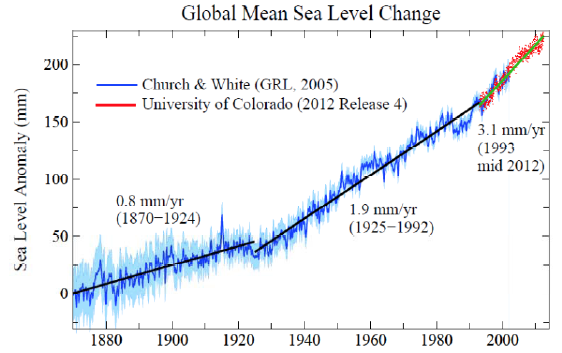
The globe warms: surface, troposphere, oceans and melting ice.
Last week, after the White House announced its support for Syrian rebels was finished, the United States said it dropped 50 tons of ammunition from the air into Syria, ostensibly for unnamed Arab groups fighting ISIS. That, supposedly, was the last assistance those people were going to get.
A few days later, various anti-ISIS Syrian Arabs issued a collective, huh?
What happened to that ammo that supposedly fell out of the sky?
Nobody seemed to get any ammo.
All became clear the next day when Eli Lake and Josh Rogin reported in Bloombergthat, according to various officials, the aid was never intended for Syrian Arabs. That 50 tons of ammo actually went to the Kurds.
“Turkey cannot accept any kind of cooperation with terror organizations that have declared war against Turkey,” Prime Minister Ahmet Davutoglu said.
That ammunition went to no kind of terrorist organization. It went to the Kurdish People’s Protection Units, or YPG, the only half-way sane militia in all of Syria that’s capable of taking on ISIS and winning.
The YPG is allegedly linked to the quasi-Marxist Kurdistan Worker’s Party, or PKK, over the border in Turkey which is listed by the United States government, among others, as a terrorist organization. But the PKK and the YPG are different organizations. They have different goals, different ideas, different leaders, and different enemies. They aren’t even in the same country. And the extent of their linkage is hotly disputed.
The officials who told Lake and Rogin that it went to the Kurds are anonymous sources. They spoke unofficially and off the record. But this isn’t a case of one person said “this” and another said “that.” Lake and Rogin have American, Kurdish and Syrian Arab sources who back up that claim.
The Pentagon is almost certainly lying so it won’t infuriate Turkey.
Look. Running guns and ammo under the radar to legitimate proxies in a fight against a terrorist army is entirely reasonable behavior on the part of the United States government. We’ve been doing that sort of thing for decades. Pretty much everyone else in the Middle East does it, too, but they almost always run guns and ammo to terrorist organizations rather than to groups fighting terrorist organizations.
Regardless, it’s high time we come out and say exactly what we’re doing and why. Everyone already knows we’re backing the Kurds against ISIS, and everyone already knows the Turks would rather see an ISIS victory than a Kurdish victory. None of this is even remotely a secret. It’s all right out in the open. Official denials aren’t fooling anybody.
Besides, pretending we’re not doing what we clearly are doing just makes it look like the Turkish government’s complaint is legitimate.
It’s not.
Turkey says arming Syrian Kurds is unacceptable. Well. You know what’s unacceptable from everyone else’s point of view? Telling the rest of the world that we all have to suffer the plague of ISIS because an independent Syrian Kurdistan is inconvenient to Turkey.
I just watched the 5 pm news hour on CNN anchored by Wolf Blitzer, and the editors had clearly decided that the lead was that Russian bombing in south Aleppo risks creating a new wave of refugees. They also stuck to the cover story that the Russians are only attacking the “moderate rebels.”
American bombing of populated areas has never been reported in that way on mainstream cable news. The US bombing that killed Sanafi al-Nasr, said to have been the no. 2 man in the Syrian branch of al-Qaeda, the Support Front, was reported on the same show as a great victory. But was he in a completely deserted area? Were any civilians killed around him? It has now come out that most US drone strikes don’t even kill the intended target; probably it is the landlord’s family that mainly dies. Was al-Nasr a renter?
Nor did CNN lead with civilian casualties when it covered Israeli PM Netanyahu’s bombardment of defenseless little Gaza in summer of 2014.
Russian bombing of populated areas, like all such bombing, is killing civilians, of course. The point isn’t that CNN is wrong but that it is selective.
Whether Russian bombing is more or less egregious than any other can could be debated. I suspect it is less egregious than that of the Syrian air force itself, though that wouldn’t be saying much. Robert Fisk reportsthat the Syrian Arab Army is frustrated with the Russians precisely because their air force is being very cautious about civilian casualties:
“The Syrians have found that the Russians do not want to fire at targets in built-up areas; they intend to leave burning hospitals and dead wedding parties to the Americans in Afghanistan. This policy could always change, of course. No air force bombs countries without killing civilians. Nor without crossing other people’s frontiers. But the Russians are now telling the Turks – and by logical extension, this information must go to the Americans – their flight coordinates.”
Note that the Syrian regime has been dropping barrel bombs on civilian areas for years now and no CNN news hour has begun with this headline. It appears to me that they mind when Russia bombs, but not when anyone else does. I should underline that I oppose the Russian intervention in Syria and think it will likely go to dark places. But I also insist that it be reported and analyzed exactly as actions of the US and its allies are. And this is clearly not the case. The Fisk point of view should be reported, as I just did, even if one has reservations about it (as I do).
As for the “moderate rebels,” who have suddenly reappeared in American official discourse only after Russia intervened, former Chairman of the Joint Chiefs of Staff Gen. Martin Dempsey wrote Congress in fall of 2013 that he did not want to intervene in Syria because he could not be sure that the victorious rebels would support US interests:
” In an August 19 letter to Representative Eliot Engel, obtained by the Associated Press, Gen. Dempsey effectively ruled out even limited intervention, including US cruise missile attacks and other options that wouldn’t require US troops on the ground. “Syria today is not about choosing between two sides but rather about choosing one among many sides,” he said. “It is my belief that the side we choose must be ready to promote their interests and ours when the balance shifts in their favour. Today, they are not.”
What he was saying was that by the middle of 2013, the democratic forces in the Free Syrian Army had either collapsed or their units had joined or closely allied with one of the two major al-Qaeda offshoots, Daesh (ISIS, ISIL) or the Support Front (Jabhat al-Nusra, which reports to al-Qaeda 9/11 mastermind Ayman al-Zawahiri).
There are lots of small rebel groups in the hinterlands of Homs, Hama and Aleppo and in Idlib province who are not al-Qaeda. But most have become hard line Salafis a la Saudi Arabia who want sharia law and allow as how they might not kill all the Alawis, Christians, Druze and other minorities that come under their rule but keep them as second class citizens under a dictatorship. Some are still Muslim Brotherhood, some of whom want a Muslim state but with elections.
However, these groups are small and not very effective fighters, and have been forced to ally with al-Qaeda to avoid being killed by the Syrian Arab Army and in hopes of taking more territory. Moreover, the amount of Syrian territory now held by rebels who want democratic elections and full legal equality for all Syrians would be in my estimation zero percent. Almost all Syrian rebels now want a society ruled by sharia or a hard line medieval notion of Islamic law. (Sharia itself, as private practice and individual choice, is as inoffensive as Jewish Halakha or Roman Catholic canon law; but making a fundamentalist interpretation of it the basis for national law is a whole set of human rights crimes waiting to happen).
Note the irony. The same GOP politicians who denounce all US Muslims for allegedly wanting to impose sharia or Muslim law on all Americansare talking about the Syrian rebels who want a sharia society as “moderates” and “US allies” being targeted by Russia. (The allegation about American Muslims, who in my experience love the US constitution half to death, is incorrect).
When Wolf Blitzer interviewed Rep. Adam Schiff, he asked a leading question about the Russians attacking the “moderate rebels.” Schiff concurred that that was what Moscow was doing, and spoke of these forces as being backed by US allies in the Gulf. He did, however, veer off script by admitting that Russia is also attacking al-Qaeda in Syria. He complained, however, that Russia is not attacking Daesh/ ISIL.
Russia is, of course, occasionally bombing Daesh. But that organization mainly holds territory in the far east of the country away from the western population centers. It is Syrian al-Qaeda that holds a great deal of Idlib Province and spearheads the Army of Conquest coalition of Salafi jihadis who control the rest of Idlib Province.
So why is it objectionable that Russia is attacking an organization reporting to al-Qaeda chief Ayman al-Zawahiri, who killed nearly 3,000 Americans in 2011? Or that Russia is attacking groups that have political or tactical alliance with al-Qaeda in Syria? Wouldn’t that make them like the Taliban in Afghanistan? Is the US wrong to bomb the latter, on the grounds that they were only allied with al-Qaeda?
And how can the same news hour report positively on the killing by American bombing of al-Qaeda’s al-Nasr and slam the Russians for bombing . . . al-Qaeda?
This isn’t news reporting. This is government propaganda.