COLLECTIVE MADNESS


“Soft despotism is a term coined by Alexis de Tocqueville describing the state into which a country overrun by "a network of small complicated rules" might degrade. Soft despotism is different from despotism (also called 'hard despotism') in the sense that it is not obvious to the people."

Wednesday, April 19, 2017

If You Don't Know Where an Entire Aircraft Carrier Strike Fleet Is, How Can You Have No Doubt About a Chemical Weapon Attack in Syria?

Trump on North Korea: 'We Are Sending an Armada'

President Trump warned in a pair of tweets Tuesday that North Korea “is looking for trouble” with its nuclear weapons program, and he doubled down on that tough talk in a Fox Business Network interview with Maria Bartiromo.

Trump, who dispatched a Navy strike group to the Korean Peninsula amid the rogue nation's continued ballistic missile and nuclear testing, told Bartiromo he's not going to reveal exactly what strategy he will use against North Korea.


"You never know, do you? You never know," Trump said, explaining that he's not going to announce his military plans to our adversaries, as former President Obama did.

Although he didn't get into specifics, Trump spoke about his decision to send the USS Carl Vinson aircraft carrier and its battle group to waters off the Korean Peninsula.

"We are sending an armada. Very powerful." Trump said. "We have submarines. Very powerful, far more powerful than the aircraft carrier, that I can tell you."
As for North Korean leader Kim Jong Un, Trump said he's "doing the wrong thing" with his ongoing nuclear testing and saber-rattling.

Responding to the U.S. moving the Navy strike group, the isolated nation vowed to “hold the U.S. wholly accountable for the catastrophic consequences.”

Trump also weighed in on the situation in the Middle East, saying that he he has no plans to enter Syria, despite ordering airstrikes on a Syrian military base last week.

Tuesday, April 18, 2017

"Let them eat chocolate cake"

War Cries Drown Out ‘America First’ by -- Antiwar.com

"Why would I call China a currency manipulator when they are working with us on the North Korean problem?" tweeted President Donald Trump on Easter Sunday.

Earlier, after discovering "great chemistry" with Chinese President Xi Jinping over "the most beautiful piece of chocolate cake" at Mar-a-Lago, Trump had confided, "I explained … that a trade deal with the U.S. will be far better for them if they solve the North Korean problem!"

"America First" thus takes a back seat to big-power diplomacy with Beijing. One wonders: How much will Xi end up bilking us for his squeezing of Kim Jong Un?
Trump once seemed to understand how America had been taken to the cleaners during and after the Cold War. While allies supported us diplomatically, they piled up huge trade surpluses at our expense and became virtual free-riders off the U.S. defense effort.

No nations were more successful at this than South Korea and Japan. Now Xi is playing the game – and perhaps playing Trump.

What is the "North Korean problem" Beijing will help solve in return for more indulgent consideration on future U.S.-China trade deals?

North Korea’s nuclear arsenal. As 80 percent of Pyongyang’s trade comes through China, Trump believes that Beijing can force Kim to stop testing missiles and atomic bombs before he produces an intercontinental ballistic missile that could hit the U.S.

But what is to prevent Xi from pocketing Trump’s concessions and continuing on the strategic course China has long pursued?

For in many ways, Pyongyang’s goals parallel China’s.

Neither could want an all-out war on the Korean Peninsula. For Kim, this would devastate his country, bring down his regime, and cost him his life. For China, war could mean millions of Koreans crossing the Yalu into Manchuria and a disruption of Beijing’s march to Asian hegemony.

A continuing crisis on the peninsula, however, with Trump and the U.S. relying on Beijing’s help, could leave Xi in the catbird seat.

And now that North Korea has declared its goal to be building missiles with nuclear warheads that could hit all U.S. bases in Asia – and even California – the clock is running for the White House.

"It won’t happen," Trump has said of North Korea’s developing an ICBM that could hit the United States. "If China is not going to solve North Korea, we will."
"The threat is upon us," says outgoing deputy national security adviser K.T. McFarland. "This is something President Trump is going to deal with in the first year."

Secretary of State Rex Tillerson and Vice President Mike Pence have declared that our policy of "strategic patience" with Pyonyang is at an end.

National security adviser H.R. McMaster said Sunday the U.S. has "to take action, short of armed conflict, so we can avoid the worst" in dealing with "this unpredictable regime."

With a stunning parade of missiles in Pyongyang on Saturday, the North’s failed firing of a solid-fueled missile that same day, and the promise of new missile tests weekly, Kim is forcing our hand.

Either he backs away from building atomic bombs and long-range missiles or Trump and his generals must make good on their warnings.
How did we get to this point?

Why, 64 years after the Korean War, a quarter-century after the Cold War, are we still obliged to go to war to defend South Korea from a North with one-half the South’s population and 3 percent of its gross domestic product?

Why are we, on the far side of the Pacific, still responsible for containing North Korea when two of its neighbors – Russia and China – are nuclear powers and South Korea and Japan could field nuclear and conventional forces far superior to Kim’s?

How long into the future will containing militarist dictators in Pyongyang with nuclear missiles be America’s primary responsibility?

Another issue arises. Before the U.S. launches any pre-emptive strike on North Korea, Congress should be called back into session to authorize any act of war against the North.

Perhaps this time, Congress would follow the Constitution.
Though Korea is the crisis of the moment, it is not the only one.
Not since 9/11 have the Afghan Taliban been stronger or controlled more territory. The United States’ commanding general there is calling for thousands more U.S. troops. Russia and Iran are reportedly negotiating with the Taliban. Pakistan is said to be aiding them.

To counter Vladimir Putin’s Russia, we have moved U.S. and NATO troops into Poland, the Baltic States, Romania and Bulgaria. We have fired missiles into Syria. We are reportedly preparing to back the Saudis in the latest escalation of their war on the Houthi rebels in Yemen.

Twenty-four years after "Black Hawk Down," the weekend brought reports of U.S. troops returning to Somalia.

The promise of a Trump presidency – that we would start looking out for our own country and own national interests first and let the rest of the world solve, or fail to solve, its own problems – appears, not 100 days in, to have been a mirage.
Will more wars make America great again?

Patrick J. Buchanan is the author of Churchill, Hitler, and “The Unnecessary War”: How Britain Lost Its Empire and the West Lost the World. To find out more about Patrick Buchanan and read features by other Creators writers and cartoonists, visit the Creators Web page at www.creators.com.
COPYRIGHT 2017 CREATORS.COM

Read more by Patrick J. Buchanan

MEANWHILE, AS WE ARE READY TO ATTACK NORTH KOREA, HOW ARE THINGS GOING IN IRAQ, FIFTEEN YEARS AFTER WE ATTACKED IT?

UPDATE:

Monday, April 17, 2017

Believing US Intelligence Agencies or US Presidents or The US Congress Again? I am SURE this time will be different!


MOSUL - April 2017


MOSUL - April 2003


300,000 Civilians Have Now Fled  Western Mosul | April 10th 2017


THE MEMO: Has Trump gone Washington?

President Trump is moving in a more conventional direction, winning plaudits from former critics in the process. But his shifts, in both policy and personnel, are disconcerting those who were once among his loudest boosters. 
The Trump diehards are queasy at the notion that a president who ran as a proud outsider might be co-opted by a Washington establishment they loathe.  
“Trump won by bringing out millions of people who hadn’t voted in decades, maybe ever,” the conservative commentator Ann Coulter told The Hill in an email. “They’re not on ABC’s ‘powerhouse roundtable,’ working on Wall Street or for the Koch brothers — where everyone is delighted with how Trump has ‘grown’ in office. 
“The base is terrified that Trump is being led down the primrose path with flattery from all the people who didn’t vote for him and never will.”
The charge that Trump is going to disappoint — or even sell out — the insurgent legions who supported him last November is not new. 
When the GOP’s internal fight over the attempt to repeal and replace the Affordable Care Act was at its height at the start of April, conservative Rep. Justin Amash (R-Mich.) lamented on Twitter that “Trump admin & Establishment have merged into #Trumpstablishment. Same old agenda.”
Even earlier, conservative media icon Matt Drudge of The Drudge Report tweeted, “The swamp drains you,” a clear jab at Trump, who promised during the campaign to "drain the swamp" in Washington. 
But those worries have intensified this week. 
The president backed away from several of his campaign positions in short order. He no longer views NATO as “obsolete”; he no longer views China to be a currency manipulator; and his opposition to the Export-Import Bank and to Janet Yellen’s reappointment as the chairwoman of the Federal Reserve have gone by the wayside.
Meanwhile, reverberations are being felt from the airstrike he launched on Syria.
During President Obama's White House tenure, Trump had warned about the dangers of getting involved in the war-torn nation.
The White House has vigorously pushed back against suggestions that the president has made u-turns on those policy issues.
Aides put a particular emphasis on the NATO question, insisting that the organization has proven receptive to Trump’s key demands: that member nations aside from the United States should pay their fair share and that the fight against terrorism should be a higher priority. NATO's moves in response, they say, are what have caused Trump to take a more favorable view of the alliance. 
White House press secretary Sean Spicer on Thursday said that “when you look at these issues and you recognize the direction in which they’re moving, they’re moving in a direction that the president stated very clearly.”
Spicer was, however, much keener to emphasize NATO over issues such as the Export-Import Bank, where there has been little, if any, germane changes to an institution that candidate Trump railed against.
“I was very much opposed to Ex-Im Bank,” the president told the Wall Street Journal this week, before explaining that he had realized “lots of small companies” as well as corporate behemoths gain from it. 
"Instinctively you would say, ‘Isn't that a ridiculous thing?’ — but actually it’s a very good thing,” he said of the bank.
Such statements have convinced some conservatives who have long been skeptical of Trump that they were right all along. 
“If Donald Trump had ran on, ‘I’m essentially Chris Christie — you might not agree with me on everything but I’m better than Hillary Clinton,’ I would still have disagreed with him, but I wouldn’t have felt I’d been misled,” said Iowa radio talk-show host Steve Deace, a Trump critic who supported rival Sen. Ted Cruz (R-Texas) during last year’s GOP primary. 
“But he ran on, ‘I’m to the right of Ted Cruz,’ and he misled people.”
Still, Trump did on Friday announce he is nominating former New Jersey Rep. Scott Garrett (R) to lead the Ex-Im Bank. Garrett was a staunch critic of the bank in Congress, saying it “embodies the corruption of the free enterprise system.”
Deace cautioned that Trump supporters were not monolithic, encompassing everyone from true believers to those who backed the president without real enthusiasm, only because they thought he was a better choice than Clinton, his Democratic opponent.
The president’s latest shifts would play differently to different strands among Trump’s supporters, Deace said. Still, he asserted, the overall effect amounted to “abandoning his own base and relying on people who don’t like him or his way of communicating. … In politics, it never works to abandon your own base.”
Policy is only one part of that picture. The shifting fortunes of individuals within the White House are also causing discontent on the right. 
Many have speculated that chief strategist Stephen Bannon — seen as the keeper of the Trumpian flame by the president’s most conservative supporters — is losing ground after being removed from the National Security Council. The president also minimized Bannon’s contribution in interviews with the Journal and the New York Post.
Figures in the White House who are perceived to be ascendant — notably Gary Cohn, a former Goldman Sachs president who now serves as the head of the National Economic Council — favor a less nationalist and more establishment-friendly stance than Bannon.
“If Trump fired Bannon and kept Cohn, I don’t think the White House understands that s---storm they would face,” one Trump associate told The Hill earlier this week.
Defenders of the president argue that most voters are uninterested in the latest palace intrigue and have faith in Trump as an agent of change. 
“Every time the press reports that everything is in turmoil, a lot of voters understand that is not necessarily true,” said Republican strategist Hogan Gidley. “Instead what they are seeing is business as usual being shaken up.”
Gidley added that Trump is such an inherently unorthodox figure that there was never a danger of him succumbing to Beltway norms.
“I don’t think there is a real fear that he will ‘go Washington.’ People don’t know what he is going to do. He doesn’t follow any of the conventional political norms. To try to ascribe to him a traditional political motive is complete folly.” 
But others are far from convinced. 
“It was a magical moment to finally have a president who is not owned by Wall Street,” Coulter said. “You’ll never see that again. There’s no reason for Trump to voluntarily turn his [administration] over to all the people who hysterically opposed him, but if there’s one more Goldman Sachs hire, they might as well fly the Goldman flag over the White House.” 
The Memo is a reported column by Niall Stanage, primarily focused on Donald Trump’s presidency. 

Sunday, April 16, 2017

One week on and still no evidence on sarin gas bombing in Syria by Assad - Jihadis now have a template to further play Trump


ANTIWAR

Over 100 Killed as Car Bomb Targets Buses Full of Syrian Evacuees

Shi'ites Departing Idlib Province Attacked in Rebel-Held Area

Spending some two years under siege by al-Qaeda and its allied forces in Idlib Province, Shi’ite civilians from the towns of Foua and Kfraya began a mass evacuation as part of the “town swap”  deal, but didn’t get far outside of Idlib before they were attacked in a massive car bombing which killed at least 100 people.

The convoy of buses were heading into government territory, but were targeted with the huge explosion in a rebel-controlled area outside of Aleppo. The attack reportedly killed not only a large number of civilians in the convoy, but between 20 and 30 rebels who were present to “guard” the convoy.

The whole population transfer is apparently in limbo after the blast, with rebels accusing the government of “violating” the deal by not sending enough security to escort the rebel fighters and their families out of the towns near Lebanon which are being evacuated on the other side of the deal. As a result, the rebels had stopped the Shi’ite convoy at the time of the attack.

This means that in the wake of the attack, and its huge casualties, thousands of Shi’ites are basically stranded in rebel-held territory not particularly far from the towns they were forced to abandon, and while the Red Crescent is providing food while they wait, many say they’ve been gone for some 30 hours, and have no access to toilets.

Despite this being a bombing attack on pro-government Shi’ites in a rebel-held area, the rebels were quick to blame the Syrian military for the attacks, calling for international intervention against them .

DON'T BELIEVE FOR A SECOND THESE EVENTS ARE NOT CONNECTED


REUTERS

Death toll from Aleppo bomb attack at least 112: Observatory


The death toll from a bomb blast on a crowded Syrian bus convoy outside Aleppo reached at least 112 people, the Syrian Observatory for Human Rights monitoring group said on Sunday.
Syrian rescue workers the Civil Defence said that they had carted away at least 100 bodies from the site of Saturday's blast, which hit buses carrying Shi'ite residents as they waited to cross from rebel into government territory in an evacuation deal between warring sides.

The British-based Observatory said the number was expected to rise.

Those killed were mostly residents of the villages of al-Foua and Kefraya in Idlib province, but included rebel fighters guarding the convoy, the Observatory said.

There was no immediate claim of responsibility for the attack, which pro-Damascus media said was carried out by a suicide car bomber.


The convoy was carrying at least 5,000 people including civilians and several hundred pro-government fighters, who were granted safe passage out of the two Shi'ite villages which are besieged by rebels.


Under the evacuation deal, more than 2,000 people including rebel fighters were granted safe passage out of Madaya, a town near Damascus besieged by government forces and their allies.


That convoy was waiting at a bus garage in a government-held area on Aleppo's outskirts, a few miles from where the attack took place. Madaya evacuees said they heard the blast.


(Reporting by John Davison; Editing by Alison Williams)

DONALD RODHAM TRUMP:

You got to love it - The crazy diamonds out there


North Korea makes unsuccessful missile launch day after massive show of strength


North Korea launched a missile early on Sunday morning, but the weapon failed shortly after it was fired from a site near the port city of Sinpo.

South Korea's Joint Chiefs of Staff said analysts have not yet identified the type of missile that was launched, but it comes just a day after the North Korean military paraded through the streets of Pyongyang with an array of weapons that included what might be a new generation of intercontinental ballistic missile that is capable of striking the American mainland.

The parade was part of celebrations marking the 105th anniversary of the birth of Kim Il-sung, the founder of the North Korean state, and included a total of 56 missiles of 10 different models. 

They included Pukkuksong-1 submarine-launched ballistic missiles, which the regime has been testing off its east coast.

North Korea warns US it is ready for nuclear attack
"North Korea attempted to test an unidentified type of missile from the Sinpo area, in South Hamkyong Province this morning, but we suspect the launch has failed," the South Korean defence ministry said in a statement.

The North's previous attempted missile launch, on April 5, also suffered an in-flight failure before the weapon crashed into the Sea of Japan.

Experts have suggested that the United States may be carrying out "left-of-launch" attacks on the missiles using electromagnetic propagation or cyber attacks, including through infected electronics aboard the weapon that confuse its command and control or targeting systems.

The US. Pacific Command confirmed it had detected and tracked what it assessed to be a North Korean ballistic missile launch at 11:21 a.m. Hawaii time (2121 GMT) on Saturday, said US Navy Commander Dave Benham, a spokesman for  Pacific Command.

"The missile blew up almost immediately. The type of missile is still being assessed," he said.

North Korea celebrates birthday of late leader with military paradeNorth Korea celebrates birthday of late leader with military parade 00:56
South Korea will hold a national security meeting about the failed launch later this morning.

President Donald Trump, who is at his Mar-a-Lago retreat in Florida, has been briefed on the latest developments, Jim Mattis, the US Defence Secretary, said.
North Korean state media has made no comment on the launch, which analysts say is normal for the Pyongyang regime when things go awry.

North Korea is subject to United Nations sanctions because of its determination to pursue its nuclear weapons programme in defiance of the international community.

It has already carried out five nuclear tests, including two last year, as well as multiple missile launches.

The deployment of the fleet reflects a tougher line being taken by the US. But at the same time President Trump, who met his Chinese counterpart, Xi Jinping, just over a week ago, hopes that Beijing will be able to rein in Pyongyang.

Mike Pence, the US vice president, is scheduled to arrive in Seoul on Sunday for talks with the South Korean government over how to deal with Pyongyang's belligerence.

A Foreign Office spokesman said: "We are concerned by reports of a missile test by North Korea and are monitoring the situation closely."

IT PAYS TO BE:

Saturday, April 15, 2017

“Eli, Eli, lama sabachthani?

Will Christianity Perish in Its Birthplace?


This post was viewed 6,500 times.
1 Star2 Stars3 Stars4 Stars5 Stars Votes: 4.88 Stars!
By Patrick J. Buchanan
“Eli, Eli, lama sabachthani? (My God, my God, why have you forsaken me?)” Those are among Jesus’ last words on the Cross that first Good Friday.
It was a cry of agony, but not despair. The dying Christ, to rise again in three days, was repeating the first words of the 22nd Psalm.
And today, in lands where Christ lived and taught and beyond where the Christian faith was born and nourished, the words echo. For it is in the birthplace of Christianity that Christians face the greatest of persecutions and martyrdoms since the time of Vladimir Lenin and Josef Stalin.
President Donald Trump, outraged by pictures of infants and children who had perished in the nerve gas attack in Syria, ordered missile strikes on the air base from which the war crime came.
Two days later, Palm Sunday, 44 Coptic Christians celebrating Christ’s triumphal entry into Jerusalem were martyred in terrorist attacks in Egypt. The first bombing was at St. George’s Church in Tanta, the second at St. Mark’s in Alexandria, where the Coptic Pope Tawadros II was at Mass.
The pope was unhurt, but 100 Christians were injured in the attacks. At St. George’s, one witness described the scene after the bomb exploded near the altar: “I saw pieces of body parts. … There was so much blood everywhere. Some people had half of their bodies missing.”
The Islamic State group claims credit for the murders, and the pictures of dead children from those churches were surely as horrific as the pictures the president saw after the gas attack.
Copts are among the earliest Christians, dating to the first century A.D., when St. Mark, one of the Twelve Apostles, established the first church outside the Holy Land and became bishop of Alexandria.
The Copts make up 10 percent of Egypt’s population. They have been especially targeted for terrorist attacks since the 2013 overthrow of the Muslim Brotherhood’s Mohammed Morsi, who had been elected president after the ouster of longtime U.S. ally Hosni Mubarak.
In the subsequent struggle between Egypt’s Islamists, whose base is in Sinai, and the Cairo regime of Abdel-Fattah el-Sissi, who was welcomed to the White House in March, the Copts are seen as soft-target allies of Gen. el-Sissi’s and hated for their faith.
Whatever they did for democracy, the U.S. interventions in the Middle East and the vaunted Arab Spring have proved to be pure hell for Arab Christians.
Have something to say about this column?
Visit Pat's FaceBook page and post your comments….
In Saddam Hussein’s Iraq, Christians were left alone if they did not interfere in politics. Indeed, they prospered as doctors, lawyers, journalists, academics, engineers, businessmen. A Christian, Tariq Aziz, was Saddam’s foreign minister who negotiated with Secretary of State James Baker to try to prevent what became the Gulf War.
Before 2003, there were still 800,000 Christians in Iraq. But after a decade of church bombings and murders of priests, their numbers have plummeted. When the Islamic State seized a third of Iraq, Christians under the group’s rule had to convert to Islam and pay a tax or face beheading.
On Dec. 26, St. Stephen’s Day, which honors the first martyr, Pope Francis hailed the Iraqi Christians lately liberated from Islamic State rule, noting, “They are our martyrs of today, and there are so many we can say that they are more numerous than in the first centuries.”
In 2016, an estimated 90,000 more Christians worldwide died for their faith.
Under Syria’s dictator Hafez al-Assad and son Bashar, Christians have been 10 percent of the population and protected by the regime. They thus have sided with Assad against the terrorists of the Islamic State and al-Qaida, whose victory would mean their expulsion or death.
Of the 10 nations deemed by Christianity Today to be the most hateful and hostile toward Christianity, eight are majority-Muslim nations, with the Middle East being the site of the worst of today’s persecutions.
Afghanistan, which we “liberated” in 2001, is listed as the third-most hostile nation toward Christians. The punishment for baptism there is death. A decade ago, a Christian convert had to flee his country to avoid beheading.
Consider. Christianity, whose greatest feast day we celebrate Sunday, is the cradle faith of the culture and the civilization of the West. And in our secularized world, Christianity remains the predominant faith.
A millennium ago, Christendom mounted crusades to ensure that its pilgrims would not lose the right to visit the Holy Land in peace.
Now, a decade and a half after we launched invasions and occupations of the Muslim world in Afghanistan and then Iraq to bring the blessings of democracy, the people there who profess that Christian faith are being persecuted as horribly as they were under the Romans in Nero’s time.
Where are the gains for religious freedom and human rights to justify all the bombings, invasions and wars we have conducted in the lands from Libya to Pakistan — to justify the losses we have endured and the death and suffering we have inflicted?

Truth be told, it is in part because of us that Christianity is on its way to being exterminated in its cradle.
Happy Easter!

US report on Idlib Sarin attack ‘misinterprets evidence - Was politically motivated – MIT Professor Theodore Postol

2014:

MIT professor exposes ‘egregious error’ & evidence tampering in US report on Syria sarin incident


MIT professor exposes ‘egregious error’ & evidence tampering in US report on Syria sarin incident
A closer look at photos from the town of Khan Shaykhun shows that the chemical attack site was tampered with and that the US report blaming the Syrian government can’t be true, says the MIT professor skeptical of the White House narrative.

Massachusetts Institute of Technology Professor Theodore Postol, who wrote a preliminary review of the US government claims earlier this week and shared his findings with RT, examined photographs of the attack site and concluded that the report endorsed by the White House “could not be true.”

Senior US administration officials who briefed the media on Tuesday admitted the White House intelligence was partly “based on the pro-opposition social media reporting,” which “tells a very clear and consistent story about what we think happened.”
Postol’s six-page addendum, made public on Thursday evening, “unambiguously shows that the assumption in the [White House report] that there was no tampering with the alleged site of the sarin release is not correct.”

That assumption was “totally unjustified,” wrote Postol, “and no competent intelligence analyst would have agreed that this assumption was valid.” 
By implication, the report was not reviewed and released by competent intelligence experts – “unless they were motivated by factors other than concerns about the accuracy of the report,” the professor added.

Postol’s key argument is a series of photographs of the crater where the container holding sarin was supposedly air-dropped. He pointed to a photograph of several men inspecting the site, wearing loose clothing and medical gloves.

“If there were any sarin present at this location when this photograph was taken everybody in the photograph would have received a lethal or debilitating dose of sarin,” he wrote. “The fact that these people were dressed so inadequately either suggests a complete ignorance of the basic measures needed to protect an individual from sarin poisoning, or that they knew that the site was not seriously contaminated.”
Another photo shows the crushed contained half-buried in the crater, while in other photos is has been dug up and repositioned.

On Thursday, CIA Director Mike Pompeo confirmed that it was his agency which concluded that the Syrian government was responsible for the chemical weapons attack in Khan Shaykhun, which persuaded Trump to fire 59 cruise missiles at a Syrian airbase last week.

“We were good, and fast,” Pompeo said at an event in Washington, DC, “and we got it right.” 

The US missile attack caused tensions between Washington and Moscow, leading to a suspension of a military hotline intended to “deconflict” operations over Syria and the US-led coalition scaling back its strikes against Islamic State (IS, formerly ISIS/ISIL.)

The Syrian government has denied using or even possessing chemical weapons. Syria’s compliance with the Chemical Weapons Convention was certified by international observers in 2013, the Russian General Staff said, noting that this did not include two sites on territory controlled by the rebels.
----------

MORE

Trump Withholds Syria-Sarin Evidence

Exclusive: Despite President Trump’s well-known trouble with the truth, his White House now says “trust us” on its Syrian-sarin charges while withholding the proof that it claims to have, reports Robert Parry.
By Robert Parry

After making the provocative and dangerous charge that Russia is covering up Syria’s use of chemical weapons, the Trump administration withheld key evidence to support its core charge that a Syrian warplane dropped sarin on a northern Syrian town on April 4.
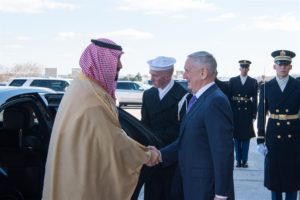
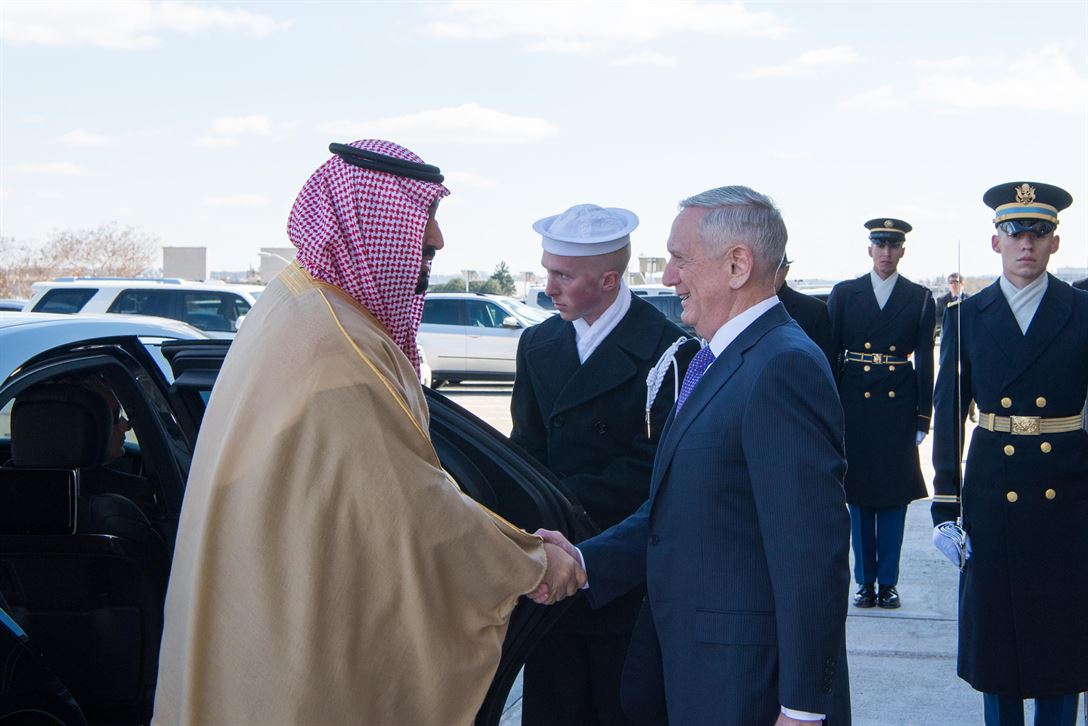
Defense Secretary Jim Mattis welcomes Saudi Deputy Crown Prince and Defense Minister Mohammed bin Salman to the Pentagon, March 16, 2017. (DoD photo by Sgt. Amber I. Smith)
four-page white paper, prepared by President Trump’s National Security Council staff and released by the White House on Tuesday, claimed that U.S. intelligence has proof that the plane carrying the sarin gas left from the Syrian military airfield that Trump ordered hit by Tomahawk missiles on April 6.

The paper asserted that “we have signals intelligence and geospatial intelligence,” but then added that “we cannot publicly release all available intelligence on this attack due to the need to protect sources and methods.”

I’m told that the key evidence was satellite surveillance of the area, a body of material that U.S. intelligence analysts were reviewing late last week even after the Trump-ordered bombardment of 59 Tomahawk missiles that, according to Syrian media reports, killed seven or eight Syrian soldiers and nine civilians, including four children.

Yet, it is unclear why releasing these overhead videos would be so detrimental to “sources and methods” since everyone knows the U.S. has this capability and the issue at hand – if it gets further out of hand – could lead to a nuclear confrontation with Russia.

In similarly tense situations in the past, U.S. Presidents have released sensitive intelligence to buttress U.S. government assertions, including John F. Kennedy’s disclosure of U-2 spy flights in the 1962 Cuban Missile Crisis and Ronald Reagan revealing electronic intercepts after the Soviet shoot-down of Korean Airlines Flight 007 in 1983.

Yet, in this current case, as U.S.-Russian relations spiral downward into what is potentially an extermination event for the human species, Trump’s White House insists that the world must trust it despite its record of consistently misstating facts.

In the case of the April 4 chemical-weapons incident in the town of Khan Sheikhoun, which reportedly killed scores of people including young children, I was told that initially the U.S. analysts couldn’t see any warplanes over the area in Idlib province at the suspected time of the poison gas attack but later they detected a drone that they thought might have delivered the bomb.

A Drone Mystery

According to a source, the analysts struggled to identify whose drone it was and where it originated. Despite some technical difficulties in tracing its flight path, analysts eventually came to believe that the flight was launched in Jordan from a Saudi-Israeli special operations base for supporting Syrian rebels, the source said, adding that the suspected reason for the poison gas was to create an incident that would reverse the Trump administration’s announcement in late March that it was no longer seeking the removal of President Bashar al-Assad.
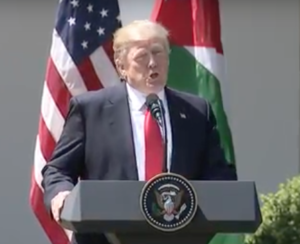
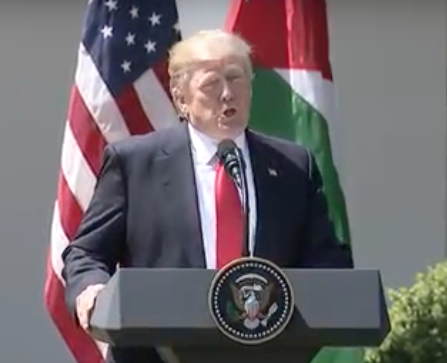
President Trump at a news conference with Jordan’s King Abdullah II on April 5, 2017, at which the President commented on the crisis in Syria. (Screen shot from whitehouse.gov)
If indeed that was the motive — and if the source’s information is correct — the operation would have been successful, since the Trump administration has now reversed itself and is pressing Russia to join in ousting Assad who is getting blamed for the latest chemical-weapons incident.

Presumably, however, the “geospatial intelligence” cited in the four-page dossier could disprove this and other contentions if the Trump administration would only make its evidence publicly available.

The dossier stated, “Our information indicates that the chemical agent was delivered by regime Su-22 fixed-wing aircraft that took off from the regime-controlled Shayrat Airfield. These aircraft were in the vicinity of Khan Shaykhun approximately 20 minutes before reports of the chemical attack began and vacated the area shortly after the attack.”
So, that would mean – assuming that the dossier is correct – that U.S. intelligence analysts were able to trace the delivery of the poison gas to Assad’s aircraft and to the airfield that Trump ordered attacked on April 6.

Still, it remains a mystery why this intelligence assessment is not coming directly from President Trump’s intelligence chiefs as is normally the case, either with an official Intelligence Estimate or a report issued by the Director of National Intelligence.
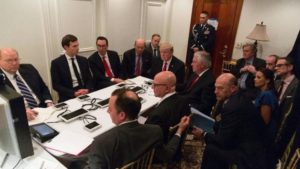
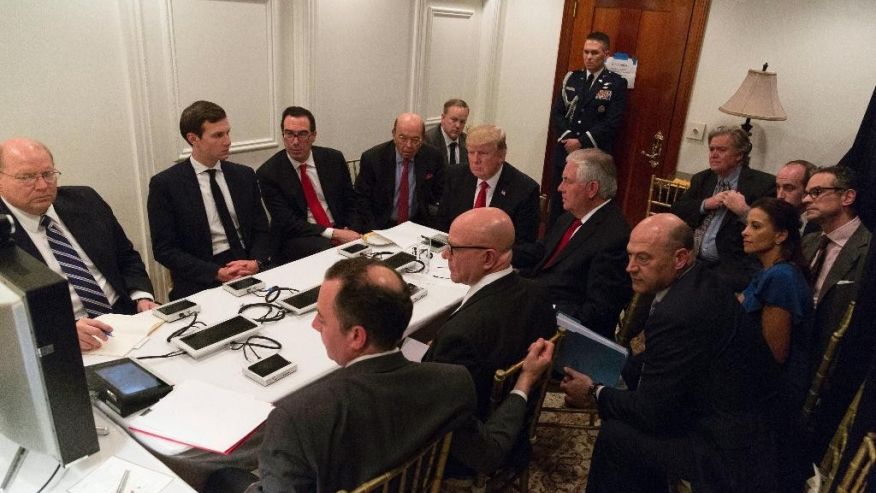
The photograph released by the White House of President Trump meeting with his advisers at his estate in Mar-a-Lago on April 6, 2017, regarding his decision to launch missile strikes against Syria.
The White House photo released late last week showing the President and a dozen senior advisers monitoring the April 6 missile strike from a room at his Mar-a-Lago estate in Florida was noteworthy in that neither CIA Director Mike Pompeo nor Director of National Intelligence Dan Coats was in the frame.
Now, it is the White House that has released the four-page dossier supposedly summing up the assessment of the “intelligence community.”

An Argumentative Dossier

The dossier also seems argumentative in that it assumes that Russian officials – and presumably others – who have suggested different possible explanations for the incident at Khan Sheikdoun did so in a willful cover-up, when any normal investigation seeks to evaluate different scenarios before settling on one.

It is common amid the “fog of war” for people outside the line of command – and even sometimes inside the line of command – to not understand what happened and to struggle for an explanation.

On April 6, before Trump’s missile strike, I and others received word from U.S. military intelligence officials in the Middle East that they, too, shared the belief that the poison gas may have resulted from a conventional bombing raid that ruptured containers stored by the rebels, who – in Idlib province – are dominated by Al Qaeda’s affiliate and its allies.

Those reports were cited by former U.S. intelligence officials, including more than two dozen who produced a memo to President Trump urging him to undertake a careful investigation of the incident before letting this crisis exacerbate U.S.-Russia relations.
The memo said “our U.S. Army contacts in the area” were disputing the official story of a chemical weapons attack. “Instead, a Syrian aircraft bombed an al-Qaeda-in-Syria ammunition depot that turned out to be full of noxious chemicals and a strong wind blew the chemical-laden cloud over a nearby village where many consequently died,” the memo said.

In other words, to suggest possible alternative scenarios is not evidence of a “cover-up,” even if the theories are later shown to be erroneous. It is the normal process of sorting through often conflicting initial reports.

Even in the four-page dossier, Trump’s NSC officials contradicted what other U.S. government sources have told The New York Times and other mainstream news outlets about the Syrian government’s supposed motive for launching the chemical-weapons attack on the town of Khan Sheikhoun.

According to the earlier accounts, the Syrian government either was trying to terrorize the population in a remote rebel-controlled area or was celebrating its impunity after the Trump administration had announced that it was no longer seeking Assad’s removal.

But the dossier said, “We assess that Damascus launched this chemical attack in response to an opposition offensive in northern Hamah Province that threatened key infrastructure.” Although Khan Sheikhoun was not near the fighting, the dossier presented the town as an area of support for the offensive.

Assuming this assessment is correct, does that mean that the earlier explanations were part of a cover-up or a propaganda operation? The reality is that in such complex situations, the analyses should continue to be refined as more information becomes available. It should not be assumed that every false lead or discarded theory is proof of a “cover-up,” yet that is what we see here.
“The Syrian regime and its primary backer, Russia, have sought to confuse the world community about who is responsible for using chemical weapons against the Syrian people in this and earlier attacks,” the dossier declared.

But the larger point is that – given President Trump’s spotty record for getting facts straight – he and his administration should go the extra mile in presenting irrefutable evidence to support its assessments, not simply insisting that the world must “trust us.”

[In a separate analysis of the four-page dossier, Theodore Postol, a national security specialist at the Massachusetts Institute of Technology, concluded that the White House claims were clearly bogus, writing:

“I have reviewed the document carefully, and I believe it can be shown, without doubt, that the document does not provide any evidence whatsoever that the US government has concrete knowledge that the government of Syria was the source of the chemical attack in Khan Shaykhun, Syria at roughly 6 to 7 a.m. on April 4, 2017. 

“In fact, a main piece of evidence that is cited in the document points to an attack that was executed by individuals on the ground, not from an aircraft, on the morning of April 4. This conclusion is based on an assumption made by the White House when it cited the source of the sarin release and the photographs of that source. My own assessment, is that the source was very likely tampered with or staged, so no serious conclusion could be made from the photographs cited by the White House.”]

Investigative reporter Robert Parry broke many of the Iran-Contra stories for The Associated Press and Newsweek in the 1980s. You can buy his latest book, America’s Stolen Narrative, either in print here or as an e-book (from Amazon and barnesandnoble.com).