COLLECTIVE MADNESS


“Soft despotism is a term coined by Alexis de Tocqueville describing the state into which a country overrun by "a network of small complicated rules" might degrade. Soft despotism is different from despotism (also called 'hard despotism') in the sense that it is not obvious to the people."

Monday, September 28, 2015

“I cannot help asking those who have forced this situation, do you realize now what you have done?” Putin said - Only a Republican could be so egregiously dishonest, utterly shameless or blatantly ignorant enough to deny the integrity in Putin’s statement.

“COWARDS” and REAL MEN” - You Judge


Home / Features / In Gaza no figures can express the sorrow

In Gaza no figures can express the sorrow

26th September 2015 | International Solidarity Movement, Gaza Team | Gaza Strip, Occupied Palestine
If there is any reason for our existence, at least it should be our capacity to inform about a story while it is happening, in a way that nobody can say: We did not know, nobody had told us anything”
Robert Fisk
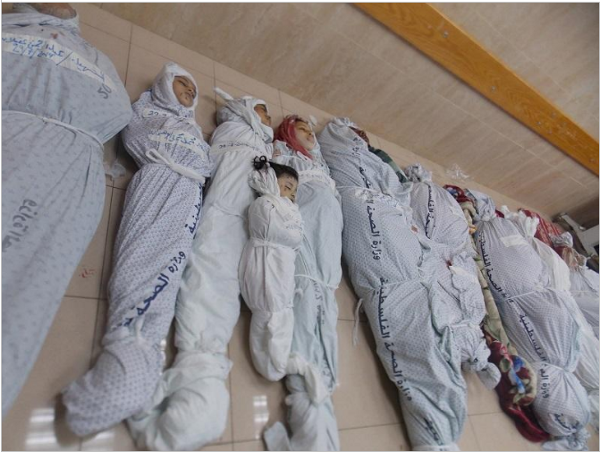
I don’t know if pain can destroy or fortify, I only know that pain changes everything. I also know that the recollection of such suffering shall remain, has to remain in my memory. At the beginning of the Israeli aggression, the first days of last July, I had promised myself not to forget the names of the children that were killed, those who I photographed horrified in the nightmare’s morgues in Gaza under fire.
In that moment I didn’t know that it would be impossible to keep that promise. More than 500 names of children, destroyed by bombs should be now pronounced by my voice, one by one. However, I do not forget, I can not nor want to forget.
The crimes and brutality do not deserve forgetfulness nor forgiveness, onlyrage. An unmitigated rage that drives us to act, to fight to prevent that their murders go unpunished, so that death won’t be in vain, even though the death of children always is. They are gone, we cannot bring them back to life, but we can, have to punish their executioners.
It is 10 am and several drone’s fire impact onto a house in Deir Al Balah while a Bulldozer recovers the remains of a family, buried under a one-ton bomb dropped by a F-16, those that leave craters, smoke and smell of death, where before were homes, affections, dreams, lives.
Bodies of children killed in Israeli attack on Gaza last year
The ambulance fills with wounded persons in seconds, a man enters carrying a small body of a child about six or seven years old, the boy lacks the right calf, his foot is hanging from a tendon or a shred of skin, I don’t know, I don’t want to look, but I do.
The boy squirms and his intestines are out of his belly, I help the man to lay down the child on the floor of the ambulance – the only stretcher is already occupied by another injured person. The ambulance drives fast to the Al-Aqsa Hospital, located in the central area of the Strip, the same hospital that has been attacked by Israel leaving seven dead and over seventy injured.
At each turn the child’s blood is spilled on the floor of the ambulance, I put my hand over his eyes to prevent him seeing his own intestines, I don’t want to see them either, or step on his blood; I don’t want to see his father mourn and cry in despair. But who cares about what I want? What his father wants? With all the impotence of his anguish, with all the force of his love, everything is banal, useless, tiny compared to death.
Boy wounded by Israeli forces during last year's attack on Gaza on the ambulance floor
Boy wounded by Israeli forces during last year’s attack on Gaza on the ambulance floor
The murderers do not care about anything nor the world. For Israel it is easy to kill, Israel is massacring children for free.
A man in the ambulance asks, demands the father to pray, and then they start to pray together, everybody who can articulate a word inside the crowded vehicle prays, I don’t do it, I don’t know how, I just hold his light head of shaved hair in my hand with the other I still cover his eyes. 
I look at him and strange details are recorded in my mind, terrible and tender ones. His little face is beautiful despite the agony that deforms his face. I think he has his hand clenched into a fist because of the pain then I look again and it is not a fist – the Israeli bomb has torn all his fingers and the little bones are now protruding from his knuckles, they are fragile, white and thin, like those of a bird.
The boy stops squirming slowly and his lips turn pale, I’m relieved that he is no longer struggling, that his intestines stop escaping from his belly, I’m relieved by this calm so close to the end, it relieves me so much that I feel guilty. Till this day I do not know his name, I only know that he died minutes after arriving at the hospital.
On the ruins of my house I hoisted the Palestinian flag, it is our symbol of resistance,” tells me Ahmed without any drama and then smiles, “now my family lives in a crowded shelter in a school”.
Less than a block away, in Beit Hanoun, seven little girls are sitting on a rickety mattress under a makeshift tent, here called “Jaima”, located next to some rubble that once was their home. Through an unstable triangle of collapsing walls the girls enter into this concrete tomb to retrieve a doll, rescued from an abyss of desolation and then smile.
The joy, that bombproof joy, I think amazed, resists death in Palestine, and sometimes just sometimes wins the battle, and if it doesn’t win at least dignifies it, dignifies and saves it from brutality and impunity.
More than 100.000 people have lost their homes under the Israeli bombs that devastated Gaza during the fifty one days of cowardly attacks.
Shelling from F-16s, Apache helicopters, drones, tanks, mortars and all the machinery of war they have – thanks to the support of the so called western democracies – the occupying entity sadly known as Israel uses machinery of war that allowed them to raze entire neighborhoods from the infamous distance of their powerful ships, but did not allow them to defeat the Palestinian resistance in the field, in a man to man combat because that requires that there were men on both sides. The courage and love for the land cannot be purchased with US Dollars in the arms market.
Zionist aggression caused a real slaughter, the almost 70 years of Israeli occupation still remains and it will continue causing damages and death mainly among women, youth and children, as Israel’s military objectives are always homes, mosques, schools used as shelters, ambulances. That’s where those perish who had previously survived the cowardly brutality of Israel, to die after, to continue dying a thousand times in this slaughterhouse called Gaza.
The numbers speak for themselves but today I cannot contain human suffering into figures. Sorrow is not measurable, sorrow is just that and it is everything.

Saturday, September 26, 2015

The Israeli Manufactured Lie to Get the US into War With Iran

Myth Surrounding Alleged Iranian Nuclear Facility Begins to Unravel 

Posted on Sep 24, 2015
By Gareth Porter, Middle East Eye
Ronald Zak / AP
This piece first appeared at Middle East Eye.

For well over three years, heavy doses of propaganda have created a myth about a purported steel cylinder for testing explosives located on a site at Iran’s Parchin military testing reservation. Iran was refusing to allow the International Atomic Energy Agency (IAEA) to inspect the site while it sought to hide its past nuclear weapons-related work, according to that storyline.

Now Iran has agreed to allow the IAEA to visit the site at Parchin and environmental samples have already been collected at the site. However, the politically charged tale of the bomb test chamber of Parchin is beginning to unravel. IAEA director general Yukiya Amano entered the building in which the explosives chamber had supposedly been located on Monday and announced afterward that he found “no equipment” in the building.

That is surely a major story, in light of how much has been made of the alleged presence of the chamber at that location. But you may have missed that news, unless you happened to read the story by Jonathan Tirone of Bloomberg Business News, who was the only journalist for a significant news outlet who chose to lead with the story in his coverage of Amano’s Monday visit.

The rest of the news media buried that fact far down in their stories, focusing almost entirely on the fact that the Iranians have been allowed to physically gather environmental samples at the site under the gaze of IAEA technicians rather than IAEA inspectors carrying out that function.

The main storyline associated with the purported bomb cylinder since early 2012 has been that Iran has been removing evidence from the site for years in anticipation of an eventual IAEA inspection in order to hide the evidence of past experiments using the purported chamber. But the full story of that mysterious chamber makes it clear that it was highly dubious from the start.

The first description of an explosive chamber at Parchin appeared in an IAEA report published in early November 2011. But less than two weeks after the story of the cylinder was reported in the media, Associated Press reporter George Jahn published a report that an official of an unidentified state had “cited intelligence from his home country, saying it appears that Iran is trying to cover its tracks by sanitising the site and removing any evidence of nuclear research and development”.

The official provided an “intelligence summary” from which Jahn quoted: “Freight trucks, special haulage vehicles and cranes were seen entering and leaving” the site on 4-5 November 2011, it said, and “some equipment and dangerous materials were removed from the site”.


Disputed Intelligence

 The purpose of that language was clearly to suggest that Iran had actually removed the cylinder and the nuclear materials that it had been testing. If true, it would have been very incriminating evidence of Iran’s nuclear deception. But there was a problem with that claim. Officials of two other IAEA member states that were obviously following the aerial photography of the Parchin site closely denied that the story being peddled to Jahn by the unnamed state was true.

It was true that there was more activity than normal at the site on those days, they told Jahn, but nothing resembling the activities claimed by the unidentified state’s “intelligence summary”. One of those two countries denying the story was clearly the United States. Pentagon spokesman Captain John Kirby told Jahn he had “seen nothing to indicate that those concerns are warranted”.

The episode of the AP story begs the obvious question: Why was the state that could not be named so intent on planting a false story of Iranian removal of the purported cylinder? The obvious purpose of such a story would be to prepare government and public opinion for a possible IAEA visit to the site in the future, and the subsequent discovery that there was nothing incriminating at the site. 
That, in turn, indicates that the state in question was the same one that had provided the original story of the explosive cylinder to the IAEA and that it already knew that no cylinder would be found there because the original story had been a fabrication.


Israeli-Supplied Documents


The IAEA member state that had provided the information about a purported bomb cylinder was never identified by the IAEA. But IAEA director-general Mohamed El Baradei asserts in his memoirs that in the summer of 2009 Israel turned over to the IAEA a number of intelligence documents purporting to show that Iran had carried out nuclear weapons work “until at least 2007,” most of which consisted of purported Iranian official documents whose authenticity had been questioned by some of the agency’s technical experts.

El Baradei refused to bow to diplomatic pressures from Israel’s allies, coordinated by the head of Israel’s Atomic Energy Commission, to publish a compendium of those documents, including the claim in an intelligence report of the Parchin explosives cylinder. The Israelis and the Obama administration had to wait until Amano succeeded him and agreed to do exactly that. 

The episode of the AP story isn’t the only evidence that the unidentified state had concocted an intelligence document on Parchin that was a complete falsehood. In August 2012, an IAEA report stated that the agency had acquired the satellite imagery available on the Parchin site for the entire period from February 2005 to January 2012. The report revealed that the imagery showed “virtually no activity at or near the building housing the containment vessel” during that entire period.imagery clearly suggested that Iran had not been using the site for any sensitive activities, much less the activities suggested by the IAEA in its report, during the seven years, nor had they engaged in any cleanup of the site.
And an earlier episode sheds further light on the issue. In 2004, John Bolton, then the administration’s Iran policymaker, leaked satellite imagery of sites at Parchin that had features someone believed might be high explosives testing facilities. After a few months of bullying by Bolton, the IAEA asked to visit Parchin. Iran not only agreed to an inspection in February 2005 but allowed the IAEA to choose any five sites in any one of the four Parchin quadrants – after the inspection team’s arrival - and take environmental samples anywhere at the sites. And in November 2005, after El Baradei requested a second inspection, Iran again gave the IAEA the choice of five more sites at which to take samples.

The significance of those two 2005 IAEA inspections is not merely that the environmental samples all came back negative. More important, Iran would never have allowed the IAEA to choose to take environmental samples anywhere it chose at Parchin if it had carried out nuclear-weapons related experiments as claimed later by the unidentified state.

Beginning in spring 2012 and continuing right up to the Vienna round of Iran nuclear negotiations last summer, the IAEA, Western diplomats and David Albright of the Institute for Science and International Security generated many dozens of stories about Iran’s “stonewalling” the IAEA on Parchin while it sought to remove evidence of its purported nuclear-related testing at the site. Those stories invariably used the term “sanitising” – the same word the Israeli official used in passing on the false story to AP. 

Those stories were just as dishonest as the original Israeli story because the IAEA and Western diplomats assigned to it know very well that there is no way to remove all traces of nuclear material from a site. In 2013, Stephan Vogt, the head of the IAEA’s environmental sample laboratory, declared in an interview: “You cannot get rid of them by cleaning, you cannot dilute them to the extent that we will not be able to pick them up.” Strangely, however, even after that interview was published, the Parchin stories continued as if Vogt had not revealed the impossibility of “sanitising” a site that had held nuclear material.

We are now only a few weeks away from the release of the environmental sampling results at Parchin. It will be amusing to this writer to see how the governments and news media who pushed the Parchin myth manage that story.


Gareth Porter is an independent investigative journalist and winner of the 2012 Gellhorn Prize for journalism. He is the author of the newly published Manufactured Crisis: The Untold Story of the Iran Nuclear Scare.

Even as America’s wars continue to go poorly by any reasonable measure, no prominent high-ranking officer has yet stepped forward either to take responsibility or in protest.

Seventy years of military mediocrity

The shared failings of america’s military academies and senior officers

21 AUGUST, by William J. Astore
Thomas Jefferson Hall, West Point’s library and learning center, prominently features two quotations for cadets to mull over. In the first, Jefferson writesGeorge Washington in 1788: “The power of making war often prevents it, and in our case would give efficacy to our desire of peace.” In the second, Jefferson writes Thomas Leiper in 1815: “I hope our wisdom will grow with our power, and teach us that the less we use our power, the greater it will be.”
Two centuries ago, Jefferson’s points were plain and clear, and they remain so today: while this country desired peace, it had to be prepared to wage war; and yet the more it avoided resorting to raw military power, the more it would prosper.
Have America’s military officers and politicians learned these lessons? Obviously not. In the twenty-first century, the U.S. unquestionably ranks number one on this planet in its preparations for waging war — we got that message loud and clear — but we’re also number one in using that power aggressively around the globe, weakening our nation in the process, just as Jefferson warned.
Of course, the world today is a more complex and crowded place than in Jefferson’s time and this country, long a regional, even an isolationist power, is now an imperial and global superpower that quite literally garrisons the planet. That said, Jefferson’s lessons should still be salutary ones, especially when you consider that the U.S. military has not had a convincing victory in a major “hot” war since 1945.
There are undoubtedly many reasons for this, but I want to focus on two: what cadets at America’s military academies really learn and the self-serving behavior of America’s most senior military officers, many of whom are academy graduates. Familiar as they may be with those words of Jefferson, they have consistently ignored or misapplied them, facilitating our current state of endless war and national decline.

America’s military academies: high ideals, cynical graduates

America’s military academies are supposed to educate and inspire leaders of strong character and impeccable integrity. They’re supposed to be showcases for America’s youth, shining symbols of national service. Ultimately, they’re supposed to forge strong military leaders who will win America’s wars (assuming those wars can’t be avoided, as Jefferson might have added). So how’s their main mission going?
I taught at the Air Force Academy for six years, and I’ve talked to former cadets as well as fellow officers who taught at the Army’s West Point and the Navy’s Annapolis. Here are a few reflections on the flaws of these institutions:
1. In reality, the unstated primary mission of the three military academies is to turn raw cadets into career officers dedicated and devoted to their particular branch of service. On the other hand, service to the American people is, at best, an abstract concept. More afterthought than thought, it is certainly mentioned but hardly a value consistently instilled.
Careerism and parochialism are hardly unique to military academies. Still, as one former cadet wrote me, it’s surprising to encounter them so openly in institutions dedicated to “service before self.” More than a few of his peers, he added, were motivated primarily by a desire for “a stable, well-paying career.” While a perfectly respectable personal goal, to be sure, it’s a less than desirable one at academies theoretically dedicated to selfless, even sacrificial service.
2. The academic curriculum is structured to prepare cadets for the technical demands of their first jobs, meaning that it’s heavily weighted toward STEM(science/technology/engineering/math). Despite the presence of a Cadet Honor Code, the humanities and questions of ethics play too small a role in the intellectual and moral development of the students.
3. Cadets quickly learn that excelling within the system is the surest path to coveted opportunities — increasingly scarce pilot slots, Special Ops schools, or the like — after graduation. Educationally speaking, they are driven by the idea of advancement within the conformist norms defined by their particular academy and branch of service. A system that rewards energetic displays of conformity also tends to generate mediocrity as well as cynicism. As one former cadet put it to me, “There is something deeper and more perverse here as well: The ‘golden boys’ [in the eyes of Academy officialdom] got the coveted slots but were generally hated by their cynical peers. Cynicism seems to define the Academy experience.”
A former colleague of mine had this comment: “The [military] academies don’t make great people and they don’t always make good people better. I have seen them turn off a few really good people, however.”
4. Because the academies are considered prestige institutions as well as symbols of rectitude and their reputations are always at stake, few risks are taken. Misconduct, when it occurs, is frequently hushed up “for the good of the Academy.” Scandals involving cheatingsexual assaults, and religious discrimination have often been made worse by not being dealt with openly and honestly. Cadets know this, which is another reason many emerge from their education as cynics when it comes to the high ideals the academies are supposed to instill.
5. As schools, they are remarkably insular, insider outfits often run by academy graduates whose goals tend to be narrow and sometimes even bizarrely parochial. For example, I knew of one superintendent (a three-star general) at the Air Force Academy whose number one goal was a winning football program. In that sense, he certainly reflected American society: think of the civilian college presidents who desire just that for their institutions. But military academies are supposed to be about creating leaders, not winning football trophies — and the two bear remarkably little relationship to each other no matter how many times the Duke of Wellington is (mis)quoted about the Battle of Waterloo being won on the playing fields of Eton.
6. Finally, there’s a strong emphasis at all the academies on simply keeping cadets busy. To the point where — especially in their first year — they’re often sleep-deprived and staggering into class. Theoretically, this is meant to be a test both of their commitment to military life and their ability to handle pressure. Whether they learn anything meaningful while dazed or sleeping in class is not discussed. Whether this is a smart way to develop creative and strong-minded leaders is also not up for consideration.
As one former cadet put it: busywork and demanding rituals that sometime cross the line and become hazing are embraced in military education as a “rite of passage.” The idea “that we [cadets] suffered through something and prevailed is an immensely powerful psychological ‘badge’ which leads to pride (or arrogance) and confidence (or hubris).”
Add up the indoctrination and the training, the busywork in classrooms and the desire to excel in big-time collegiate sports, and what you tend to graduate is a certain number of hyper-motivated true believers and a mass of go-along cynics — young men and women who have learned to subsume their doubts and misgivings, even as they trim their sails in the direction of the prevailing winds.
While the cadets are encouraged to over-identify with their particular academy and service branch, they’re also encouraged to self-identify as “warriors,” as, that is, an elite apart from and superior to the civilians they’re supposed to serve. That this country was founded on civilian control of the military may be given lip service, but in the age of the ascendant national security state, the deeper sentiments embedded in an academy education are ever more distant from a populace that plays next to no part in America’s wars.
That the classic civilian-military nexus, which was supposed to serve and promote democracy, has turned out to have a few glitches in our time should surprise no one. After all, President Dwight Eisenhower warned us about what was coming back in 1961. As Ike noticed, the way it was working — the way it still works today — is that senior officers in the military too often become tools of the armaments industry (his “military-industrial complex”) even as they identify far too closely with the parochial interests of their particular service branch. Add to this the distinctly twenty-first-century emphasis on being warriors, not citizen-soldiers, and you have the definition of a system of self-perpetuating and self-serving militarism rather than military service.
To the extent that the military academies not only fail to curb this behavior but essentially encourage it, they are failing our democracy.

America’s senior officers: lots of ribbon candy, no sweetness of victory

In my first article for TomDispatch back in 2007, I wrote about America’s senior military leaders, men like the celebrated David Petraeus. No matter how impressive, even kingly, they looked in their uniforms festooned with ribbons, badges, and medals of all sorts, colors, and sizes, their performance on the battlefield didn’t exactly bring to mind rainstorms of ribbon candy. So why, I wondered then, and wonder still, are America’s senior military officers so generally lauded and applauded? What have they done to deserve those chests full of honors and the endless praise in Washington and elsewhere in this country?
By giving our commanders so many pats on the back (and thanking the troops so effusively and repeatedly), it’s possible that we’ve prevented the development of an American-style stab-in-the-back theory — that hoary yet dangerous myth that a military only loses wars when the troops are betrayed by the homefront. In the process, however, we’ve written them what is essentially a blank check. We’ve given them authority without accountability. They wage “our” wars (remarkably unsuccessfully), but never have to take the blame for defeats. Unlike President Harry Truman, famous for keeping a sign on his desk that read “the buck stops here,” the buck never stops with them.
Think about two of America’s most celebrated generals of the twenty-first century, Petraeus and Stanley McChrystal and how they fell publicly from grace. Both were West Point grads, both were celebrated as “heroes,” despite the fact that their military “surges” in Iraq and Afghanistan proved fragile and reversible. They fell only because Petraeus was caught with his pants down (in an extramarital affairwith a fawning biographer), while McChrystal ran afoul of the president by tolerating an atmosphere that undermined his civilian chain of command.
And here, perhaps, is the strangest thing of all: even as America’s wars continue to go poorly by any reasonable measure, no prominent high-ranking officer has yet stepped forward either to take responsibility or in protest. You have to look to the lower ranks, to lieutenant colonels and captains and specialists (and, in the case of Chelsea Manning, to lowly privates), for straight talk and the courage to buck the system. Name one prominent general or admiral, fed up with the lamentable results of America’s wars, who has either taken responsibility for them or resigned for cause. Yup — I can’t either. (This is not to suggest that the military lacks senior officers of integrity. Recall the way General Eric Shinseki broke ranks with the Bush administration in testimony before Congress about the size of a post-invasion force needed to secure Iraq, or General Antonio Taguba’s integrity in overseeing a thorough investigation of prisoner abuse at Abu Ghraib. Their good deeds did not go unpunished.)
Authority without accountability means no one is responsible. And if no one is responsible, the system can keep chugging along, course largely unaltered, no matter what happens. This is exactly what it’s been doing for years now in Iraq, Afghanistan, and elsewhere.
Can we connect this behavior to the faults of the service academies? Careerism. Parochialism. Technocratic tendencies. Elitism. A focus on image rather than on substance. Lots of busywork and far too much praise for our ascetic warrior-heroes, results be damned. A tendency to close ranks rather than take responsibility. Buck-passing, not bucking the system. The urge to get those golden slots on graduation and the desire for golden parachutes into a lucrative world of corporate boards and consultancies after “retirement,” not to speak of those glowing appearances as military experts on major TV and cable networks.
By failing to hold military boots to the fire, we’ve largely avoided unpleasantness between the military and its civilian leadership, not to speak of the American public. But — and here’s the rub — 70 years of mediocrity since World War II and 14 years of failure since 9/11 should have resulted in anti-war protests, Congressional hearings, and public controversy. It should have created public discord, as it did during the Vietnam War, when dissent was a sign of a healthy democracy and an engaged citizenry. Nowadays, in place of protest, we hear the praise, the applause, the thank-yous followed by yet another bombastic rendition of “God Bless America.” Let’s face it. Our military has failed us, but haven’t we failed it, too?

Listening again to Jefferson

America’s military academies are supposed to be educating and developing leaders of character. If they’re not doing that, why have them? America’s senior military leaders are supposed to be winning wars, not losing them. (Please feel free to name one recent victory by the U.S. military that hasn’t been of the Pyrrhic variety.) So why do we idolize them? And why do we fail to hold them accountable?
These are more than rhetorical questions. They cut to the heart of an American culture that celebrates its military cadets as its finest young citizens, a culture that lauds its generals even as they fail to accept responsibility for wars that end not in victory but — well, come to think of it, they just never end.
The way forward: I don’t have to point the way because Thomas Jefferson already did. Just read his quotations in the West Point library: we need to become a peace-loving nation again; we need to act as if war were our last resort, not our first impulse; we need to recognize that war is corrosive to democracy and that the more military power is exercised the weaker we grow as a democratic society.
Jefferson’s wisdom, enshrined at West Point, shouldn’t be entombed there. We need a new generation of cadets — and a few renegade generals of my generation as well — who want to serve us by not going to war, who know that a military is a burden to democracy even when victorious, and especially when it’s not. Otherwise, we’re in trouble in ways we haven’t yet begun to imagine.

Israel, the New Rhodesia - “At the top of the racist pyramid was Israel’s founder David Ben-Gurion”


Israeli IDF thugs attack journalists

The dark narrative of Israel's Rhodesia fantasy


The Rhodesia fantasy sees an Israel that can be controlled by a very small elite, what they refer to as a ‘villa in the jungle.’ At the heart of the delusion is an imagined community of ‘founders’ and an imagined majority status for what was always a minority.
By Seth J. Frantzman 972 MAG
Hagana militants training in the Yizrael Valley, January 3, 1948. (Photo by Zoltan Kluger/GPO)
Members of the pre-state Hagana militia, predecessor to the IDF, training in the Yizrael Valley, January 3, 1948. (Photo by Zoltan Kluger/GPO)
Earlier this month the editor of a major newspaper in Israel complained that the “non-Zionist tribes” were gaining ground in Israel. “There is no consensus on a joint, unifying national ethos…Ultra-Orthodox Jews and Arabs, who do not wave the flag or sing the national anthem, reject the ‘Jewish and democratic’ formula. As long as they were weak, small minorities, the center ignored them and moved on. But when half the first-graders belong to the non-Zionist tribes, the national anthem and flag have a problem.”
This narrative has a history that stretches back to the 1950s. Every decade voices have risen in Israel that have discussed the demographic threat. Haaretzeditor Aluf Benn writes: “more ultra-Orthodox, Arabs and religious Jews and fewer secular Jews, the impact of demographic changes on Israeli society will only get stronger.” Ari Shavit writes about the capital of the country: “The battle for Jerusalem is almost lost. Haredi (ultra-Orthodox) students currently account for 39 percent of all the capital’s school children. Arab students account for 37 percent of the capital’s school children. Zionists account for only 24 percent of the capital’s school children and, of those, only half are secular.”
The demographic narrative is particularly interesting in Israel because it unites most streams of “Zionism,” from left to right. At the heart of the equation is “how many others are there” and “how many of us.” The definition of what is “us” changes depending on where one stands on the political spectrum. For the “Liberal Zionist left” it is about being secular and “liberal.” These kinds of debates were at the heart of the recent series of columns by Zionist Camp leader Isaac Herzog and Gideon Levy about whether Levy was “inside” the Zionist Camp or outside of it.
At a speech to the Herzliya Conference Herzog told the audience:

In about a decade, the Arabs between the Jordan and the Mediterranean will be a majority and the Jews a minority. The Jewish national home will become the Palestinian national home. We will be again, for the first time since 1948, a Jewish minority in an Arab state. I want to separate from the Palestinians. I want to keep a Jewish state with a Jewish majority. I don’t want 61 Palestinian MKs in Israel’s Knesset. I don’t want a Palestinian prime minister in Israel. I don’t want them to change my flag and my national anthem.
A fellow traveller in the Zionist-demographic narrative, S. Daniel Abraham writes, “Within its current borders, Israel is not a Jewish state. But the vast majority of Israeli Jews want to live in a Jewish state; most Jews worldwide want Israel to remain a Jewish state. Is Netanyahu listening at all?”
Border police officers stands in front of Palestinians as they wait to cross from Qalandiya checkpoint outside Ramallah, West Bank, into Jerusalem to attend the Ramadan Friday Prayers in the Al-Aqsa Mosque, July 26, 2013.
Border police officers hold back Palestinians waiting to cross through the Qalandiya checkpoint from Ramallah into Jerusalem to attend the Ramadan Friday Prayers in the Al-Aqsa Mosque, July 26, 2013.
There are four primary threats to the concept of the “core” Zionist Israel and the “others” who threaten it. First come those the Israeli press and politicians refer to as Arabs in Israel and as Palestinians over the Green Line. Then come the ultra-Orthodox or Haredi Jews. After them are the various groups portrayed as “immigrants,” such as Ethiopians, Russians, Mizrahim, and non-Jewish “converts.” Articles highlight the numerous “non-Jews” in Israel. Headlines shout, “new law could open Israel to millions of non-Jews”, the “wannabe Jews” and “fake Jews” who are casted as threatening the “Zionist core.” Even the ostensibly “liberal” Gideon Levy who rejects Herzog’s “Zionist core,” writes of “a million immigrants from Russia, a third of them non-Jews, some of whom…have a degree of alcohol and crime in their blood.
At the heart of the concept of “Zionist core” is an imagined community of “founders” of Israel and an imagined majority status for what was always a minority. Avigail Shaham writes of the kibbutz movement: “the fact that members were mostly Jewish doesn’t make it an ethnic community, if you meant that in the excluding sense. Just as it makes sense for a family to aspire to be a part of the same culture, heritage and language, it also makes sense for an intentional community, which in many ways is an extended version of a family.”
The concept of “intentional” community underpins “core Zionism,” which views Zionism as an exclusive preserve of a very small elite of European Jewish immigrants who came to Israel from the late 19th century to the early 20th century. In the period before Israel was created, these immigrants to Ottoman Palestine and then British Mandate Palestine, formed small communities of Jewish-Europeans only. Most of them were infused with communist and socialist ideas and blended that with Judaism and secular nationalism for a toxic mix of creating totally homogenous communities that they saw as the foundation for a national movement. When they founded a state based on their view, anyone who was not a member of the narrow movement became an “other.”
Old Jaffa
To solve the “problem” of having too many others in the country, barriers of acceptance were erected around the “intentional” communities, and the “others” were settled elsewhere. Arabs in Arab villages, immigrants from Morocco in Moroccan areas, immigrants from Yemen in their own moshavim or towns. During the Moroccan immigration, for instance, new “medical tests” were put in place to import only the strong “human material” for the young state, Avi Picard documented: “A host of medical and social restrictions were imposed on this wave of immigration. Candidates had to submit to medical examinations. Failure to appear for said examinations, or exhibiting negative behavior during them, constituted sufficient grounds for disqualifying the would-be immigrant.”
In 1951 Maj. Ezra Aaronson wrote a report on the nascent Israeli army and found the same sense of “othering” of non-Ashkenazi Jewish immigrants. “The new Israeli elite – composed almost entirely of European-born Jews – firmly held on to the view that Mizrahim were inferior.”
At the top of the racist pyramid was Israel’s founder David Ben-Gurion. In 1950 he noted, “The ingathering of the exiles is bringing us a rabble…Putting that rabble through a melting pot, reconstructing it in a human, Jewish, Israeli and afterward military way – that is the basis of soldiering.” But he had a dim view of all Jews who were not from his background, in 1965 he noted:

the young person from those countries has to be educated to sit on the toilet like a person, to wash, not to steal, not to grab an Arab girl and rape her and murder her – all this precedes the other things. Without it, the military training and education they receive is worthless…[Jews] from Morocco had no education. Their customs are those of Arabs. They love their wives, but they beat them… Maybe in the third generation something will appear from the Oriental Jew that is a little different. But I don’t see it yet. The Moroccan Jew took a lot from the Moroccan Arab, and I don’t see much we can learn from the Moroccan Arabs. The culture of Morocco I would not like to have here.
Jewish immigrants from Yemen at a camp near Rosh Ha’ayin. (Photo: GPO)
Jewish immigrants from Yemen at a camp near Rosh Ha’ayin. (Photo: GPO) The Israeli government placed immigrants from Arab countries into camps and later in peripheral ‘development towns’ instead of seeking to integrate them.
The basis of this view of non-Europeans was very much rooted in the European education and concepts of social Darwinism and eugenics that many leading Zionist “experts” in the 1950s had brought with them. For instance, German-born Col. Yehuda Wallach wrote: 

I have met three major types of Moroccans. For example, the educated urban Moroccan who was schooled in France and digested certain cultural values. There’s the urban Moroccan who came into contact with culture but did not digest it – he’s the Levantine type whom we know from the Beirut, Damascus or Jaffa Arab. And the Moroccan who comes from rural areas, who is ignorant and is at least a thousand years behind in terms of civilization.
In a sense this imagined community of “core Zionism” that was being constructed in the 1950s sought to rationalize the country along the same racial-ethnic ladder theories that had been common in Europe through the 1950s. Similar racial views of the “inherent” inferiority of other groups tarred U.S. thought in the Old South and in the South Africa of the 1960s and Henrick Verwoerd’s “rational” racism.
The “fathers” of Israeli sociology such as Arthur Ruppin were deeply involved in training entire generations of Israelis that anyone who was not European was inferior. For instance Shmuel Noah Eisenstadt, who influenced Israeli sociology from his perch at Hebrew University “developed a process for the socialization of the Mizrahim, which he termed ‘desocialization’ and ‘resocialization.’ First, the state must divest the immigrants of the Oriental cultural baggage with which they arrived in Israel; in the second stage they would be refashioned according to European cultural values.” When I studied at Hebrew University for my PhD in 2006, his views were still worshipped and accepted.
Members of Kibbutz Amir, June 30, 1940. (Zoltan Kluger/GPO)
The long affect of these views was to inculcate a view of what is called a “white tribe” in Israel. Even in the last Israeli elections of 2015 the concept of the struggle between the “white tribe” and the rest of Israel was very paramount. Nehemia Shtrasler defined this group as “an amorphous group comprising Jews of Ashkenazi origin who live in north Tel Aviv.” This is the same group that refers to itself as “core Zionism.” This is the “core” that is threatened by Arabs, haredim and everyone else. This is the “center” that is threatened by the “periphery.” Carlo Strenger sums this up neatly:

Much of Mizrahi voting patterns are therefore due to the fact that Mizrahim constitute the overwhelming majority of Israel’s lower socioeconomic percentiles and of Israel’s periphery…Israel’s left has tried to tackle the animosity of socioeconomically disadvantaged Mizrahim in the wrong way. It has desperately tried to show how socially minded it is, implicitly trying to ingratiate itself to the lower socioeconomic classes… we care about Israel’s remaining a liberal democracy, and our deepest concern is that Israel’s political right is undermining core liberal values.
+972’s Larry Derfner writes the same way, “I want to stress that I am referring only to poor, generally under-educated Mizrahim who make up the base of Likud supporters…Israeli leftists say we have to treat the poor Mizrahim as equals, we have to stop patronizing them.” He claims though that not all “Mizrahim” deserve to be outcast; “don’t turn your backs on the Mizrahim poor. They’re not all fascists by any means, and the ones who are have children, and those children need our solidarity.”

You want people like me to stay [in Israel]? You want the almost one million citizens who voted for Zionist Union and Meretz, whose form of Zionism and Judaism don’t align with yours, to not disengage from the rest of Israel? Prove to me that we are not outside the fence – because that is how it feels at the moment… Why should we feel extra responsibility for the education, health and welfare of all Israelis?
birthing-the-nationHe was wondering why the “Zionist core” that he is a part of, his “form of Zionism” should have to continue to pay for the “others,” those outside the “core.” When other members of this group speak of Jerusalem being “lost” because of “demographics” because of “too many first graders” from other groups, this is when we see the concept of Israel’s Rhodesia fantasy emerging.
The Rhodesia fantasy sees an Israel that can be controlled by a very small elite, what they refer to as a “villa in the jungle.” They pretend sometimes that their “Zionism” is being threatened or they are “outside the fence,” but the real fence is the one they erected in 1948. They erected fence after fence to keep “others” out. Whether it was restricting immigration, or the fences to keep the Arab minority from “infiltrating” or the curfews imposed until 1966 on Arabs in Israel, or the fences of the acceptance committees that keep all minorities out of rural communities, or the concept of center and periphery, development town and kibbutz, from 1948 to 2015 the concept has been to at once and the same time, fence out the “other” but maintain a Rhodesia concept of control of the majority by a tiny minority.
There has been no real attempt to impose a full Rhodesia solution to “save core Zionism” from the others, because of the 1977 elections and the decision by the military elite not to impose a coup on the solution. But you can hear in the voices of this angry group how much they fear their Rhodesia being eroded. It is “lost” they say, it is being “taken” from them, they complain. The children in schools no longer are “theirs” and no longer wave the right flag. The national “ethos” is gone.
It is interesting that they have self-defined the national “Zionist” ethos as their own, when they worked so hard to prevent Arabs, haredim, Mizrahim and everyone from partaking of that ethos. When you build an acceptance committee and only allow “your kind,” it is hard to then complain that the others didn’t embrace your values. How can the colonized embrace the values of the colonizer when they are the second-class citizens, Memmi would have wondered. Israel’s others are not exactly colonized, but they are unwanted. They are the vast majority of the country, some 80 percent, but they are seen as a threat to the “villa.”
The Rhodesia fantasy of “core Zionism” and the core being “eaten away” is precisely due to the failure to have created an inclusive society in Israel. Instead of viewing all the groups as a “threat” they should have been viewed as part of the country and included. Parties should be diverse, not ethnically homogenous. It isn’t just a problem of the 1950s, it is a problem of 2015 because those voices nurtured on Ruppin are now adults and view the country the same way: they were in the same youth group, raised in the same closed society, in the same units in the army, and their view of most of the country is that it is a threat and that it doesn’t even belong in the country. Mizrahim, Arabs and haredim are viewed as “foreigners” in a country that they are native to. When the first “core Zionists” got off the boats they were greeted by Sephardic families, Arab stevedores, and haredim. Those were the majority groups in the country and especially in places like Jerusalem. When people claim Jerusalem is “lost” because it has Arabs and haredim, it isn’t lost — they are the native inhabitants of Jerusalem.
Secular “core Zionism” has imagined itself as an indigenous national ethos which is entirely an imagined community. Had it wanted to be a core ethos it would have been more open and welcoming. It wasn’t and that is why it has failed and why its “core” is crumbling.
The author is a Jerusalem-based journalist and academic who holds a PhD from The Hebrew University of Jerusalem. This article was first published on his website.
For additional original analysis and breaking news, visit +972 Magazine's Facebook page or follow us on Twitter. Our newsletter features a comprehensive round-up of the week's events. Sign up here.