COLLECTIVE MADNESS


“Soft despotism is a term coined by Alexis de Tocqueville describing the state into which a country overrun by "a network of small complicated rules" might degrade. Soft despotism is different from despotism (also called 'hard despotism') in the sense that it is not obvious to the people."

Sunday, July 26, 2015

Turkey is bombing PKK in Iraq and ISIS in Syria

Turkey’s outlawed Kurdistan Workers’ Party says the conditions for maintaining a ceasefire with Ankara is no longer in place. This, after Turkish warplanes bombed PKK positions in northern Iraq. 

Two Turkish soldiers killed as tensions mount

Sunday 26 July 2015 11.32
1 of 2


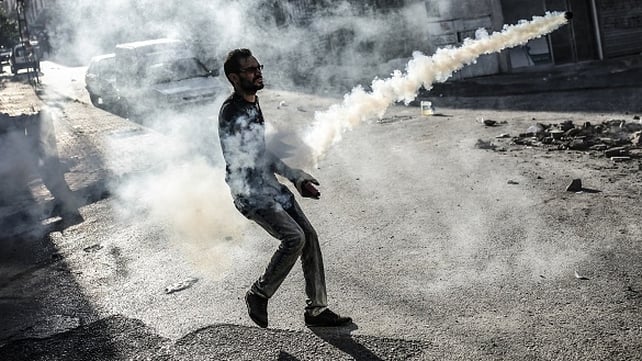
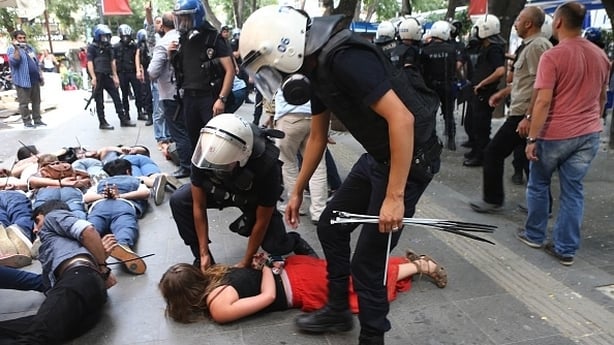
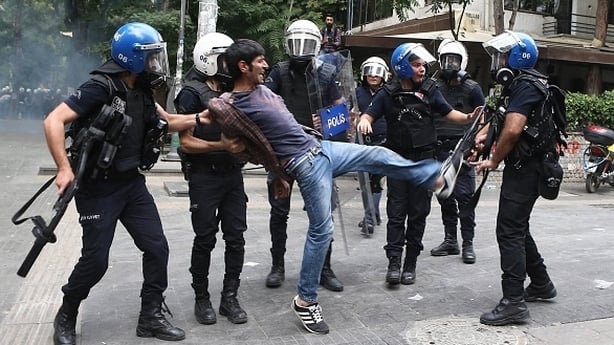
There have been a number of protests and confrontations with police in Ankara and Istanbul
Two Turkish soldiers were killed and four wounded in a car bomb attack on their convoy in the mainly Kurdish southeast of the country, officials said.
The attack came after the Kurdistan Workers Party (PKK) rebel group threatened to no longer observe a truce, following Turkish air strikes on its positions in northern Iraq.
It comes after a wave of unrest triggered by a suicide bomb in Suruc, blamed on so-called Islamic State which killed 32 people.
There have been a number of protests and confrontations with police in Ankara and Istanbul.
The car bomb went off as the soldiers were travelling on a road in the Lice district of the Diyarbakir province late yesterday, a statement from the Diyarbakir governor's office said.
"Two of our personnel were killed in the heinous attack, four were wounded," said the statement.
It said that large-scale operations have been launched to find the perpetrators.
The PKK had yesterday said that the conditions were no longer in place to observe a fragile ceasefire that has largely held since 2013.
It followed the heaviest Turkish air strikes on its positions in northern Iraq since 2011.
The PKK has for decades waged a deadly insurgency in the southeast of Turkey for self-rule that has claimed tens of thousands of lives.
A peace process that began in 2013 has so far failed to yield a final deal.
Meanwhile, the White House has said it welcomed Turkey's increased focus and efforts to fight Islamic State, and called the Kurdish militant PKK in Turkey a "terrorist" organisation.
The comments were made at a news briefing in Nairobi by a White House official during a visit to Kenya by US President Barack Obama.
Rally against IS to take place in Dublin
Meanwhile, hundreds of demonstrators are expected to gather on Dublin's O'Connell Street later to protest against the actions of the self-styled Islamic State.
The rally has been organised by the Irish Muslim Peace and Integration Council to distance Islam from the group, and show that it is a peaceful religion.
The "Not in Our Name" demonstration was organised in the wake of last month's terrorist attack in Tunisia which killed 38 people, including three Irish citizens.
Organisers say it is believed to be the first protest of its kind held in Ireland.
Keywords: pkk, turkey

GENERAL JOHN ALLEN ON ISIS IN FEBRUARY HEARINGS

Being reported today According to the Turkish newspaper Hurriyet Daily News, the deal, treated by the Turkish side as a “secret cabinet decree,” also includes plans for a “buffer zone” in northern Syria, something Ankara has long demanded as a means of escalating the war for regime change in Syria.
Gen. John Allen, Obama’s special envoy to the so-called coalition against ISIS, denied this during an appearance at the Aspen Security Forum in Colorado Thursday, saying that it “was not part of the discussion.”
State Department spokesman Mark Toner, however, cast doubt on this denial, stating in Washington that, while the Obama administration has concerns “about some of the logistical challenges inherent in a buffer zone…we obviously take threats to Turkey’s border seriously… So, we’re looking at options,” he said.
If this “option” is included in the deal, Turkey’s entry into the anti-ISIS campaign is being joined with a qualitative escalation of the US intervention in Syria.
:

Saturday, July 25, 2015

From The Jerusalem Post: Netanyahu the Disaster


The US Conga Line Giving Netanyahu His Blow Job


POLITICS AND DIPLOMACY

Netanyahu steered US toward war with Iran – the result is a deal he hates Netanyahu preferred US military strikes on Iran’s nuclear facilities, over Israeli ones, from the outset.

Much of the criticism of the Iran nuclear deal has focused on the fact that it is entirely limited to the nuclear issue, which leaves Iran a free hand — and new resources — to continue policies that have angered regional and international players. There is no denying that if Iran plays its hands well and uses the next decade to build its economic and political potential, its regional influence is likely to expand, as is its capacity to do the sort of things that have angered Israel and Gulf Arab states.

The deal’s biggest critic may be Prime Minister Benjamin Netanyahu, who called it “a historic mistake.” The irony is that the urgency with which the Obama administration pursued a nuclear deal was itself a product of Israeli actions. For Netanyahu, the deal was a good example of “be careful what you wish for.”

A little reminder is helpful here. To his credit, President Barack Obama succeeded early in his first term to get international support for sanctioning Iran - one critical reason for Iran’s willingness to take the negotiations more seriously. There have been deliberate and sustained efforts to continue pressuring Iran on multiple levels, including its behavior outside the nuclear issue.

Netanyahu preferred US military strikes on Iran’s nuclear facilities, over Israeli ones, from the outset. His calculus was that the key fear that could drive the US debate to support military strikes on Iran was the timeline of Iran’s nuclear program — not Tehran’s support for groups like Hamas and Hezbollah.

Netanyahu exaggerated the imminent nuclear threat as much as possible. Remember how many times, over the years, he cited Iran as being only six months away from a bomb? He gave the impression that Israel was prepared to take matters into its own hands by striking Iran’s nuclear facilities, even without US backing. Initially, however, most analysts, including US officials, believed he was simply bluffing.

There were many reasons why the United States didn’t take Netanyahu’s early threats seriously. For one, Israel’s capacity for sustained long-distance military operations remained limited. More important, even substantial US strikes were seen to have the capacity only to delay Iran’s nuclear program — not stop it.

Israel would then have also had to worry about Iranian and Hezbollah retaliation, as well as eventually dealing with a nuclear Iran. The focus on Iran was also seen as partly intended to shift attention from the Israeli-Palestinian conflict, where Netanyahu faced much international pressure.

But something happened in the lead-up to the 2012 US presidential elections. The Israeli pressure on the Obama administration to take action substantially increased.

At first, it was hard to know if this was merely a political play. It was no secret that Netanyahu preferred the Republican nominee for president, former Massachusetts Governor Mitt Romney. His pressure on Obama was seen to be playing into the Republicans’ hands. But there was far more to the story than politics.

The Israelis took steps in 2012 that portrayed as credible their threat to attack Iran – and inevitably drawing the United States into the fight. We don’t know much about the specifics, but reports revealed hints that the Obama administration was growing increasingly alarmed by Israel’s actions. The Netanyahu government was spending billions of dollars on a military buildup, as well as consolidating military cooperation with Azerbaijan near Iran’s northern borders.

Not until a year later were there whispered suggestions — including one from former prime minister Ehud Olmert — that Netanyahu had spent billions to make his threats look more credible to Washington rather than for serious military preparation.

What is clear is that the Israeli moves were taken seriously by the Obama administration, which shifted its assessment in 2012 as more high-level US officials began to take the Israeli threat to attack as credible.

Even aside from the coming presidential elections in November, the prospect was seen as disastrous for Obama. He was not going to allow himself to be dragged into another messy war in the Middle East with no end in sight. Only the Iran issue had the potential to do so, even after his re-election. And Obama also understood that the war would have been even worse for Israel.

How would war have been good for Israel? The Jewish state would have been, for the first time, at war with a Persian civilization (since all Iranians would likely have unified against the enemy) that would inevitably develop nuclear weapons anyway. It would have seemed that the United States was deliberately dragged into war on behalf of Israel — undermining the Israeli-US relationship. How in the world is that good for Israel?

So a nuclear deal that would avoid war — and make it less likely to result in an Iranian bomb than war — became the Obama administration’s priority. It went into full diplomatic gear and worked on multiple tracks. The administration did everything it could to make it happen before Obama left office.

Which also meant the focus of the deal had to ignore nonnuclear issues because that would have opened a Pandora’s Box by making an early agreement almost impossible. Besides, this was not merely a US-Iranian negotiation but one that involved five other countries, not to mention messy American and Iranian domestic politics.

Sure, there were other incentives along the way. The rise of Islamic State, for example, created common interests. Iran had leverage for involvement in troubled areas where US influence was limited: Syria and Iraq. Some may also have seen strategic leverage to be gained with two longtime US allies that can be hard to influence: Israel and Saudi Arabia.

But these were benefits that came after the fact. What truly focused US priorities was that Israel made it clear to the White House in 2011-12 that Washington could otherwise be dragged into a war it could not control. One that would likely have devastating effects on both the United States and Israel. Thus started Obama’s urgent search for a nuclear deal.

In clinching the deal with Iran, Obama has, above all, succeeded in averting a disastrous war that would not have prevented Tehran from acquiring nukes. And it was Netanyahu who made sure Obama thought war was on the horizon.

Friday, July 24, 2015

Military style police tactics do not make people just fear the police. They make people hate the police.

In Iraq, I raided insurgents. In Virginia, the police raided me.


Alex Horton is a member of the Defense Council at the Truman National Security Project. He served as an infantryman in Iraq with the Army’s 3rd Stryker Brigade, 2nd Infantry Division.
I got home from the bar soon after Saturday night bled into Sunday morning and fell into bed. I didn’t wake up until three police officers barged into my apartment, barking their presence at my door. They sped down the hallway to my bedroom, their service pistols drawn and leveled at me.
It was just past 9 a.m., and I was still under the covers. The only visible target was my head.
In the shouting and commotion, I felt an instant familiarity. I’d been here before. This was a raid.
I had done this a few dozen times myself, 6,000 miles away from my Alexandria, Va., apartment. As an Army infantryman in Iraq, I’d always been on the trigger side of the weapon. Now that I was on the barrel side, I recalled basic training’s most important firearm rule: Aim only at something you intend to kill.
I had conducted the same kind of raid on suspected bombmakers and high-value insurgents. But the Fairfax County officers in my apartment were aiming their weapons at a target whose rap sheet included parking tickets and an overdue library book.
My situation was terrifying. Lying facedown in bed, I knew that any move I made could be viewed as a threat. Instinct told me to get up and protect myself. My training told me that if I did, these officers would shoot me dead.
In a panic, I asked the officers what was going on but got no immediate answer. Their tactics were similar to the ones I used to clear rooms during the height of guerilla warfare in Iraq. I could almost admire it — their fluid sweep from the bedroom doorway to the distant corner. They stayed clear of one another’s lines of fire in case they needed to empty their Sig Sauer .40-caliber pistols into me.
They were well-trained, their supervisor later told me. But I knew that means little when adrenaline is injected into an imminent-danger scenario, real or imagined. Triggers are pulled. Mistakes are made.
I spread my arms out to either side. An officer jumped onto my bed and locked handcuffs onto my wrists. The officers rolled me from side to side, searching my boxers for weapons, then yanked me up to sit on the edge of the bed.
At first, I was stunned. I searched my memory for any incident that would justify a police raid. Then, it clicked.
Earlier in the week, the managers of my apartment complex moved me to a model unit while a crew repaired a leak in my dishwasher. But they hadn’t informed my temporary neighbors. So when one resident noticed the door slightly cracked open to what he presumed was an unoccupied apartment, he looked in, saw me sleeping and called the police to report a squatter. 
Sitting on the edge of the bed dressed only in underwear, I laughed. The situation was ludicrous and embarrassing. My only mistake had been failing to make sure the apartment door was completely closed before I threw myself into bed the night before.
I told the officers to check my driver’s license, nodding toward my khaki pants on the floor. It showed my address at a unit in the same complex. As the fog of their chaotic entry lifted, the officers realized it had been an unfortunate error. They walked me into the living room and removed the cuffs, though two continued to stand over me as the third contacted management to confirm my story. Once they were satisfied, they left.
When I later visited the Fairfax County police station to gather details about what went wrong, I met the shift commander, Lt. Erik Rhoads. I asked why his officers hadn’t contacted management before they raided the apartment. Why did they classify the incident as a forced entry, when the information they had suggested something innocuous? Why not evaluate the situation before escalating it?
Rhoads defended the procedure, calling the officers’ actions “on point.” It’s not standard to conduct investigations beforehand because that delays the apprehension of suspects, he told me.
I noted that the officers could have sought information from the apartment complex’s security guard that would have resolved the matter without violence. But he played down the importance of such information: “It doesn’t matter whatsoever what was said or not said at the security booth.”
This is where Rhoads is wrong. We’ve seen this troubling approach to law enforcement nationwide, in militarized police responses to nonviolent protesters and in fatal police shootings of unarmed citizens. The culture that encourages police officers to engage their weapons before their minds devalues information-gathering and endorses the mind-set that nothing, including citizen safety, is more important than officers’ personal security. That approach has caused public trust in law enforcement to deteriorate.
It’s the same culture that characterized the early phases of the Iraq war, in which I served a 15-month tour in 2006 and 2007. Soldiers left their sprawling bases in armored vehicles, leveling buildings with missile strikes and shooting up entire blocks during gun battles with insurgents, only to return to their protected bases and do it all again hours later.
The short-sighted notion that we should always protect ourselves first endangered us more in the long term. It was a flawed strategy that could often create more insurgents than it stopped and inspired some Iraqis to hate us rather than help us. 
In one instance in Baghdad, a stray round landed in a compound that our unit was building. An overzealous officer decided that we were under attack and ordered machine guns and grenade launchers to shoot at distant rooftops. A row of buildings caught fire, and we left our compound on foot, seeking to capture any injured fighters by entering structures choked with flames.
Instead, we found a man frantically pulling his furniture out of his house. “Thank you for your security!” he yelled in perfect English. He pointed to the billowing smoke. “This is what you call security?”
We didn’t find any insurgents. There weren’t any. But it was easy to imagine that we forged some in that fire. Similarly, when U.S. police officers use excessive force to control nonviolent citizens or respond to minor incidents, they lose supporters and public trust.
That’s a problem, because law enforcement officers need the cooperation of the communities they patrol in order to do their jobs effectively. In the early stages of the war, the U.S. military overlooked that reality, as well. Leaders defined success as increasing military hold on geographic terrain, while the human terrain was the real battle. For example, when our platoon entered Iraq’s volatile Diyala province in early 2007, children at a school plugged their ears just before an IED exploded beneath one of our vehicles. The kids knew what was coming, but they saw no reason to warn us. Instead, they watched us drive right into the ambush. One of our men died, and in the subsequent crossfire, several insurgents and children were killed. We saw Iraqis cheering and dancing at the blast crater as we left the area hours later.
With the U.S. effort in Iraq faltering, Gen. David Petraeus unveiled a new counterinsurgency strategy that year. He believed that showing more restraint during gunfights would help foster Iraqis’ trust in U.S. forces and that forming better relationships with civilians would improve our intelligence-gathering. We refined our warrior mentality — the one that directed us to protect ourselves above all else — with a community-building component.
My unit began to patrol on foot almost exclusively, which was exceptionally more dangerous than staying inside our armored vehicles. We relinquished much of our personal security by entering dimly lit homes in insurgent strongholds. We didn’t know if the hand we would shake at each door held a detonator to a suicide vest or a small glass of hot, sugary tea.
But as a result, we better understood our environment and earned the allegiance of some people in it. The benefits quickly became clear. One day during that bloody summer, insurgents loaded a car with hundreds of pounds of explosives and parked it by a school. They knew that we searched every building for hidden weapons caches, and they waited for us to gather near the car. But as we turned the corner to head toward the school, several Iraqis told us about the danger. We evacuated civilians from the area and called in a helicopter gunship to fire at the vehicle.
The resulting explosion pulverized half the building and blasted the car’s engine block through two cement walls. Shrapnel dropped like jagged hail as far as a quarter-mile away.
If we had not risked our safety by patrolling the neighborhood on foot, trusting our sources and gathering intelligence, it would have been a massacre. But no one was hurt in the blast.
Domestic police forces would benefit from a similar change in strategy. Instead of relying on aggression, they should rely more on relationships. Rather than responding to a squatter call with guns raised, they should knock on the door and extend a hand. But unfortunately, my encounter with officers is just one in a stream of recent examples of police placing their own safety ahead of those they’re sworn to serve and protect.
Rhoads, the Fairfax County police lieutenant, was upfront about this mind-set. He explained that it was standard procedure to point guns at suspects in many cases to protect the lives of police officers. Their firearm rules were different from mine; they aimed not to kill but to intimidate. According to reporting by The Washington Post, those rules are established in police training, which often emphasizes a violent response over deescalation. Recruits spend an average of eight hours learning how to neutralize tense situations; they spend more than seven times as many hours at the weapons range.
Of course, officers’ safety is vital, and they’re entitled to defend themselves and the communities they serve. But they’re failing to see the connection between their aggressive postures and the hostility they’ve encountered in Ferguson, Mo., Baltimore and other communities. When you level assault rifles at protesters, you create animosity. When you kill an unarmed man on his own property while his hands are raised — as Fairfax County police did in 2013 — you sow distrust. And when you threaten to Taser a woman during a routine traffic stop (as happened to 28-year-old Sandra Bland , who died a in Texas jail cell this month), you cultivate a fear of police. This makes policing more dangerous for everyone.
I understood the risks of war when I enlisted as an infantryman. Police officers should understand the risks in their jobs when they enroll in the academy, as well. That means knowing that personal safety can’t always come first. That is why it’s service. That’s why it’s sacrifice.
Twitter: @AlexHortonTX
Read more from Outlook and follow ou

There are no chosen people, there is not even a chosen planet. Time to recalibrate on the one that we have:

Nasa Kepler telescope: Earth-like planet found

  • 2 hours ago
A haul of 500 new planets discovered by Nasa's Kepler telescope includes a world sharing many characteristics with Earth.
Kepler-452b orbits at a very similar distance from its star, though its radius is 60% larger. 
Mission scientists said they believed it was the most Earth-like planet yet.
Such worlds are of interest to astronomers because they might be small and cool enough to have liquid water on their surface - and perhaps be able to support life.
Nasa's science chief John Grunsfeld called the new world "Earth 2.0" and the "closest so far" to our home.
It is around 1,400 light years away from Earth.
Artist's impressions of exoplanets
Artist's impressions of exoplanets discovered by Kepler, alongside Earth. From left: Kepler-22b, Kepler-69c, the just announced Kepler-452b, Kepler-62f, Kepler-186f and, finally, our planet
Infographic

Tuesday, July 21, 2015

How to know that the Iran Agreement is a great deal : Virtually every opponent of the new Iran deal was also a proponent of invading Iraq 12 years ago.

Why HistoryGives Obama the Benefit of the Doubt on the Iran Deal

U.S. presidents of both parties have often shown better judgment in knowing when to accept diplomatic solutions than in choosing to go to war.

The Atlantic - James Fallowes
On Friday, The Atlantic ran an exchange of views among Jeffrey Goldberg, Peter Beinart, and David Frum about the plusses and minuses of the new Iran deal.
To oversimplify: Peter Beinart thought the deal was more good than bad, David Frum thought it was nearly all bad, and Jeffrey Goldberg could see merits on both sides but thought on balance that the deal might be the best of flawed alternatives.
In case you’ve been wondering what the debate would have been like with four participants, wonder no more. And if you’re wondering why I care, given that the Mideast is not my normal beat, here’s why:
— There’s a backward-looking reason: I’ve been interested in Iran since I first visited in the 1970s. Also, I worked for a president whose final two years were wrapped up with, and ultimately destroyed by, the effects of the Iranian Revolution; who believed deeply in nuclear non-proliferation; and who probably would have been reelected if not for his failed “Desert One” mission to rescue American hostages in Iran—some of whom I knew.


— There’s a forward-looking reason too: In the years since the foreseeably disastrous U.S. invasion of Iraq, the next-most frequently discussed potential arena for U.S. combat has been Iran. For reasons I laid out in an Atlantic cover story back in 2004, I contend that anyone who has looked at the realities understands that the fantasy of a successful “preemptive” strike against Iran has always been pure, reckless fantasy, an extension of the “cakewalk” delusions that led us into the Iraq War. Moreover, from the American perspective I argue that there is far more to gain than lose in strategies to bring Iran in from its pariah status. (For more on the argument, see the Iran postings collected here, and this.)
To oversimplify my hypothetical fourth-man argument: If I were in the debate I would have agreed with Peter Beinart, completely disagreed with David Frum, and agreed most heartily with the parts of Jeffrey Goldberg’s writing in which he was agreeing with Beinart.
I’d go further. On reflection, I think this is a far better deal than most rational observers thought obtainable—especially considering that “our side’s” negotiators included not simply the U.S. and its normal Western allies but Russia and China as well. I also think that the agreement does more to avert a nuclear-armed Iran than any real-world (not tough-talk fantasy-world) alternative would do.
I know this won’t be the case, but in the upcoming congressional debate I think the burden of proof should be on the opponents to explain what arrangements, in the real world, would have done more to advance American interests and delay or deter the prospect of Iran getting the bomb.
Let’s consider, briefly, facts and judgments.
* * *
Facts: There is one simple-seeming factual point that President Obama emphasized in his thoroughgoing defense of the Iran deal at his news conferencea few days ago, and that (my one-time professor) Graham Allison has examined in even more thoroughgoing fashion here, here, here, and here. That point is: If you don’t like this deal, what’s your better idea?


More specifically: What is your better real-world idea, one that could actually come about, not your applause line for a speech or your snappy summary on a cable-TV hit?
Most of the “Oh, we should have been tougher—that would have done the trick!” rhetoric, including David Frum’s in this Atlantic exchange, abstracts away from several realities. Of these, the most important is that the U.S. can’t get its way just because Tom Cotton, Lindsey Graham, Bill Kristol, or Ted Cruz thinks it should (as Peter Beinart argued here). Iran is smaller, weaker, and poorer than the United States. But that doesn’t mean it will just accede—a lesson the United States might have learned from its dealings with Vietnam, Cuba, and various Middle Eastern states over the years. Negotiations are what both sides agree to, not what tough guys on one side think that side should demand.
Moreover, Russia and China, while somewhat poor in per-capita terms, are very far from small and weak. The most amazing part of U.S. debate on this deal is how rarely anyone notices that Vladimir Putin’s Russia and Xi Jinping’s China, the opposite of strategic allies of the United States right now, have been shoulder to shoulder with the Western negotiating team so far. Is the thought that because an American hardliner, or for that matter one from Israel, tells them they’re too lily-livered, they’ll suddenly snap to? That’s an argument you might make on a talk show or in an op-ed, but not if you’ve dealt with either country.
For more on the facts, apart from Graham Allison’s careful parsing of the deal, I direct you to the roundtable of the Bulletin of the Atomic Scientists. (E.g. from Siegfried Hecker, former director of Los Alamos Labs: “Much hard work lies ahead to make it a historic opportunity. Even so, the Iran nuclear deal was hard-won and is better than any other reasonably achievable alternative.” Or from Sharon Squassoni, director of the Proliferation Prevention Program at CSIS: “The Vienna agreement with Iran ... is a lumbering, 159-page tome of historic dimensions. ... Still, the level of detail, nuance, and overlapping obligations is impressive. Some of the details are astonishing.”—which she means in a good way. Or from Kingston Reif, of the Arms Control Association: “Many observers, including this author, doubted whether such an agreement could be reached. While a final judgment on the deal must await its implementation, what has been achieved to date is remarkable and historic.”) Or consider this analysis from the Molad institute about why the deal is more advantageous for Israel than any real-world alternative. Or this from Steven Metz.
Maybe these people are wrong. But if so, let’s hear some details of a better approach. Let’s hear a realistic alternative. Rather than, “Oh, that Obama is so weak. He just should have been strong.”


* * *
Judgment: Of course, provable facts take us only so far into the future. Judgment about appropriate risks and rewards inevitably comes into play. And here I argue: The historical balance weighs very heavily against the judgment of those opposing the deal. Those who have lined up against similar deals, in the past, have usually been wrong. This doesn’t prove that opponents are wrong now, but it’s worth thinking about.
I’m not even talking about recent historical judgment concerning this same part of the world. Virtually every opponent of the new Iran deal was also a proponent of invading Iraq 12 years ago. In both cases, Iraq and Iran, the very same people thought that the threat was imminent and grave, that diplomacy was ineffective, and that a hard line was called for. This group notably included David Frum, who at the time was a speechwriter for George W. Bush. (Before you ask: I was a speechwriter for Jimmy Carter while the movement to overthrow the shah was gaining momentum in 1978.)
So far, I have found exactly two public figures who have opposed or questioned the Iran deal and who did not also support the Iraq War: They are Senator Robert Menendez of New Jersey and, disappointingly, former-Senator-now-presidential-candidate Jim Webb of Virginia. In all other cases, people who are alarmist about Iran in 2015 are the same ones who were alarmist about Iraq in 2003.
* * *
The more important point about judgment concerns the long record of agreements of this sort. Many of them have been controversial; some have been enacted and some have not. But in most cases, I contend, the skeptical opponents have been proven, by history, to have been wrong. Let’s consider: There has been one major case in which the proponents of diplomacy were proven naive, the advocates of a tougher line were right, and the talk of compromise ended in ashes. That was of course Munich in 1938.
If you think that every adversary is Hitler’s Nazi Germany, that every pro-negotiation Western diplomat is Neville Chamberlain, and that every hardline opponent is Winston Churchill, then you’re likely to see every negotiated agreement as a mistake. But consider a few other examples:
The League of Nations vote, 1920: Senator Henry Cabot Lodge and his allies campaigned ferociously against Woodrow Wilson’s advocacy of American entry into the League of Nations after World War I. The opponents won; the League of Nations entry failed; a bitter and vengeful peace of Versailles, minus U.S. participation, followed. Might the history of 1930s Europe have been different otherwise? Who knows. But I don’t find any historian of the era saying, Thank God for the foresight of Henry Cabot Lodge.


The partial test-ban treaty, 1963: A few months after the modern world’s closest brush with nuclear disaster, during the Cuban Missile Crisis of of 1962, John Kennedy gave his famous speech at American University urging negotiations with the Soviet Union to reduce the nuclear threat. The main result was an agreement in the summer of 1963 to ban atmospheric nuclear tests. Barry Goldwater based part of his rise to the Republican nomination in 1964 on his opposition to this “dangerous” treaty. On this, as on some other points, Goldwater was wrong.
The Panama Canal treaty, 1978: Jesse Helms, already a senator from North Carolina, became a national figure through his opposition to the treaty that transferred operational control of the canal to Panama. Strom Thurmond, then a senator from South Carolina, said that it would lead to the communist encirclement of the United States. Negotiations for the transfer had actually begun under Gerald Ford, but they were frozen during the 1976 election because of Republican Party criticism. Jimmy Carter completed the treaty (I was there, in Panama, for the transfer ceremony) and got it through the Senate. The Republicans made it a campaign issue in 1978 and 1980. Every one of their fears and warnings has proven wrong.
Law of the Sea Treaty, 1960s-onward: The United States participated in the drafting of a Law of the Sea treaty, but for the usual reasons has never ratified it. E.g., Jeane Kirkpatrick, the Reagan administration’s UN ambassador, said duringthe George W. Bush administration that “it was a bad bargain,” and that “its ratification will diminish our capacity for self-government, including, ultimately, our capacity for self-defense.” Now some 160+ other nations have ratified the treaty, but not the United States—and one perverse result is to deny one grounds for protest against China’s expansion into the South and East China Seas. Without going into all the details, the treaty opponents look as wise as Henry Cabot Lodge.
Some other treaties of the Cold War era, notably the ABM treaty and the Salt I and Salt II treaties of the 1970s, now seem enmeshed in the arcana of that era (though I remember taking part in heated debates on all of them). Here’s the point: Looking back, very few people could say that they represented irresponsible, naively gullible deals with the enemy. And virtually no one would say that about the Non-Proliferation Treaty of the 1960s.


* * *
Let’s raise this to a higher principle. In modern times, executive-branch judgment in decisions to go to war has often been flawed. In two consequential cases—a Democratic administration’s judgment about going to war in Vietnam, and a Republican administration’s judgment about invading Iraq—the result, more than mere flaw, was strategic disaster.
But for Republican and Democratic administrations alike, judgment about accepting the risks of negotiated agreement has generally proven sound. The one gross counter-example is Munich. But to state the obvious: That wasn’t an American agreement; it involved the unique evils of Hitler and Nazism; and it was nearly 80 years ago. Counting examples from modern American diplomacy, even with full skepticism about abuse of executive power, there are more reasons to trust administrations’ judgment about treaties than to mistrust them.
* * *
We’ll hear the case, we’ll consider the arguments, we’ll allow for the unknown. But on the facts, it would be good to hear a better alternative from people who oppose the deal. And on judgment, for now the benefit of the doubt is with the administration rather than its critics.

Phyllis Bennis checks in:

Phyllis Bennis is a Fellow and the Director of the New Internationalism Project at the Institute for Policy Studies in Washington DC. She is the author of Understanding the Palestinian-Israeli Conflict: A Primer, Before and After: US Foreign Policy and the September 11 Crisis , Ending the US War in Afghanistan: A Primer and Understanding the US-Iran Crisis: A Primer. Her most recent book is Understanding ISIS and the New Global War on Terror: A Primer


Monday, July 20, 2015

U.N. Moves to Lift Sanctions on Iran After Nuclear Deal - VOTE 15-0 for approval - The EU Also Approved the Iran Nuclear Deal


NY TIMES
UNITED NATIONS — The United Nations Security Council on Monday unanimously approved a resolution that creates the basis for international economic sanctions against Iran to be lifted, a move that incited a furious reaction in Israel and potentially sets up an angry showdown in Congress.
The 15-0 vote for approval of the resolution, 14 pages long, was written in Vienna by diplomats who negotiated a landmark pact last week that limits Iran’s nuclear capabilities in exchange for ending the sanctions.
Iran has pledged to let in international monitors to inspect its facilities for the next 10 years and other measures that were devised to guarantee that its nuclear energy activities are purely peaceful.
The Security Council resolution, which is legally binding, lays out the steps required for the lifting of United Nations sanctions, not the sanctions imposed separately by the United States and the European Union that have squeezed Iran economically.
The European Union also approved the Iran nuclear deal on Monday, putting in motion the lifting of its own sanctions, which include prohibitions on the purchase of Iranian oil. Europe will continue to prohibit the export of ballistic missile technology and sanctions related to human rights.
Diplomats have warned that if the United States Congress refuses to lift American penalties against Iran, the Iranians may renege on their commitments as well, which could result in a collapse of the entire deal.
The resolution takes effect in 90 days, a time frame negotiated in Vienna to allow Congress, where members have expressed strong distrust of the agreement, to review it. President Obama, who has staked much of his foreign policy ambitions on the Iran pact, has vowed to veto a congressional rejection of the nuclear accord.
The resolution will not completely lift all Council restrictions on Iran. It maintains an arms embargo, and sets up a panel to review the import of sensitive technology on a case-by-case basis.
It also sets up a way to renew sanctions if Iran does not abide by its commitments. In the event of an unresolved dispute over Iran’s enrichment activities, the United Nations sanctions snap back automatically after 30 days. To avoid the sanctions renewal requires a vote of the Council — giving skeptics, namely the United States, an opportunity to veto it.
Mr. Obama’s critics in Congress, including at least two senior Democrats, objected to the Council vote’s taking place before Congress has had a chance to debate it.
The United States ambassador, Samantha Power, speaking immediately after the vote, told the Council that sanctions relief would start only when Iran “verifiably” meets its obligations under the deal.
“We have a responsibility to test diplomacy,” she said.
In an effort to assuage critics, including Israel, Ms. Power went on to say that the United States would continue to scrutinize the “instability that Iran fuels beyond its nuclear program.”
She also called on Iran “to immediately release all unjustly detained Americans,” a reference to three Americans of Iranian descent who have been incarcerated in Iran, including one for nearly four years.
The Israeli government, which considers Iran one of its most dangerous enemies and has expressed strong opposition to the nuclear accord, quickly denounced the Council resolution.
“The hypocrisy knows no bounds,” Prime Minister Benjamin Netanyahu of Israel said of the vote. He asserted that Iran had “systematically” violated prior Council resolutions and “calls for the destruction of Israel.”
“The best way to fight this hypocrisy is to tell the truth in a strong and unified manner,” Mr. Netanyahu told Israel’s parliament, according to a translation provided by his office.
“They say that this agreement makes war more distant,” Mr. Netanyahu said. “This is not true; this agreement brings war closer.”
The ambassadors from France and Russia both described the resolution as historic, but used their Council pulpit to emphasize their own positions. The French ambassador, François Delattre, said the pact must be carefully monitored. “We will judge by its actions Iran’s willingness to make this agreement a success,” he said.
The Russian envoy, Vitaly I. Churkin, indirectly nudged the United States to do its part. “We expect all countries will quickly adopt to the new conditions,” he said.