COLLECTIVE MADNESS


“Soft despotism is a term coined by Alexis de Tocqueville describing the state into which a country overrun by "a network of small complicated rules" might degrade. Soft despotism is different from despotism (also called 'hard despotism') in the sense that it is not obvious to the people."

Wednesday, April 20, 2016

Deuce returns from Moscow after lunch with Putin


Prior to Putin leaving  for discussions with Netanyahu, Deuce and Putin met for lunch to discuss matters on trade relations and had a frank sharing of views on the situation in the Middle East.

By mutual agreement no further statements will be made on the talks.

Tuesday, April 19, 2016

Trump Destroys Cruz

Donald Trump’s back – and there's nothing the Republican party can do | Christopher Barron


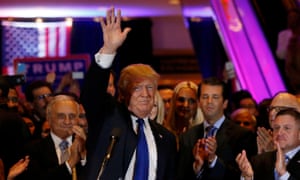
Donald Trump speaks at his New York presidential primary night rally
Two weeks is an eternity in politics. On April 5, Senator Ted Cruz won a decisive victory over GOP frontrunner Donald Trump in Wisconsin. Cruz’s victory was supposed to mark the beginning of the end for Trump. The pundits and the anti-Trump crowd in the Republican party crowed about how his campaign was finally on the verge of the meltdown they always insisted would transpire.

Back then, Cruz declared: “Tonight is a turning point. It is a rallying cry.”
Well, on a spring night in New York, that turning point became a U-turn.
Trump’s victory cuts across every demographic. He won right across the state. With young and old. And despite all the talk about his problems with female voters, he won decisively with both men and women.

All of the work Cruz had done to narrow the delegate gap over the last two weeks, picking them off one at a time, is likely to be completely undone by tonight’s victory. Worse for him and his supporters, the calendar is about to get even more daunting. Next week, voters will go to the polls in Connecticut, Pennsylvania, Delaware, and Maryland. All states where Donald Trump leads in the polls.
The trajectory of this race is now back to where it was before Wisconsin. Donald Trump is in the driver’s seat. He is the only candidate capable of securing the 1,237 delegates needed before the Republican national convention in Cleveland and he is the clear favorite to win the nomination.

This does not mean that Trump is unstoppable. It’s still possible that the formidable anti-Trump forces within the party might succeed – but it won’t be at the ballot box.

Because what tonight’s results make clear is that when Republican voters are asked to go to the polls to select the party’s nominee, Trump usually wins. The Cruz campaign has banked on low-turnout caucuses and winning delegates in states that didn’t bother to have a presidential preference vote at all.

This presents a stark contrast in how the two men are perceived as we head towards the finish line. Donald Trump is the candidate of Republican primary voters, while Ted Cruz – incredibly, given his past – is the candidate of party insiders.

If Donald Trump fails to secure the nomination in Cleveland, it will not be because it was “stolen” from him as Trump supporters are already claiming. If Cruz – or some other candidate – succeeds on a second, third or fourth ballot, that will be completely with the rules. It won’t be cheating, but it also won’t be consistent, even in the vaguest sense, with what Republican primary voters actually want.

I am not a Trump supporter. I didn’t vote for him when my state (Virginia) voted, and I am not sure that I can vote for him in November if he is the nominee. I do, however, believe strongly that political parties are made up of people, and at the end of the day the Republican party should be a reflection of what those people actually want. 

Donald Trump will go to Cleveland having won – by far – the most votes, the most primaries, and the most delegates. What would it say about the Republican party if at that point, at the end of an almost year-and-a-half-long process, it simply said “thanks, but no thanks” to the will of its own voters?

New York, like so many of the nominating contests in this cycle, might not be want party insiders want, but it does express the desires of grassroots Republicans. 

Right now all roads lead to a Trump nomination. The only question is whether the establishment can find a last minute detour.

Sunday, April 17, 2016

Trump in Watertown New York. He is the most natural politician since Bill Clinton.

Who would you prefer to negotiate with the Saudi threats to dump all their US assets? Trump or Hillary Clinton? Trump would teach the Saudis a hard lesson in Debtors’ Leverage. 


Saturday, April 16, 2016

Is It US Exceptionalism Or Is It Plain Old Exceptional Stupidity?

As has happened repeatedly since 9/11, the US and countries like Britain fail to combat terrorism because they give priority to retaining their alliance with Saudi Arabia and the Gulf monarchies, even when their policies – as in Yemen – wreck a whole country and enable al Qaeda and Isis to use the chaos to establish safe havens.

Thanks to UK and US intervention, al-Qaeda now has a mini-state in Yemen. It's Iraq and Isis all over again

They have done it again. The US, Britain and regional allies led by Saudi Arabia have come together to intervene in another country with calamitous results. Instead of achieving their aims, they have produced chaos, ruining the lives of millions of people and creating ideal conditions for salafi-jihadi movements like al-Qaeda and Islamic State.

The latest self-inflicted failure in the “war on terror” is in Yemen, where Saudi Arabia and a coalition of Sunni states intervened on one side in a civil war in March 2015. Their aim was to defeat the Houthis - labelled somewhat inaccurately as Shia and pro-Iranian - who had seized most of the country in alliance with the former President Ali Abdullah Saleh, who retained the loyalty of much of the Yemeni army. Yemeni politics is exceptionally complicated and often violent, but violence has traditionally been followed by compromise between warring parties.

The Saudi intervention, supported in practice by the US and Britain, has made a bad situation far worse. A year-long campaign of air strikes was supposed to re-impose the rule of former president Abd Rabbo Mansour Hadi, whose dysfunctional and unelected government had fled to Saudi Arabia. Relentless bombing had some success and the forces fighting in President Hadi’s name advanced north, but were unable to retake the capital Sanaa. Over the last week there has been a shaky truce.

The real winners in this war are al-Qaeda in the Arabian Peninsula (AQAP) which has taken advantage of the collapse of central government to create its own mini-state. This now stretches for 340 miles – longer than the distance from London to Edinburgh – along the south coast of Yemen. AQAP, which the CIA once described as the most dangerous protagonist of “global jihad” in the world, today has an organised administration with its own tax revenues.  

Unnoticed by the outside world, AQAP has been swiftly expanding its own statelet in Yemen in 2015/16, just as Isis did in western Iraq and eastern in Syria in 2013/14. Early last year, President Obama contemptuously described Isis as being like a junior basketball team that would never play in the big leagues. Likewise in Yemen, the American and British governments misjudged the degree to which AQAP would benefit from Operation Decisive Storm, the ill-chosen Saudi name for its military intervention that has proved predictably indecisive.

The Saudi intervention turned a crisis into a catastrophe. Some 6,427 people are known to have been killed in the fighting, but these are only the figures for casualties known to the health authorities. Since the UN says that 14.1 million Yemenis, 54 per cent of the population, have no access to health care, this is likely to be an underestimate. Even before the war, Yemen was the poorest Arab nation and its people are now starving or malnourished. OXFAM estimates that 82 per cent of Yemen’s 21 million population are in need of humanitarian assistance.

The disaster is not only humanitarian, but political, and does not only affect Yemen. As in Iraq, Libya, Syria and Afghanistan, foreign intervention energises and internationalises local difference as factions become the proxies of outside powers.

Yemen has always had Shia and Sunni, but it is only recently that sectarian hatred has begun to get anywhere near the level of Syria and Iraq. Saudi Arabia portrays the Houthis as pawns of Iran, though there is little evidence for this, so Yemen is drawn into the regional confrontation between Saudi Arabia and Iran.
A point seldom given sufficient weight is that AQAP is expanding so fast, not because of its own strength, but because its opponents are so weak. The Saudi and Gulf financed media often refer to pro-President Hadi forces as taking territory, but in reality the government-in-exile remains in Saudi Arabia. It recaptured the port city of Aden last summer, but its few officials who are there dare not leave their heavily-defended compound except by helicopter. Even where Saudi-backed fighters advance, they leave anarchy behind them, conditions in which the arrival of disciplined AQAP forces may be welcomed by local people.

I have been struck, ever since the US and British invasion of Iraq in 2003, by the extent to which their whole strategy depends on wishful thinking about the strength and popularity of their local ally who usually, on the contrary, is feared and hated. I seldom spoke to Afghans who truly supported the Taliban, but I was always impressed by the number who detested the Afghan government. Yet when one UN official stated publicly that the foreign powers fighting the Taliban, supposedly in support of the government, had “no local partner”, he was promptly fired.

Inside Isis secret tunnels

There was the same lethal pretence by Western powers in Libya and Syria that the rebels they backed represented the mass of the population and were capable of taking over from existing regimes. In reality, the weakening or destruction of central government created a power vacuum promptly filled by extreme jihadi groups.

The dire consequences of the Saudi intervention and the rise of AQAP has been largely ignored by Western governments and media. Contrary to their grim-faced declarations about combating terrorism, the US and UK have opened the door to an al-Qaeda mini-state.

This will have an impact far beyond the Middle East because what makes the atrocities orchestrated by Isis in Paris and Brussels so difficult to stop is that they are organised and funded by a real administrative apparatus controlling its own territory. If one terrorist cell, local leader or bomb expert is eliminated, they can be replaced.

As has happened repeatedly since 9/11, the US and countries like Britain fail to combat terrorism because they give priority to retaining their alliance with Saudi Arabia and the Gulf monarchies, even when their policies – as in Yemen – wreck a whole country and enable al Qaeda and Isis to use the chaos to establish safe havens.

Patrick Cockburn’s 'Chaos and Caliphate: Jihadis and the West in the Struggle for the Middle East' (OR Books) is published this month

TRUMP - On Message - Disciplined - In Connecticut


HARTFORD COURANT

Trump Brings Fiery Message To Thousands in Hartford

HARTFORD — Donald Trump rode his front-running campaign into Hartford Friday night, bringing a fiery message of economic rebirth to thousands of supporters who jammed the Connecticut Convention Center as hundreds of protesters gathered outside.

Citing Connecticut's declining manufacturing industry and pointing to the departure of General Electric, Trump's words drew roars of approval as protesters tried to disrupt his speech at times. Police estimated the crowd at between 6,000 and 7,000 inside and another 1,000 outside who could not get in. Police said there were 400-500 protesters outside the convention center.
"I know Hartford. I've lived in Connecticut. I love Connecticut,'' Trump said after taking the stage at 7 p.m. for a 30-minute speech. "You can't lose General Electric, you just can't. I don't know what happened. I will say this, if I were governor, I wouldn't be losing General Electric, that I can tell you."


"I'm a big buyer of Carrier products,'' Trump said, referring to the Farmington-based United Technologies company that has moved some manufacturing to Mexico. "I'm not going to buy them anymore."

The speech was interrupted repeatedly by protesters inside the convention hall. After the speech, thousands of departing Trump supporters confronted a jeering crowd along Columbus Avenue, creating a chaotic and tense scene. Police reported no arrests, however.

In his speech, Trump emphasized his message of voter anger about a rigged political system and promised that "millions of people aren't going to vote" if he is not the Republican nominee. "This is no longer a silent majority This is a massive, noisy majority,'' he said, pledging support for the 2nd Amendment, immigration enforcement, restrictions on trade, job creation, a strong national defense and a wall along the Mexican border.

"Our country doesn't win anymore. We are going to start winning,'' Trump said. "Do we love our country? Are we going to take our century back? Are we not going to be the stupid people anymore? We are led by people who are grossly incompetent,'' Trump said. "That is going to end, folks."
Protesters who interrupted Trump's speech were quickly escorted out of the convention center.

"There's one of the dummies. Get him out of here. There is nothing more fun than a Trump rally -- nothing,'' Trump said as a protester was helped out. "Get 'em out. Don't hurt 'em. I say get 'em out.''


Urging supporters to vote for him in the Connecticut primary on April 26, Trump promised that "you're going to look back in two years, in four years, in 20 years, you're going to look at your family, you're going to look at your friends and you're going to say 'That was the greatest vote I've ever cast.' "

Before the speech, classic rock blasted over the speakers, and excited supporters talked in anticipation of the evening. A recorded announcement reminded the audience not to engage any protesters, and audience members recited the Pledge of Allegiance. Shortly before 7, hundreds of Trump supporters were still waiting to enter the convention center.

Many in the largely white crowd of men and women of all ages wore red hats and carried "The Silent Majority Stands With Trump" signs. The audience appeared to include few, if any, prominent state Republicans.
Enjoying the balmy spring day, Trump supporters began to arrive in the early afternoon, coming from across Connecticut and New England. The city was surprisingly quiet, with some companies telling employees to work from home. They began filing in to the convention center at 3 p.m., an hour earlier than doors were scheduled to open.

Among those waiting hours to enter was David Veste, 69, who drove down from Enfield early to avoid the expected afternoon crowd.

"I like everything about him. Like most of us, he's not an eloquent speaker,'' Veste said. "Our country is being attacked. Our world is being attacked."
Dan Ladd, an accountant from western Massachusetts, said he took the day off from work because he missed Trump's appearance in his home state last month.


"He's like a person, he's not polished,'' Ladd said. "Someone who can identify solutions first is better than someone who says they have the perfect solution every time."

While protesters wore costumes, played music and argued with Trump backers, the convention center filled up with supporters. The police department had more than 80 officers on hand for the event. Matt Bordonaro, a spokesman for Travelers, said the insurance company advised employees to work from home Friday to avoid traffic.

Terrence Lambert was at the front of the line which, by 2 p.m., snaked around the convention center's courtyard. Clad in his Bridgeport police uniform, the retired officer said he came to support Trump because "he's the only candidate that cares about police."

Lambert said he's voting for Trump for the sake of Brooke, his daughter, who accompanied him to the rally. "I want him to come in and fix the country," he said.

Austin Sullivan, a 19-year-old from Southington, said he came out to protest because Trump is "taking advantage of the fears of millions and millions of people across the nation." Sullivan said he wrote a song for the occasion called "Hello Mr. Trump."


Southbury resident Chris Cannici, Michael Alberino, of Hamden, and Ryan Becker, of New Haven, came to Hartford as part of a planned protest by the ANSWER coalition, a national anti-war group.

"We're here to show the countermovement to Trump's bigotry," Becker, 21, said. "We didn't come to change anyone's deep-seated beliefs."

The small army of merchandise salesmen outside the convention center included Adrian Robinson, 33, who has been hawking Trump shirts, buttons and even rubber masks since January, when his friend persuaded him to leave St. Louis and join him on the road. XXX

"People are surprised when they see a black guy supporting Trump," he said outside the convention center. "But when they talk to me, they usually understand; why should I let my skin color influence my vote?"
A few feet away from Robinson was Agnes Pireh, the 2003 Mrs. Connecticut International.

The former beauty queen drove up from Newington with her brother to wait in line for a candidate she calls "rough, but honest."

"He says the truth about what's going on," Pireh said. "I'm not a politician, but neither is he. That's why we like him. He's like us."


A presidential primary poll released this week by Emerson College showed Trump capturing half of the Republican vote in Connecticut. Ohio Gov. John Kasich was second, at 26 percent, and Sen. Ted Cruz of Texas finished third, with 17 percent. In a November Emerson poll Trump was the top choice of Connecticut Republicans, but polled at just 25 percent.

If Trump hits the 50 percent threshold, and wins in all five of the state's congressional districts, as the Emerson poll projects, he would take home all 28 of Connecticut's Republican delegates.

Courant staff writers Vinny Vella, David Moran, Christine Dempsey, Christopher Keating, Daniela Altimari, Russell Blair, Edmund Mahony, Kevin Vellturo and Stephen Singer contributed to this report.

Friday, April 15, 2016

Bernie Sanders does not court the Israel lobby's billionaire mega-donors. He can speak his conscience.

Bernie Is Speaking the Truth About Israel-Palestine


During last night’s heated Democratic debate in Brooklyn, Senator Bernie Sanders came out firing on Israel. A candidate who initially sought, seemingly at all costs, to avoid foreign policy altogether finally spoke out on the most politically charged issue of global affairs in Washington—the Israeli-Palestinian conflict—and he took it by the horns.

That’s why it was so disappointing that, only a few hours earlier, the Sanders campaign suspended one of its young staffers, Simone Zimmerman, who served only briefly as its Jewish outreach coordinator. (Disclosure: I edited Zimmerman at a blog where I worked in 2013, and we have remained friends.) Zimmerman’s sin was to call the right-wing Israeli Prime Minister Benjamin Netanyahu an “asshole,” adding “Fuck you, Bibi,” using his nickname, for good measure, in a Facebook post last winter, when she was all of 24 years old.

At the time, Netanyahu was coming to Washington to marshal support against the Iran nuclear deal, claiming to speak on the behalf of all “Jewish People” everywhere, not just Israelis. Zimmerman, who has been deeply involved for years in Jewish and liberal pro-Israel activism—often critical, though it may be—took umbrage at the notion, resulting in her expletive-laden post on social media. Within half a day, Zimmerman edited the Facebook post to remove the curses—mentioning in a comment that she did so to “reflect the seriousness with which I take this issue”—but not soon enough. Someone had screen-captured the original text, and lay in waiting for more than a year to leak it to the McCarthyite smear artists at the right-wing Washington Free Beacon (one only needs to scan the post, where liberal Zionist groups are derided as anti-Israel, to see what ideologues this lot are).


In the Brooklyn debate, however, Sanders sounded not unlike his erstwhile staffer. He doubled down on his condemnation of Israel’s 2014 war on Gaza as a “disproportionate” response to sporadic terrorist attacks, leaving too many innocents dead. He expressed dismay that the Palestinian economy, especially in Gaza, was so dismally in the gutter. Like Zimmerman, Sanders supports the two-state solution, but clearly finds the indignities of the half-century-long occupation too much to bear silently. And then Sanders took this most impolitic of shots, by elite Washington standards: “There comes a time when if we pursue justice and peace, we are going to have to say that Netanyahu is not right all of the time.” In more crass terms, fuck that asshole.

Sanders’s statement reflects an obvious truth, but one that politicians aren’t supposed to utter. All indications are that, when it comes to justice and peace, Netanyahu is right (correct) very little of the time. That much is readily evident in the flare-ups of violence in Gaza. It is evident in his lackluster attempts at peace-making, and his constantly unfolding counterproductive policies. It is evident in the right-wing prime minister’s racist electioneering and disavowal of the two-state solution. And it was perhaps most evident to the United States in Netanyahu’s approach to the Iran deal, in his posture of belligerence and bald-faced interference in our national debate.


Even as mainstream liberals supported the Iran deal, however, they were not supposed to go therewhen it came to Netanyahu. Just ask Hillary Clinton: She has made mending fences with Netanyahu a centerpiece of her Israel policy. Rehabilitating Netanyahu’s bruised image among American liberals became the business of a think tank dedicated to electing Clinton. In Brooklyn on Thursday night, Isaac Chotiner wrote at Slate, Clinton’s talking points “sounded like a back issue of Commentary.”

And why not? Clinton’s top donor, Haim Saban, shares some of Netanyahu’s more noxious views. His top priority—his only priority, according to a 2010 New Yorker profile—is Israel, and it shows: Saban displays a willingness, all too common among the Democratic Party’s unreconstructed pro-Israel hawks, to bend over backwards in an attempt to play nice with the right wing of the pro-Israel community. Saban—and by extension Clinton, who rarely speaks about Israel in a way that would contrast starkly with her billionaire backer—cannot be described by the cliché “Israel, right or wrong”; he, too, is at home with the mantra of the Commentary crowd, one that declares, “Israel, always right!”

This is not Bernie Sanders’s milieu. He does not court the Israel lobby’s billionaire mega-donors. He can speak his conscience. And that’s what makes his caving in on Simone Zimmerman so jarring—especially amid the stark contrast of his fine debate performance. In the Brooklyn Navy Yard, Bernie Sanders sounded like a leader on this issue: He may not have a majority, or even a majority of Democrats, behind him, but he spoke truths about the Israeli-Palestinian conflict that needed to be spoken. This kind of honesty on the topic—that Palestinians have rights, that Israel is responsible for violating them—is almost nonexistent on the national political stage, whether among Republicans or Democrats.

Showing this sort of leadership may be “bad politics,” but the great struggles in the name of liberal values are rarely easy in light of electoral politics. Clinton will likely end up winning New York’s Jewish vote and the primary, and then the Democratic nomination. Yet, on the Israeli-Palestinian conflict, she shows no glimmer of leadership when it comes to, as Sanders put it, the pursuit of peace and justice. But Simone Zimmerman has, and for that she has been cast into the wilderness.

Spike Lee Interviewing Bernie Sanders

Putting our country first, and staying out of other people’s wars

America's Imperial Overstretch - Antiwar.com Original

by , April 15, 2016

This week, SU-24 fighter-bombers buzzed a U.S. destroyer in the Baltic Sea. The Russian planes carried no missiles or bombs.

Message: What are you Americans doing here?

In the South China Sea, U.S. planes overfly, and U.S. warships sail inside, the territorial limits of islets claimed by Beijing. 

In South Korea, U.S. forces conduct annual military exercises as warnings to a North Korea that is testing nuclear warheads and long-range missiles that can reach the United States. 

U.S. warships based in Bahrain confront Iranian subs and missile boats in the Gulf. In January, a U.S. Navy skiff ran aground on an Iranian island. Iran let the 10 U.S. sailors go within 24 hours.

But bellicose demands for U.S. retaliation had already begun. 

Yet, in each of these regions, it is not U.S. vital interests that are threatened, but the interests of allies who will not man up to their own defense duties, preferring to lay them off on Uncle Sam. 

And America is beginning to buckle under the weight of its global obligations. 
And as we have no claim to rocks or reefs in the South China Sea – Vietnam, Taiwan, Malaysia, Brunei and the Philippines do – why is this our quarrel? 
If these rocks and reefs are so vital they are worth risking a military clash with China, why not, instead, impose tariffs on Chinese goods? Let U.S. companies and consumers pay the price of battling Beijing, rather than U.S. soldiers, sailors and airmen. 

Let South Korea and Japan build up their forces to deal with the North, and put Beijing on notice: If China will not halt Kim Jong Un’s nuclear weapons program, South Korea and Japan will build their own nuclear deterrents. Half a century ago, Britain and France did.

Why must we forever deter and, if need be, fight North Korea?

And why is the defense of the Baltic republics and East Europe our responsibility, 5,000 miles away, not Germany’s, whose economy is far larger than that of Russia? 

Even during the darkest days of the Cold War, U.S. presidents refused to take military action in Hungary, Czechoslovakia or Poland. 

When Moscow intervened there, the U.S. did nothing. When did the independence of Eastern Europe become so vital an interest that we would now risk war with a nuclear-armed Russia to ensure it?

Under Article 5 of NATO, an attack upon any of 28 allied nations is to be regarded as an attack upon all. 

But is this the kind of blank check we should give Turkey’s Recep Tayyip Erdogan, who, a few months back, ordered a Russian fighter plane that crossed into Turkish territory for 15 seconds be shot down? 

Do we really want to leave to this erratic autocrat the ability to drag us into a war with Russia?

When Neville Chamberlain in 1939 handed a war guarantee to a junta of Polish colonels, who also had an exaggerated opinion of their own military power and prowess, how did that work out for the Brits?

America should not write off the Baltic Republics or Eastern Europe. But we should rule out any U.S.-Russian war in Eastern Europe and restrict a U.S. response to Russian actions there to the economic and diplomatic. For the one certain loser of a U.S.-Russian conflict in Eastern Europe – would be Eastern Europe.

As for Iran, the U.S. intelligence community, in 2007 and 2011, declared with high confidence that it had no nuclear weapons program. 

Since the Iran nuclear treaty was signed, 98 percent of Iran’s enriched uranium has been shipped out of the country; no more 20 percent enriched uranium is being produced; the Arak reactor that could have produced plutonium has been scuttled and reconfigured; and nuclear inspectors are crawling all over every facility.

Talk of Iran having a secret nuclear-bomb program and testing intercontinental missiles comes, unsurprisingly, from the same folks who assured us that Iraq had weapons of mass destruction. 

The goal is the same: Stampede America into fighting another war, far away, against a nation they want to see smashed.

Since the end of the Cold War in 1991, this country has been steadily bled and slowly bankrupted. We are now as overextended as was the British Empire in the 1940s.

And like that empire, we, too, are being challenged by nations that seek to enlarge their place in the sun – a resurrected Russia, China, Iran. And we are being bedeviled by fanatics who want us out of their part of the world, which they wish to remake according to the visions of their own faiths and ideologies.
Time for a reappraisal of all of the war guarantees this nation has issued since the beginning of the Cold War, to determine which, if any, still serve U.S. national interests in 2016. Alliances, after all, are the transmission belts of war.

This is not isolationism. It is putting our country first, and staying out of other people’s wars. It used to be called patriotism.

Patrick J. Buchanan is the author of Churchill, Hitler, and “The Unnecessary War”: How Britain Lost Its Empire and the West Lost the World. To find out more about Patrick Buchanan and read features by other Creators writers and cartoonists, visit the Creators Web page at www.creators.com.
COPYRIGHT 2014 CREATORS.COM

Read more by Patrick J. Buchanan